
Multiply your household’s daily water use (people × 75 to 85 gallons per person) by your water’s hardness in grains per gallon and then by the number of days you want between regenerations, usually about a week. Round that number up to the nearest standard grain capacity. Many homes use common capacities like 24,000, 32,000, or 48,000 grains, though households with high iron or heavy water use often require larger sizes.
TL;DR:
- The softener size should be based on household size, water hardness, iron content, and regeneration frequency, with proper measurement of water hardness being critical.
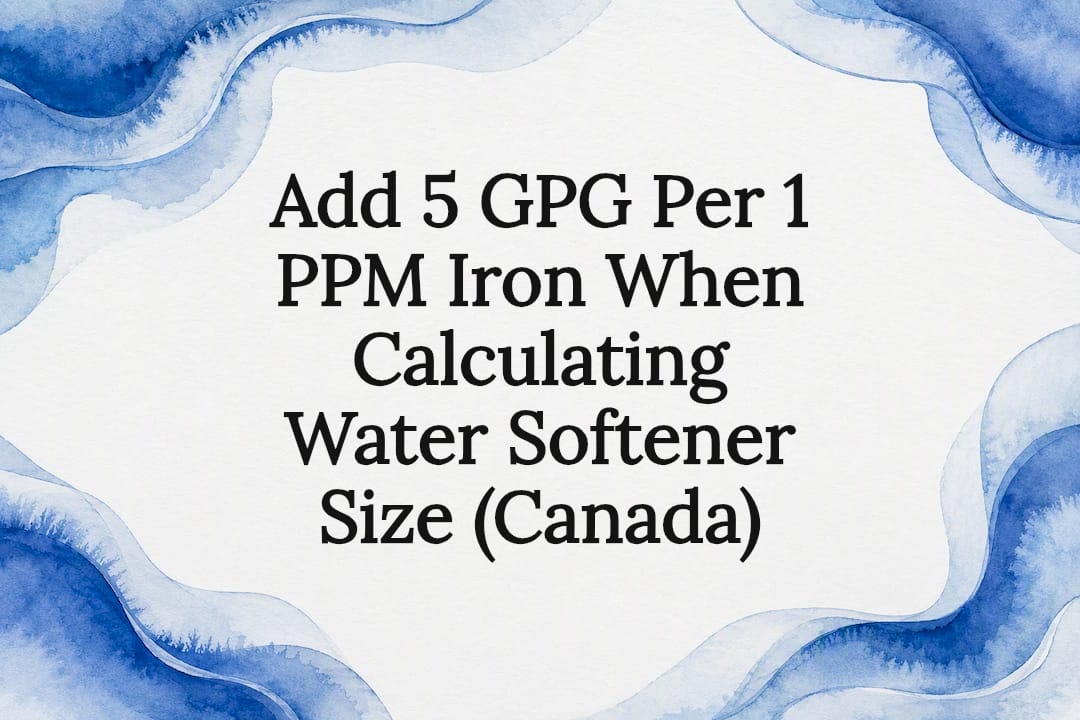
- Iron in water reduces softener capacity; for every 1 ppm of iron, add approximately 5 GPG to the hardness value to ensure accurate sizing.
- Testing raw incoming water with professional means provides the most reliable data, preventing undersizing or oversizing due to incorrect assumptions.
- Oversized softeners can lead to resin fouling if they sit idle too long, especially when iron is present, while undersized units regenerate too frequently, increasing salt and water use.
- Upgrading size in small increments for expected household growth is acceptable, but larger jumps often cause operational and maintenance issues.
Table of Contents
- Water softener size: how to calculate required grain capacity
- How to measure water hardness accurately before you buy
- Why iron changes your water softener size calculation
- Flow rate and regeneration: matching a system to real household demand
- Worked examples: matching household size and hardness to real sizes
- What happens when you get the size wrong
- Maintenance implications of different softener sizes
- Why professional testing changes everything about sizing
- Getting the right size softener without the guesswork
- Sources
- FAQ
Water softener size: how to calculate required grain capacity
Getting your water softener size right starts with three numbers: household size, hardness, and how often you want the system to regenerate. Here’s how the calculation actually works.
- Estimate daily water use. Multiply the number of people in your home by 75 gallons per person per day, the figure most sizing guides use as a baseline. Bump that to 80 or 85 gallons if your household runs irrigation, does frequent laundry, or has teenagers who shower like it’s a competitive sport.
- Confirm your hardness number in GPG. Water reports often list hardness in parts per million (ppm) or milligrams per litre (mg/L). Divide that number by 17.1 to convert to grains per gallon. A reading of 171 ppm works out to 10 GPG.
- Calculate daily grain removal needed. Multiply people × gallons per person × GPG hardness. A family of four using 75 gallons each with 10 GPG water needs to remove 3,000 grains per day.
- Multiply by your target regeneration interval. Most homeowners aim for seven days between regenerations. That daily figure of 3,000 grains becomes a weekly requirement of 21,000 grains.
- Round up to the next standard size. Softeners come in common capacities like 24,000, 32,000, 48,000, 64,000, and 80,000 grains. A 21,000 grain requirement rounds up to a 24,000 grain unit.
If your number lands close to the boundary between two standard sizes, sizing up one step is reasonable. Sizing up two or three steps is not, and we’ll get into why later.
How to measure water hardness accurately before you buy
Your entire calculation depends on one number: hardness. Get that wrong and everything downstream is off, no matter how carefully you do the math.
Test the raw water coming into your home, before it passes through any existing softener or filter. Testing a downstream tap after treatment gives you a false, low reading that leads to undersizing.
You have a few ways to get that number:
- Municipal water reports list average hardness for city supplies, though local variation can be significant.
- Home titration test strips are inexpensive and reasonably accurate for a quick estimate.
- Handheld digital meters offer more consistency than strips but still carry some margin of error.
- Professional lab or in-store testing gives the most reliable reading, particularly for well water where hardness and iron can vary house to house.
Remember the conversion: divide ppm or mg/L by 17.1 to get GPG. A report showing 250 ppm converts to about 14.6 GPG.
Pro Tip: Write down both the hardness (GPG) and iron (ppm) readings before you shop for a system. An installer can’t size anything correctly without both numbers in hand.
Why iron changes your water softener size calculation
Iron doesn’t just stain your sinks. It eats into your softener’s capacity faster than hardness alone, which means skipping this adjustment is one of the most common sizing mistakes homeowners make.
The iron rule: Add roughly 5 GPG to your hardness number for every 1 ppm of clear-water iron. Water testing 12 GPG hard with 1 ppm of iron should be programmed and sized as if it were 17 GPG.
Manufacturer multipliers vary slightly, so check your specific valve manual before finalizing the number. These adjustments matter because dissolved, clear-water iron binds to the resin bed the same way hardness minerals do, consuming capacity you’d otherwise reserve for calcium and magnesium.
There’s a ceiling to what a softener alone can handle. Once iron climbs past roughly 5 ppm, a dedicated upstream iron filter becomes the standard approach rather than trying to oversize your way around the problem. Oxidized or particulate iron, the reddish sediment you sometimes see in a glass of well water, behaves differently than dissolved iron and typically calls for filtration rather than a softener adjustment at all.
Flow rate and regeneration: matching a system to real household demand
Grain capacity tells you how much hardness a softener can remove before it needs to regenerate. It says nothing about whether the unit can keep up when someone’s running the dishwasher, showering, and doing laundry at the same time. That’s where flow rate, measured in gallons per minute (GPM), comes in.
Two softeners with identical grain ratings can perform very differently under peak demand if their valves and resin tank sizes differ. A system that can’t handle your household’s peak GPM will drop water pressure or let hard water slip through during high-use periods, even if the grain capacity is technically sufficient.
| Household profile | Minimum GPM | Recommended GPM |
|---|---|---|
| 1–2 bathrooms, 2–3 people | 8 | 10 |
| 2–3 bathrooms, 4–5 people | 10 | 12–15 |
| 3+ bathrooms, 5+ people | 12–15 | 15 |
Aim to regenerate every 7 to 10 days. Practitioner guidance suggests keeping intervals within 3 to 7 days for peak resin health, and no longer than roughly 12 days operationally, especially if your water carries any iron.
Worked examples: matching household size and hardness to real sizes
Numbers make more sense with context. Here are three scenarios that walk through the math from start to finish.
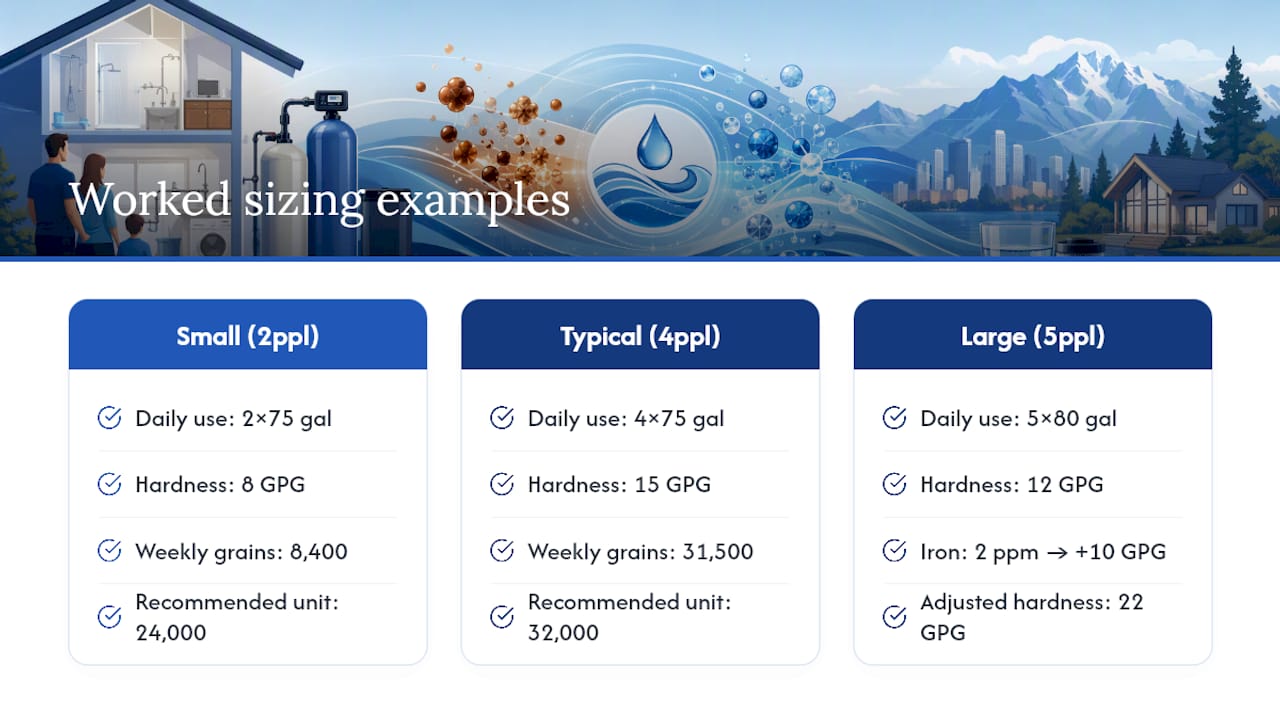
Small household, moderate hardness. Two people, 75 gallons each, 8 GPG hardness, no iron. Daily grains: 2 × 75 × 8 = 1,200. Weekly total: 8,400 grains. Rounds up to a 24,000 grain unit, the smallest standard size and typically more than enough headroom.
Typical family, harder water. Four people, 75 gallons each, 15 GPG hardness. Daily grains: 4 × 75 × 15 = 4,500. Weekly total: 31,500 grains. This lands right at the boundary, so a 32,000 grain system is the right call.
Large household with iron. Five people, 80 gallons each (extra for laundry volume), 12 GPG hardness, plus 2 ppm iron adding 10 GPG. Adjusted hardness: 22 GPG. Daily grains: 5 × 80 × 22 = 8,800. Weekly total: 61,600 grains, which rounds up to a 64,000 grain system, or a duplex configuration if simultaneous demand is high.
If you’re planning for a growing family, a future basement bathroom, or occasional irrigation, sizing up one step now often costs less than replacing an undersized unit in three years.
What happens when you get the size wrong
Undersizing and oversizing cause different problems, but both cost you money over time.
An undersized softener regenerates constantly, sometimes daily instead of weekly, burning through salt and water while still letting hardness slip through during peak use. You’ll notice scale returning on faucets and appliances faster than expected, along with a mysteriously high salt bill.
Oversizing carries its own risks. A tank far larger than your household needs sits mostly idle between regenerations, which lets resin sit wet and stagnant for extended stretches. That’s a particular problem if any iron is present, since stagnant resin fouls faster when iron has time to bind and oxidize inside the bed.
- Regenerating more than twice a week usually signals undersizing.
- Regeneration intervals stretching past two weeks usually signal oversizing.
- Persistent scale despite a working softener often means the hardness setting doesn’t match your actual tested water.
- If troubleshooting the settings doesn’t fix either problem, it’s time to call a professional rather than keep guessing.
Maintenance implications of different softener sizes
A bigger tank isn’t automatically less maintenance, and a smaller one isn’t automatically more. What changes is the rhythm of upkeep, and that rhythm affects salt cost, resin lifespan, and how often you’re refilling the brine tank.
Smaller units sized tightly to your household regenerate more frequently, which means more frequent salt top ups but generally fresher resin and less risk of stagnation. You’ll be checking the salt level more often, roughly weekly in many households, but each regeneration cycle uses less water and salt per event.
Larger or duplex systems regenerate less often per unit, which can feel like less hassle day to day. The trade off is that when regeneration does happen, it often uses more salt per cycle, and if the interval stretches too long, resin sitting idle for weeks becomes more vulnerable to iron fouling or bacterial growth in the tank. Duplex systems, which alternate between two resin tanks, solve this by keeping one tank always in service while the other regenerates, which is why they show up in larger households and light commercial settings rather than smaller homes.
Whatever size you land on, the salt itself matters. A high-purity softener salt reduces the mineral buildup that can otherwise clog the brine tank and shorten resin life, regardless of whether your system regenerates every five days or every twelve.
Why professional testing changes everything about sizing
Every formula in this guide depends on one input you can’t estimate your way around: accurate hardness and iron numbers from your actual water supply. Professional testing of raw incoming water remains the most reliable way to get that starting point right, more consistent than strips and less prone to the sampling errors that throw off DIY readings.
Before you talk to an installer, bring four numbers: hardness in GPG, iron in ppm, household size, and how many fixtures might run at once during peak hours. Pure Wave Water has worked with homeowners and rural properties on exactly this kind of sizing since 1995, and that combination of tested numbers is what turns a guess into a system that actually fits your home.
— CloudSprout16
Getting the right size softener without the guesswork
You don’t have to run these calculations alone or gamble on a size based on a generic online chart. Free in-store water testing for hardness, iron, and other quality concerns is available, so the numbers driving your sizing decision come from your actual supply, not an estimate.
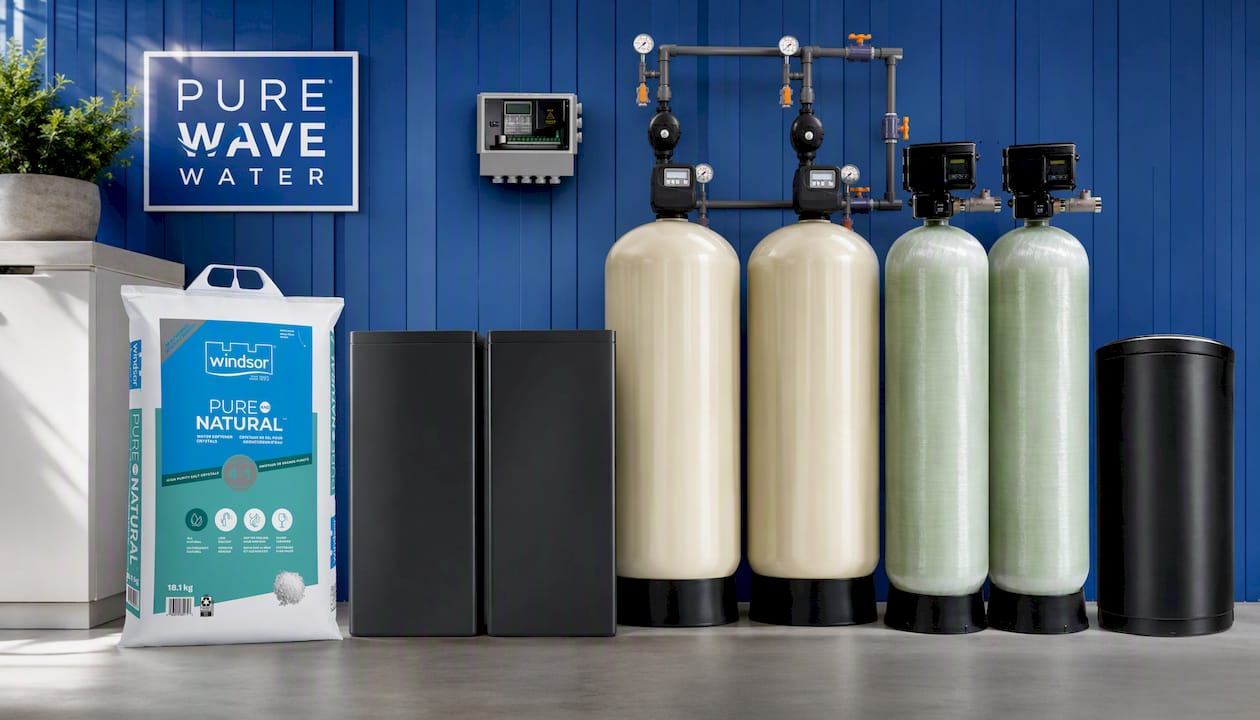
Once you know where you stand, the product lineup covers most residential and light commercial needs. For everyday households, the 75K Progressive Duplex Water Softener handles larger families, higher iron, or irrigation demand without the regeneration headaches of an undersized single tank. For acreages, rural properties, or small commercial applications with heavier simultaneous demand, the Excalibur Duplex 300 K Commercial Water Softener offers the metered capacity to keep up. And whatever system you run, Windsor Pure Natural Water Softener Salt helps protect your resin bed and brine tank between regenerations.
Book a free water test or browse the product lineup at Pure Wave Water to get a system sized to your home’s real numbers, not a guess.
Sources
FAQ
How do you tell what size water softener you need?
Multiply your household size by 75 to 85 gallons per person per day, then by your water’s hardness in GPG, then by your target regeneration interval, usually seven days. Round the result up to the nearest standard grain capacity.
Is it bad to buy too big of a water softener?
Yes, beyond a certain point. Oversizing by more than one standard step can let resin sit idle too long between regenerations, increasing the risk of fouling, especially if any iron is present in your water.
How do I calculate the size of a water softener I need?
Use the formula: people × gallons per person per day × hardness in GPG × days between regenerations. Add roughly 5 GPG for every 1 ppm of iron in your water before running the calculation.
Is it better to oversize a water softener?
Sizing up by a single standard increment is reasonable if you expect household growth, irrigation, or heavier future use. Sizing up multiple steps beyond your calculated need tends to cause more problems than it solves.

Written by the Pure Wave Water team, who test, install and service water treatment systems across Georgetown and Halton Hills.