

Visible sediment in tap water usually points to one of a few common culprits: grit from a well, rust flakes from aging pipes, loose scale from a water heater, or disturbance in the municipal mains. Stop drinking the water until you know more, run a short cold-water flush, and note whether the sediment shows up in hot water only, one fixture only, or settles quickly in a glass. Those three signals will tell you most of what you need to know.
TL;DR:
- Sediment in tap water can originate from well disturbances, municipal work, or corroding pipes, with hot water issues typically linked to the water heater.
- A glass settle test and comparison of hot versus cold water help identify whether the sediment comes from the main supply, household plumbing, or the water heater.
- Elevated turbidity can shield microorganisms from disinfection, making testing for bacteria and chemicals essential before consuming water with visible sediment.
- Fixing sediment issues may involve simple flushes, cleaning aerators, or installing targeted filters like cartridge or backwash systems based on the sediment type.
- Regular maintenance, such as filter replacement and water heater flushing, is vital for preventing persistent sediment problems, especially in wells or heavilyiled systems.
Table of Contents
- What sediment and turbidity are, and why particle type matters
- Common sources of sediment: well, municipal mains, plumbing and water heaters
- How to diagnose sediment at home: simple tests that narrow the source
- Health, safety and testing: standards and when to stop using water
- Fixes that work: quick remedies and longer-term treatment choices
- Maintenance, prevention and rough cost factors
- Publisher help: what Pure Wave Water offers and how a free in-store test helps diagnose sediment
- Author perspective and recommended next steps
- How Pure Wave Water can help: testing, products and installation
- Sources
- FAQ
What sediment and turbidity are, and why particle type matters
Sediment is simply solid material suspended in your water rather than dissolved in it, and the scientific term for how cloudy that makes the water is turbidity. Health Canada’s guidance explains that the particles responsible for turbidity range widely in size, including very small colloidal particles and particles up to visible grit sizes, which is a wide range covering everything from fine clay to visible grit. This matters because turbidity behaves differently from dissolved minerals or gases like hardness or chlorine taste: it is physical, not chemical, and a filter can remove it in a way it cannot remove something dissolved.
Turbidity also matters for safety reasons beyond appearance. According to Health Canada’s turbidity guideline, elevated turbidity can interfere with disinfection, effectively shielding microorganisms from chlorine or UV exposure inside the particle itself. Knowing what you are looking at helps you judge the fix:
- Sand or grit: heavy, settles within minutes, usually from a well.
- Silt or fine clay: stays suspended longer, often from aquifer disturbance or construction.
- Rust flakes: reddish-brown, usually from corroding iron pipes or a tank.
- Iron or manganese oxides: fine, rust-coloured to black residue, often tied to well chemistry.
- Biofilm fragments: slimy or stringy material sloughing off pipe walls after a pressure change.
Common sources of sediment: well, municipal mains, plumbing and water heaters
Sediment tends to come from one of three places, and each has its own warning signs.
- Private wells — a worn well screen, a pump intake sitting too close to the bottom of the casing, or seasonal shifts in the aquifer can all pull sand and fine particles into your supply, and storm events can push surface grit into a poorly sealed casing.
A few quick triggers are worth checking before you assume the worst. Did the sediment start right after a municipal crew worked on your street? Was there a recent storm or a noticeable pressure drop in your home? Did you just have plumbing work done, or has your pump been cycling more than usual? Any of these point toward a temporary, identifiable cause rather than a chronic one. They often resolve on their own once the disturbance settles.
How to diagnose sediment at home: simple tests that narrow the source
Before calling anyone, a homeowner can usually narrow down the source with a few minutes of observation.
- Run the glass settle test: fill a clear glass from the affected tap and let it sit for 15 to 30 minutes. Sand and grit will drop to the bottom quickly, while fine silt or organic material stays cloudy much longer.
- Compare hot and cold water: if sediment only appears in hot water, suspect the water heater tank. If it shows up in both, the source is more likely your main supply line or household plumbing.
- Check one fixture versus the whole house: sediment at a single tap usually means a local problem such as a clogged aerator or a failing fixture, while whole-house sediment points to the main line, well, or heater.
- Inspect aerators and filter cartridges: unscrew faucet aerators and look for trapped grit, and check whether any installed cartridge is visibly clogged or discoloured.
- Note the timing: sediment that appears right after the well pump cycles, after heavy water use, or after a pressure surge gives you another clue about where it originates.
If you need a lab result rather than a guess, collect a sample in a clean, unused container directly from the tap, avoiding aerators or hoses, and label it with the date, time, and which fixture it came from.
Pro Tip: Run the cold kitchen tap for two full minutes before testing. It clears standing water from the line and gives you a sample that reflects your actual supply, not what was sitting in the pipe overnight.
Health, safety and testing: standards and when to stop using water
Cloudy water is not automatically dangerous, but it is not something to ignore either. Health Canada’s guidance explains that particles causing turbidity can shield bacteria and other microorganisms from disinfection, which is why treatment plants aim to keep turbidity extremely low, often in the range of 0.1 to 0.3 NTU during most measurements. If you own a private well, Health Canada recommends testing regularly for bacteria and checking chemical parameters such as iron, manganese, pH, and hardness at recommended intervals.
Some situations call for immediate caution rather than a wait-and-see approach:
- Water that turns suddenly brown or black after a reported main break nearby.
- Any foul or rotten-egg odour accompanying the discolouration.
- Confirmed or suspected bacterial contamination, including E. coli, following a boil-water notice or test result.
A common instinct is to boil suspect water, but Health Canada notes that boiling can actually concentrate metals like manganese rather than remove them, so it is a tool for microbial risk, not for mineral or sediment problems. When in doubt, especially after a main break or well disturbance, switch to bottled or another verified supply until you have test results in hand.
Fixes that work: quick remedies and longer-term treatment choices
Once you know roughly where the sediment is coming from, the fix usually falls into one of two categories: something you can do today, and something that calls for the right equipment.
- Immediate steps: flush your cold-water lines for several minutes, avoid using hot water until you have checked the tank, clean out faucet aerators, and replace any clogged cartridge you find.
- Point-of-use filtration: a certified reverse osmosis system or a point-of-use filter at the kitchen tap handles drinking water specifically, which is a practical choice if whole-house treatment is not justified by the problem’s scope.
- Whole-house sediment filters: a housing like the Omnipure K5605-JJ Sediment Filter catches coarser grit at the point where water enters the home, while a dual-gradient cartridge such as the 20″ Hydro-Cure Big Blue Dual Gradient 25/01 Micron Sediment Filter layers coarser and finer media in one cartridge to capture a wider range of particle sizes in a single pass.
- Iron, sulphur, and manganese issues: a backwashable media system like the Zentec Value Hybrid Iron, Sulphur, and Manganese Backwashable Filter is built for the kind of persistent well chemistry that a simple cartridge cannot keep up with, since it regenerates itself rather than requiring constant cartridge swaps.
- Water heater maintenance: draining and flushing the tank once sediment has built up at the bottom restores efficiency and reduces rumbling or popping sounds during heating.
Matching the fix to the cause matters more than buying the biggest filter available. Ontario’s guidance on private wells notes that iron is often an aesthetic nuisance rather than a health hazard, but it can still stain fixtures and shorten the life of appliances, which is a good reason to treat it even when it is not dangerous.
Maintenance, prevention and rough cost factors
A sediment filter only works as well as its maintenance schedule allows. Most cartridge-style sediment filters need replacement every two to three months under moderate sediment load, though a well with heavy grit can clog a cartridge much faster. Backwashable media systems regenerate on a timer or meter rather than needing cartridge changes, but the media itself eventually needs replacing as it loses capacity.
- Cartridge filters: replace on a schedule, or sooner if water pressure drops noticeably.
- Backwashable media: check the backwash cycle periodically and plan on media replacement every several years, depending on load.
- Water heater tanks: flush annually, or more often in homes with high sediment or hard water.
Cost drivers worth expecting include the filter’s physical size and flow capacity, whether the system includes an automated backwash valve, and labour if a well screen, pump, or buried line needs repair. A clogged cartridge or a dirty aerator is a reasonable DIY fix, but recurring sediment, a suspected well casing problem, or anything tied to a health concern is worth a professional look before you spend money guessing.
Pro Tip: Keep a simple log of when you change filters and what the water looked like beforehand. Patterns over a few months tell you more about your system’s real sediment load than any single snapshot.
Publisher help: what Pure Wave Water offers and how a free in-store test helps diagnose sediment
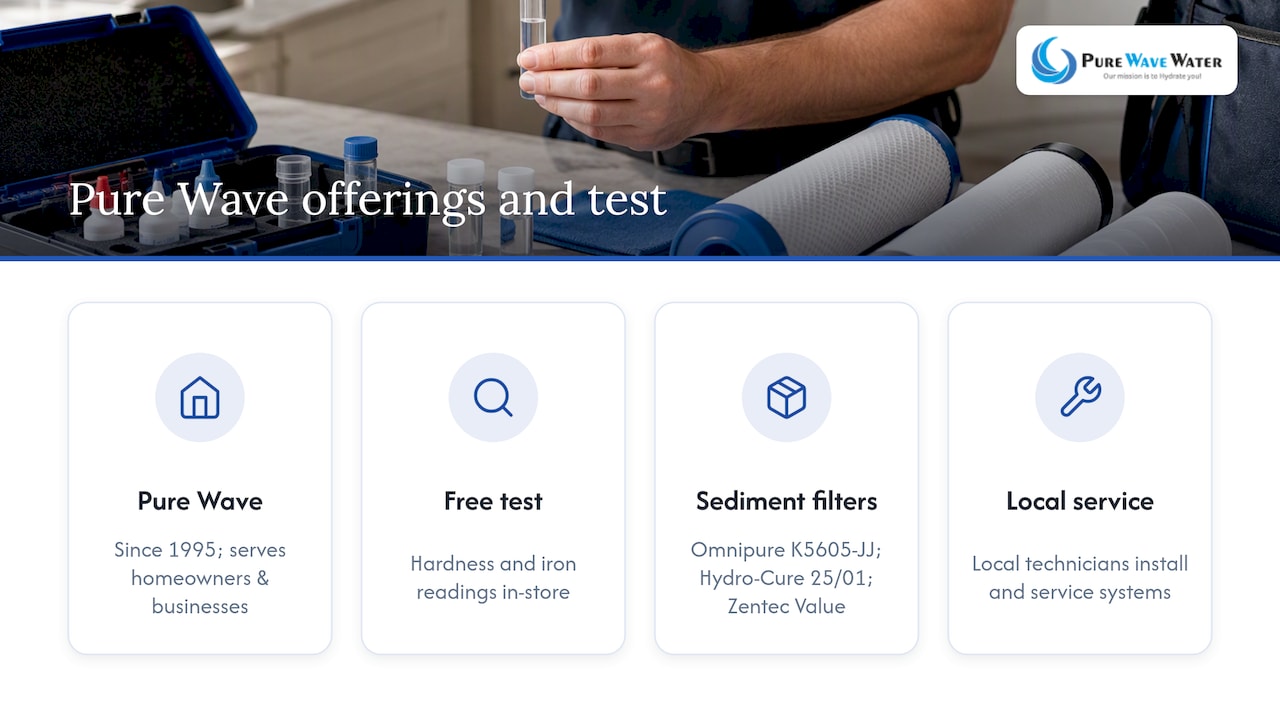
Since 1995, Pure Wave Water has worked with homeowners, families, rural property owners, and businesses on exactly this kind of problem, offering water testing, treatment, installation, repair, and maintenance. A free in-store test for hardness, iron, and other common concerns gives you an actual reading before anyone recommends equipment, rather than a guess based on what the water looks like. The shop carries sediment solutions matching the diagnostic paths above, including the Omnipure K5605-JJ Sediment Filter, the 20″ Hydro-Cure Big Blue Dual Gradient 25/01 Micron Sediment Filter, and the Zentec Value Hybrid Iron, Sulphur, and Manganese Backwashable Filter, and local technicians install and service these systems once the right fit is confirmed.
Author perspective and recommended next steps
Most sediment problems are solvable once you know the source, and the diagnostics above take less time than most people assume. The real mistake is guessing at a fix before testing, since a filter sized for grit does nothing for dissolved iron. Get a written recommendation from a provider willing to test first and sell second.
— CloudSprout16
How Pure Wave Water can help: testing, products and installation
If the checks above point to something beyond a quick flush or a cleaned aerator, Pure Wave Water offers free in-store testing alongside in-home service for installation, repair, and maintenance. 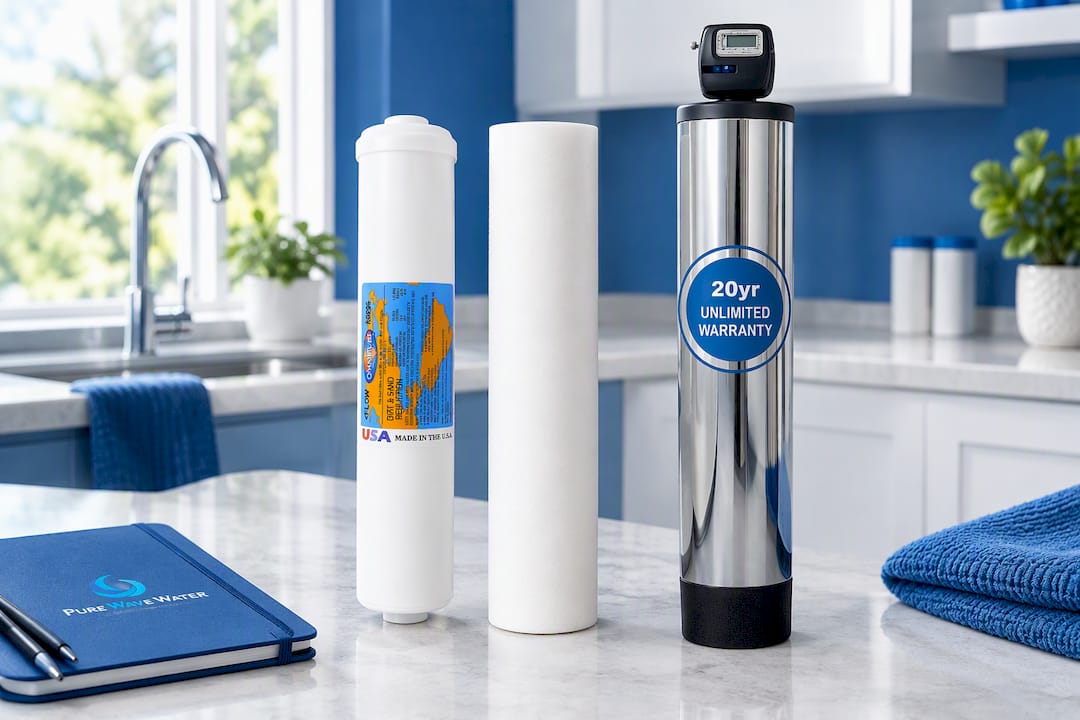
A service visit typically starts with a test, moves to a written recommendation based on what that test actually shows, and ends with a clear quote before any work begins. For homeowners who prefer to shop first, the sediment filters, housings, and related treatment products in the online shop cover the same options discussed above, from basic cartridge housings to backwashable iron and manganese media.
Sources
For readers who want to verify the standards discussed here, Health Canada publishes its turbidity guideline and its private well testing guidance, while Ontario’s government outlines private well testing and treatment options. Readers interested in general filtration troubleshooting may also find this overview of filter problems and cloudy water a useful comparison, even though it comes from a different industry.
This article is general information, not a substitute for advice from a qualified doctor. Consult a qualified healthcare professional about your own circumstances before acting on anything here.
FAQ
Is it safe to drink water with sediment?
Visible sediment alone does not automatically mean the water is unsafe, since much of it is aesthetic grit, rust, or mineral residue rather than a health hazard. Because turbidity can shield bacteria from disinfection according to Health Canada’s guidance, it is safest to avoid drinking visibly discoloured water until you have tested it or flushed the line.
Why am I getting sediment in my water?
The most common causes are a disturbed well screen or pump intake, municipal main work or a nearby break, and corroding pipes or sediment buildup inside a water heater tank. Checking whether the sediment is hot-only, whole-house, or limited to one fixture usually narrows it down quickly.
Can you flush sediment out of your plumbing lines?
Running cold water for several minutes often clears sediment that has settled after a municipal disturbance or pressure change, and draining a water heater tank clears sediment that builds up there over time. Persistent sediment that returns after flushing usually points to an ongoing source, such as a well or corroding pipe, rather than a one-time event.
What is a sediment in water?
Sediment is solid material suspended in water rather than dissolved in it, ranging from visible sand and grit down to fine particles too small to see individually. According to Health Canada, these particles can range from colloidal sizes up to around 100 micrometres and are measured as turbidity.

Pure Wave Water shares educational content about water treatment, water softeners, reverse osmosis systems, UV purification, and filtration solutions. Our guides help readers understand water quality concerns, explore treatment options, and make informed decisions about their water treatment needs.