Repair makes sense when a single component fails on a unit under 10 years old, especially if the fix is a salt bridge, a clogged injector, or a worn float valve. Replacement wins once the tank is cracked, the softener is past 12 to 15 years old, or a repair quote runs anywhere close to half the cost of a new comparable system. A local technician can test your hardness and iron levels on the spot, and Purewavewater offers free in-store water testing if you want a clear read on your water before deciding.
TL;DR:
- Repairs are generally cost-effective for units under 10 years old with a single component failure, especially for salt bridges or clogged injectors.
- Replacement is advisable once the softener exceeds 12 to 15 years of age, the tank is cracked, or repair costs approach half the price of a new system.
- Common home troubleshooting tips include checking the bypass valve, salt level, salt bridge, float, and drain line before calling a technician.
- Iron fouling and resin exhaustion are frequent causes of continued hardness, particularly above 1 part per million of iron and after a decade of use.
- Professional service involves water testing, inspecting key components, and offering detailed repair or replacement quotes based on the system’s actual condition.
Table of Contents
- Repair-or-replace checklist you can run today
- Which symptom points to which fault?
- What happens when a professional comes to your home?
- How do you decide between repair and replacement?
- What repair and replacement typically cost in Georgetown
- Are water softener parts easy to find in Georgetown?
- What’s in Georgetown’s water that affects your softener?
- How do you extend your softener’s life after service?
- Our take on repair-first thinking
- Ready for a straight answer on your softener?
- Sources
- FAQ
Repair-or-replace checklist you can run today
Before you pick up the phone, spend fifteen minutes ruling out the easy stuff. Most sudden softener failures come down to a handful of causes that homeowners can check without tools, and a practical troubleshooting checklist resolves the majority of them without a service call.
- Check the bypass valve. Confirm it’s turned to the service position, not bypass. It sounds obvious, but it gets bumped during basement projects more often than you’d think.
- Look at your salt level. It should sit a few inches above the water line inside the brine tank. Too low, and the resin never regenerates properly.
- Check for a salt bridge. Push a broom handle gently into the salt. If it hits a hard, hollow crust a few inches down instead of loose salt, you’ve found your problem.
- Break the bridge carefully. Use the handle to crack the crust in a few places, then stir gently. Never hammer at it. Once it’s broken up, run a manual regeneration cycle.
- Inspect the brine tank float. Lift the tank’s internal float assembly and make sure it moves freely. A stuck float causes the tank to overfill or underfill with water.
- Clear the drain line and injector. A slow trickle instead of a strong flush usually means the injector screen or drain line has debris in it. A gentle rinse under a tap often clears it.
Pro Tip: If your softener has been sitting through a hot, humid Georgetown summer, check for a salt bridge first. Humidity swings in the brine tank cause the salt surface to crust over even when the tank looks full.
Stop troubleshooting and call a technician if you see resin beads (small yellow or tan granules) in your faucets or toilet tank, if the tank itself shows a crack, or if the control valve won’t cycle through regeneration at all. Those symptoms point to problems that need tools, replacement parts, or a full tank teardown.
Which symptom points to which fault?
Matching what you’re seeing to the likely cause saves a diagnostic visit in a lot of cases. Here’s how the common complaints usually break down.
- Hardness returning despite a full salt tank. This is almost always a salt bridge or a mushed, compacted layer of salt sitting below the visible surface. Tap-testing with a broom handle and breaking up any crust restores flow in most cases.
- “Mushing” instead of a bridge. Sometimes salt dissolves into a thick sludge at the tank bottom rather than forming a hard crust on top. It looks different from a bridge (soft, not hollow) and usually means the tank needs to be emptied, cleaned, and refilled with fresh salt.
- Weak or no water flow into the brine tank. A clogged injector or a kinked drain line is the usual suspect. The injector is a small nozzle inside the valve body that creates suction to pull brine into the resin tank, and mineral buildup clogs it over time.
- Water staying hard even after fixing salt issues. This points toward iron fouling on the resin beads themselves. Iron above roughly 1 part per million will coat and degrade resin fairly quickly, and once fouled badly enough, cleaning solutions won’t restore capacity.
- Resin beads showing up in your plumbing fixtures. This means the distributor tube or basket at the bottom of the tank has cracked or come loose, letting resin escape into your household lines. Resin loss like this requires emptying the tank and replacing the distributor assembly, which is a job for a technician, not a homeowner with a wrench.
Resin itself has a service life. Most guides put it at 10 to 15 years under normal conditions, shorter if your well water carries iron without any pre-filtration ahead of the softener. If your unit is within that age window and showing hardness problems that salt fixes don’t solve, resin exhaustion is worth testing for by a professional before you assume the whole system is dying.
What happens when a professional comes to your home?
A solid service visit follows a pattern, and knowing it ahead of time helps you understand the quote you’re handed. Technicians typically run through hardness and iron testing on your actual water, a visual inspection of the control valve for cracks or worn seals, a check of the brine tank and float assembly, and a quick look at the resin bed condition through the top of the tank.
From there, repairs and replacements split fairly cleanly by what’s actually broken:
- Valve rebuild kits replace worn seals, spacers, and pistons inside the control head, often restoring smooth cycling without swapping the whole valve.
- Float replacement fixes tanks that overfill or underfill with brine water.
- Injector kits clear or replace the small nozzle responsible for drawing brine into the resin tank.
- Resin replacement restores softening capacity once beads are exhausted or fouled beyond cleaning.
- Distributor and basket repair addresses resin escaping into household plumbing.
Control valve rebuilds and resin swaps are genuinely common professional fixes, and they can add years to a mid-life unit rather than forcing a full replacement. When the tank body itself is cracked, or the valve is an obsolete model with no parts available, replacement becomes the only sensible path. Technicians service many systems they didn’t originally sell, and every visit ends with a written quote so you can weigh repair against replacement with real numbers in hand rather than guesswork.
How do you decide between repair and replacement?
Once you have an inspection result and a quote, the decision usually comes down to three factors working together: age, cost, and failure pattern.
- Age and component life. Resin typically lasts 10 to 15 years, control valves roughly 10 to 20 years depending on water quality and usage, and tanks themselves can often run 20 years or more if they’ve never cracked.
- The 50% rule of thumb. If a repair quote approaches a significant portion of the cost of a comparable new unit, replacement usually delivers better value over the next decade.
- Repeat failures. A softener that’s needed two or three service calls in the past year, even for different parts, is telling you something about its overall condition that a single repair won’t fix.
- Multiple faults at once. A cracked injector alongside a failing float alongside degraded resin isn’t three small problems. It’s one big sign the unit is at end of life.
- Upgrade opportunity. If you’re already facing a major repair, it’s worth asking whether a demand-initiated metered system or higher-capacity unit would serve your household better than restoring the old one.
| Factor | Favours repair | Favours replacement |
|---|---|---|
| Unit age | Under 10 years | Over 12 to 15 years |
| Repair cost vs. new unit | Well under 50% | Approaching or over 50% |
| Failure history | First issue | Repeated failures within a year |
| Faults present | Single component | Multiple components failing together |
| Tank condition | Intact | Cracked or corroded |
What repair and replacement typically cost in Georgetown
Repair costs for local homeowners generally track the complexity of the fix rather than the brand of softener. A salt bridge or float issue that a technician clears on a single visit sits at the low end. A control valve rebuild or resin replacement costs more because of both parts and labour, since the tank often needs to be drained and reassembled carefully.
Replacement costs depend heavily on capacity and features. A straightforward single-tank softener sized for an average Georgetown household costs less than a duplex system built for continuous soft water with no interruption during regeneration, like the 75K Progressive Duplex Water Softener. Larger households, rural properties on well water, or light commercial applications sometimes need the added capacity of something like the Excalibur Duplex 300 K Commercial Water Softener, which carries a higher price point than a standard single-tank unit but serves a genuinely different demand level.
Rather than guessing which category your situation falls into, request an on-site diagnosis. A technician can inspect your existing unit, test your actual water, and hand you written numbers for both the repair option and a replacement option sized correctly for your home. That comparison, done with real figures specific to your system, beats any general price range an article can offer.
Are water softener parts easy to find in Georgetown?
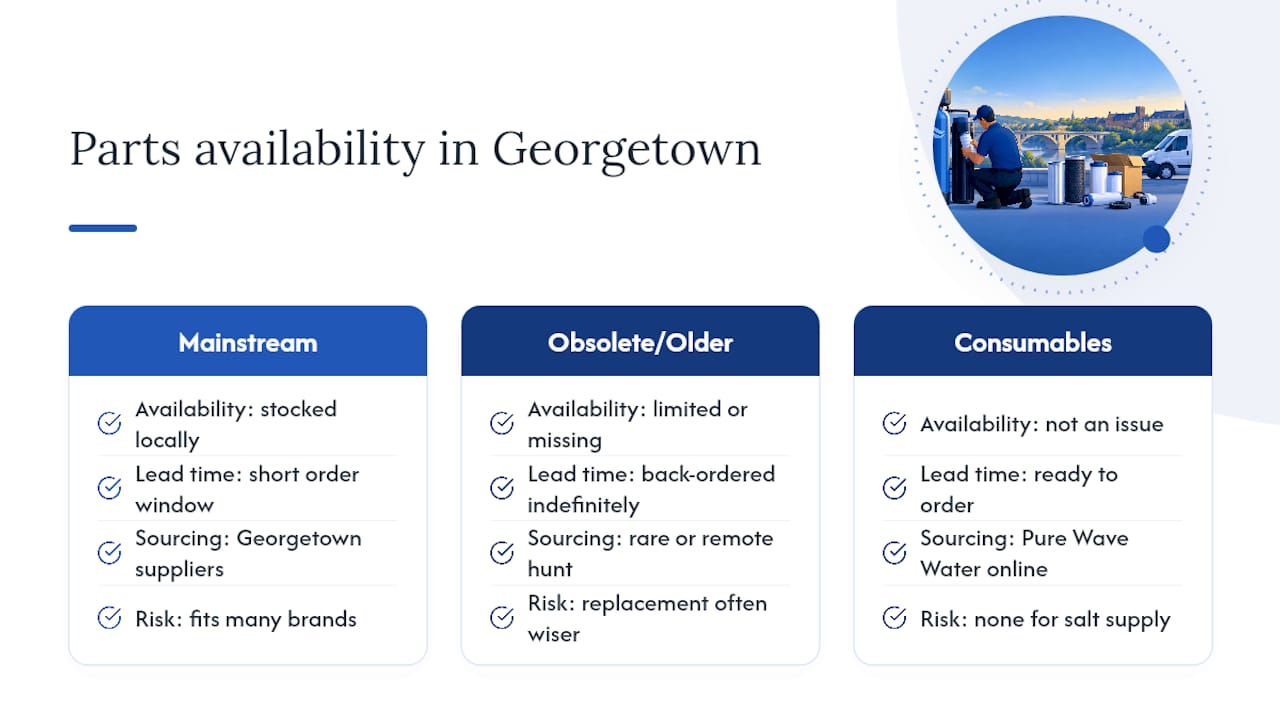
Parts availability varies a lot depending on how old and how common your softener model is. Mainstream valve bodies, injector kits, float assemblies, and standard resin are stocked locally or arrive within a short order window through Georgetown-area suppliers, since these parts fit a wide range of brands built on similar valve platforms.
Older or less common units, particularly ones built by manufacturers that have since discontinued certain valve lines, present more of a challenge. If a technician tells you a part is obsolete or back-ordered indefinitely, that’s usually the moment replacement becomes the more practical route rather than waiting weeks for a component that may not even fully solve the underlying issue.
One advantage of working with a technician who services multiple brands rather than just one product line: they’ve usually already sourced parts for softeners they didn’t originally sell, and they know which common failure points across different manufacturers share compatible replacement parts. That local knowledge shortens the wait considerably compared to hunting for a specific brand’s proprietary part yourself.
For consumables like softener salt, availability isn’t an issue at all at the Pure Wave Water online shop. Windsor Pure Natural Water Softener Salt and similar products are stocked and ready whenever you need to top up, whether your system is freshly repaired or brand new.
What’s in Georgetown’s water that affects your softener?
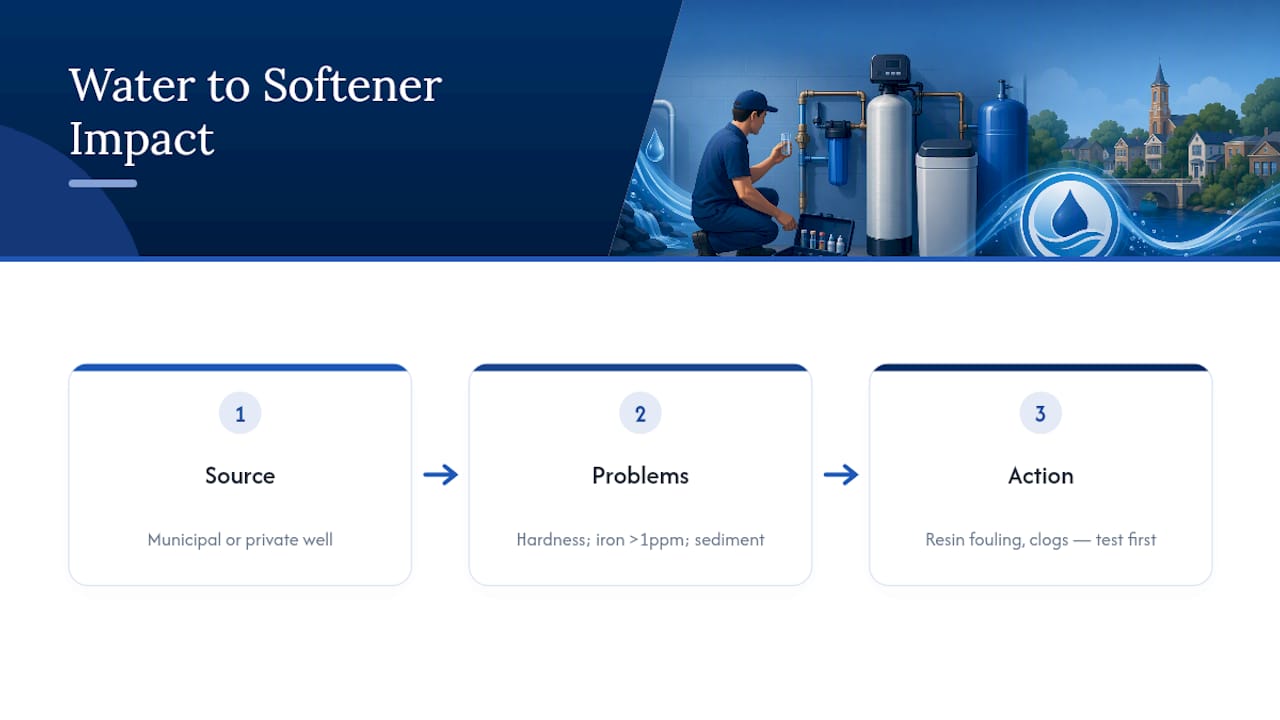
Halton Hills sits on a mix of municipal supply and private wells, and both can throw curveballs at a softener that a city dweller elsewhere might never encounter. Hard water from limestone aquifers is the baseline issue softeners are built to solve, but the region’s groundwater in many rural properties also carries iron, which complicates things considerably.
Iron is the troublemaker here. At concentrations above roughly 1 part per million, iron will foul resin beads faster than normal hardness minerals alone, coating them and reducing their softening capacity even when the mechanical parts of the softener are working fine. If your softener seems to be losing effectiveness despite regular salt top-ups and no obvious mechanical fault, iron fouling on the resin bed is worth testing for specifically.
Sediment is the other regional factor, particularly for properties on older wells or those near recent construction activity. Sediment doesn’t damage resin the way iron does, but it clogs injectors and drain lines faster, which is part of why that symptom shows up so often in local service calls.
This is exactly why testing matters before you assume you know the fix. A hardness reading alone won’t tell you if iron is the real culprit behind fading performance. Free in-store testing checks for both, along with other common water-quality concerns specific to Georgetown properties.
How do you extend your softener’s life after service?
Whether you just had a valve rebuilt or installed a brand-new unit, the habits that protect it going forward are the same. Use a granular, high-purity salt rather than rock salt with heavy impurities, since impurities build up as insoluble sediment at the bottom of the brine tank over time and eventually interfere with the float.
Check the brine tank every month or two, not just when something seems wrong. Catching a forming salt bridge early means breaking it up in thirty seconds instead of discovering three weeks later that your softener has been running on plain water. If your property has measurable iron, keep whatever pre-filtration is in place well maintained, since a fouled pre-filter defeats the purpose almost as fast as having none at all.
Schedule a resin bed inspection roughly once a year if your water carries iron or heavy sediment, since these conditions shorten resin life faster than clean municipal supply would. And if a technician ever reassembles your control head, torque matters more than people expect: over-tightening the plastic threads on a control head reassembly risks cracking the very threads that keep the valve sealed, so this is a task best left to someone who does it regularly.
Our take on repair-first thinking
Most of the water treatment industry defaults to selling replacements, and it’s not hard to see why. A new unit is a bigger ticket than a valve rebuild, and it’s an easier sale when a homeowner is already frustrated and just wants the problem gone. We think that instinct skips a step that actually serves the homeowner better.
A softener that’s eight years old with a stuck float is not a softener that needs replacing. It’s a softener that needs a $20 part and twenty minutes of a technician’s time. The households that get burned aren’t the ones who ask for a second opinion. They’re the ones who accept the first quote without asking what, specifically, is broken.
Where we push back just as hard in the other direction: sentimentality about an old unit isn’t the same as good economics. If you’ve replaced the valve once, the injector twice, and you’re now looking at a resin swap on a unit that’s already 14 years old, you’re not saving money by repairing again. You’re financing a slow-motion replacement one part at a time, usually at a worse total cost than just replacing it now. The honest answer to “repair or replace” almost always lives in the actual test results and the actual quote, not in gut feeling either way.
— CloudSprout16
Ready for a straight answer on your softener?
You don’t have to guess whether your softener needs a $150 part or a $1,500 replacement. Local technicians test your actual water for hardness and iron at no cost, then tell you plainly what’s wrong and what it takes to fix it, whether or not they originally sold you the unit.
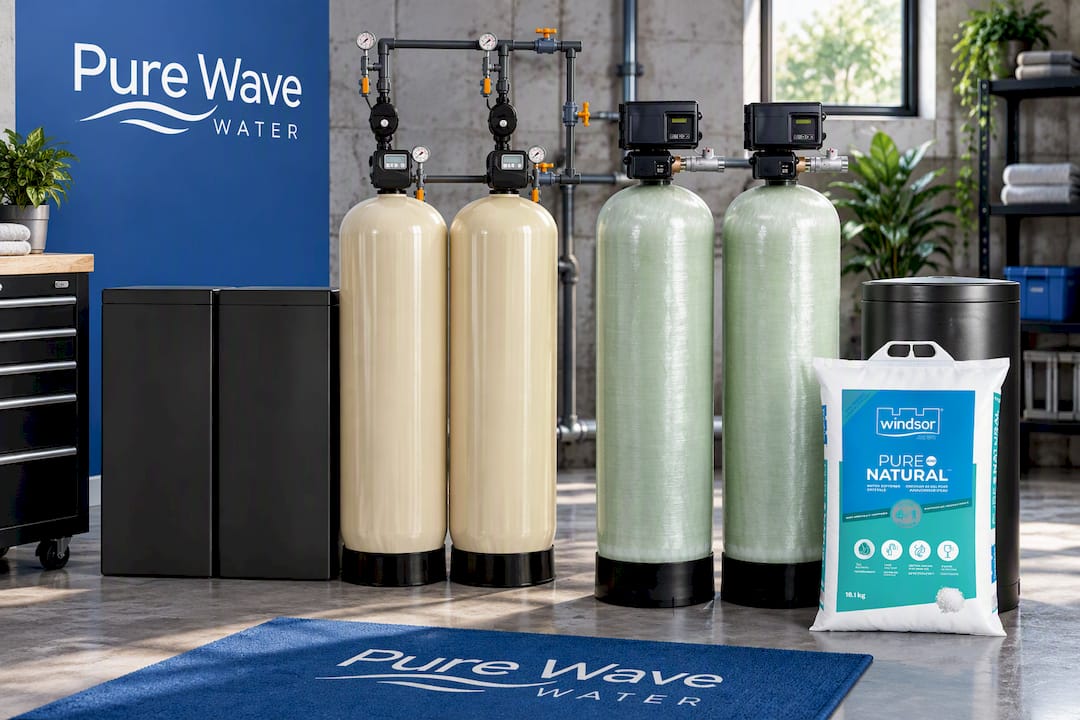
If your softener is acting up right now, book a service call and get an on-site diagnosis with a written quote for both repair and replacement, so you’re deciding with real numbers instead of a guess. Prefer to start with water quality first? Bring a sample in for a free water test and find out exactly what’s in your supply before you spend a dollar on either option. Already know you need a replacement and want to browse capacity options? Check the full lineup at our online shop, or just reach out directly and we’ll walk you through it.
Sources
- Water Softener Problems & Solutions: Complete Troubleshooting Guide
- Water Softener Not Working? Complete Troubleshooting Guide 2026
- Water softener resin loss diagnosis & cure
FAQ
How do I know if my water softener needs repair or replacement?
Check the unit’s age, how many parts have failed recently, and whether the tank is cracked. If it’s under 10 years old with a single failed part, repair almost always makes sense; past 12 to 15 years with repeated failures, replacement usually pays off faster.
Can a salt bridge really stop my softener from working?
Yes, a salt bridge is one of the most common causes of a softener suddenly failing to soften water despite a full tank. Breaking up the crust with a broom handle and running a manual regeneration typically fixes it within minutes.
How long does resin actually last in a water softener?
Resin generally lasts 10 to 15 years under normal water conditions, though iron content in your supply can shorten that considerably. If your unit falls in that age range and salt fixes aren’t restoring softness, resin exhaustion is worth testing for by a professional.
Does Purewavewater repair softeners it didn’t originally sell?
Technicians service a wide range of brands and models, not just units originally sold by the service provider. Every visit includes on-site testing and a written quote covering both repair and replacement so you can compare options directly.
What does a professional diagnostic visit typically involve?
A technician tests your water for hardness and iron, inspects the control valve and brine tank, and checks the resin bed’s condition before recommending a fix. You can request this through Purewavewater’s service page or start with a free water test to understand your water quality first.

Pure Wave Water shares educational content about water treatment, water softeners, reverse osmosis systems, UV purification, and filtration solutions. Our guides help readers understand water quality concerns, explore treatment options, and make informed decisions about their water treatment needs.