If your well water tests above 0.12 mg/L for total manganese, you’re at Health Canada’s maximum acceptable concentration and should stop using that water for drinking or infant formula until it’s treated. If infants in your household drink the water, use an alternative source even at lower levels while you arrange lab testing and a treatment plan.
TL;DR:
- Testing must include both raw and treated water samples to accurately identify manganese levels and treatment effectiveness.
- If manganese exceeds 0.12 mg/L in water tests, it is unsafe for drinking and infants, requiring immediate treatment before use.
- Point-of-use reverse osmosis filters are suitable for drinking water, while whole-home systems are necessary for addressing staining and other household problems.
- Common signs of manganese in water include staining, dark particles, and metallic taste, but only lab tests can determine actual concentration risks.
- Proper system selection depends on detailed water chemistry, underscoring the importance of lab data over generic equipment recommendations.
Table of Contents
- Why manganese in your water matters for your health
- How manganese gets into your well and what to look for
- Testing your well: what to order and how often
- What your results mean against the guideline
- Choosing between whole-home and under-sink treatment
- Choosing equipment and keeping it working
- How Pure Wave Water can help
- The part homeowners usually get wrong
- Getting your water tested and treated properly
- Sources
- FAQ
Why manganese in your water matters for your health
Manganese is a nutrient your body needs from food, but drinking water delivers it differently. Health Canada notes that manganese from water is more easily absorbed than manganese from a typical diet, which is why the drinking water guideline exists separately from dietary recommendations. That distinction matters most for infants and young children.
Formula-fed infants face the highest risk from manganese in tap water, according to Health Canada’s Water Talk explainer, because mixing formula with contaminated water can make drinking water a much larger share of an infant’s total manganese exposure than it would be for an adult. Health Canada links elevated drinking-water manganese to concerns about neurological development in this age group specifically.
It’s worth separating two different problems here. Aesthetic issues, staining, taste, cloudy water, start well below the health-based limit. Health-based concern is a separate, higher threshold. And boiling won’t help either problem: manganese doesn’t evaporate, so boiling can actually concentrate it as water is lost to steam.
How manganese gets into your well and what to look for
Manganese occurs naturally in rock and soil, and it dissolves into groundwater as water moves through certain geological formations. Well depth, local bedrock and groundwater chemistry all influence how much ends up at your tap, which is why two neighbouring wells can show very different results.
Once dissolved, manganese exists mainly as Mn(II), a soluble form that’s invisible in the glass but shows up later. When exposed to air or a treatment process, it oxidizes into particulate manganese, the form responsible for the black or brown residue homeowners actually notice. That shift between dissolved and oxidized forms is also why treatment method matters: a system built for dissolved manganese won’t necessarily catch the particulate kind, and vice versa.
Watch for these signs:
- Black or brownish staining on laundry, fixtures or the inside of your dishwasher
- Small black particles settling in toilet tanks or ice cube trays
- A metallic or slightly bitter taste in drinking water
- Manganese often turning up alongside iron and hydrogen sulphide (the rotten-egg smell), since all three tend to occur in similar groundwater conditions
Testing your well: what to order and how often
Getting a clear picture starts with the right lab request, not a general water panel.
- Ask the lab for total manganese, plus iron, pH, hardness, alkalinity, turbidity and sulphide; request bacterial testing separately if you haven’t done one recently
- Collect a raw (untreated) sample directly from the well or before any treatment equipment
- If you already have a treatment system installed, collect a second sample after treatment to confirm it’s working
- Follow your lab’s instructions on container type, timing and shipping, since manganese chemistry can shift if a sample sits too long
- Retest at least once a year, and more often for a few months after installing or servicing a treatment system
Ontario’s guidance on private well testing recommends this raw-and-treated pairing specifically because a treatment device can fail quietly, passing manganese through while looking like it’s working.
Pro Tip: Bring both your raw and treated results, in the same units, to any consultation with a water treatment technician. It saves a second round of testing before they can recommend anything.
What your results mean against the guideline
Health Canada sets two numbers that matter here: a maximum acceptable concentration (MAC) of 0.12 mg/L (120 µg/L) for total manganese, and a lower aesthetic objective (AO) of 0.02 mg/L (20 µg/L). The MAC is the health-based line. The AO exists because staining, taste and odour problems typically show up well before manganese reaches a level of health concern.
Below the AO, you likely have no issue at all. Between the AO and the MAC, you’re probably dealing with an aesthetic nuisance rather than a health risk, though infants in the household still warrant caution. At or above the MAC, treat the water before using it for drinking or formula, and consider calling your local public health unit if you’re unsure how to interpret a lab report.
Choosing between whole-home and under-sink treatment
Whether you need a whole-house system or a single tap solution depends on what you’re actually trying to fix: your health exposure, your stained laundry, or both.
Point-of-use treatment makes sense when ingestion is the only real concern and staining isn’t an issue. Certified reverse osmosis units installed under the kitchen sink are a reliable way to bring manganese down at the tap used for drinking and cooking, without treating every drop that enters the house.
Point-of-entry treatment covers the whole home, which matters if you’re seeing staining in laundry, fixtures or appliances in addition to any health concern. Common approaches, drawn from extension research on private well systems, include:
- Aeration combined with filtration, which oxidizes dissolved manganese so it can be caught mechanically
- Oxidizing (greensand) filters, which use a coated media to convert and trap manganese, and need regular backwashing to keep working
- Chemical oxidation paired with filtration, which needs enough contact time, often cited at around 20 minutes, for the oxidant to convert manganese before it reaches the filter
- Air-injection hybrid systems and ozone-based capsulate units, which inject oxygen or ozone ahead of filtration to handle iron, manganese and sulphide together
- Ion-exchange water softeners, which can remove manganese at low to moderate concentrations but only within limits set by the manufacturer
None of these substitute for disinfection unless the system is explicitly designed for it, and chemical oxidation setups in particular need pH in the right range to work efficiently. Extension guidance on iron and manganese treatment is consistent on one point: the right system depends entirely on your water’s specific chemistry, not a general recommendation.
Pro Tip: Greensand filters are one of the most common points of failure in manganese treatment. If backwash cycles aren’t run often enough, the media stops regenerating properly and manganese starts passing straight through.
Choosing equipment and keeping it working
Before you buy anything, confirm the basics: your manganese concentration and form (dissolved or particulate), pH, whether iron or sulphide is present, your household’s peak flow demand, and whether your goal is treating drinking water only or the whole home.
When you talk to a vendor or technician, ask these questions:
- Can you show me the raw-water lab report this recommendation is based on
- What treated-water concentration should I expect after installation
- What’s the maintenance and backwash or regeneration schedule
- What’s covered under warranty, and what’s the ongoing service plan
Be cautious of anyone recommending equipment without seeing a lab report first. That’s a red flag regardless of the brand. Once installed, verify performance with a treated-water test rather than judging by taste or appearance alone, and keep testing on the same annual cadence you used to diagnose the problem in the first place.
How Pure Wave Water can help
Pure Wave Water has served homeowners, rural properties and businesses in the Georgetown, Ontario area since 1995, with free in-store water testing for iron, hardness and other water quality concerns as the starting point for any recommendation. That diagnosis-first approach matters for manganese specifically, since the right equipment depends on your water’s chemistry, not a standard package.
For households dealing with confirmed iron and manganese contamination, Pure Wave Water’s catalogue includes:
- Zentec Value Hybrid Iron, Sulphur, and Manganese Backwashable Filter, a backwashable oxidative filter for combined iron, sulphur and manganese removal
- Zentec Premium Air Injection Hybrid Capsulate Iron, Sulphur, and Manganese Filter, which uses air injection ahead of filtration for the same three contaminants
- Zentec Superior Enhanced Ozone Capsulate Filter With Generator, an ozone-based system for households needing stronger oxidation
Local technicians also handle installation, servicing and troubleshooting, whichever system fits your water report.
The part homeowners usually get wrong
Most advice on manganese jumps straight to equipment: buy a filter, install it, move on. That’s backwards, and it’s the single biggest reason treatment systems underperform. Manganese exists in different chemical forms depending on your well’s geology and pH, and a system sized for dissolved Mn(II) can miss particulate manganese entirely, or vice versa. Skip the lab report, and you’re guessing.
The second thing conventional advice underplays is verification. A treatment system that worked on day one can fail quietly months later, especially greensand filters that depend on properly timed backwash cycles. Testing only the raw water before installation and never checking the treated tap afterward is how households end up drinking manganese they thought they’d already solved.
If you take one thing from this, prioritize the raw-and-treated testing pair over the brand of equipment. A correctly diagnosed problem paired with an ordinary filter beats an expensive system chosen without lab data behind it.
— CloudSprout16
Getting your water tested and treated properly
Reading a lab report is one thing. Matching it to the right equipment, sized for your household’s flow and your water’s specific chemistry, is where most manganese problems either get solved or get expensive.
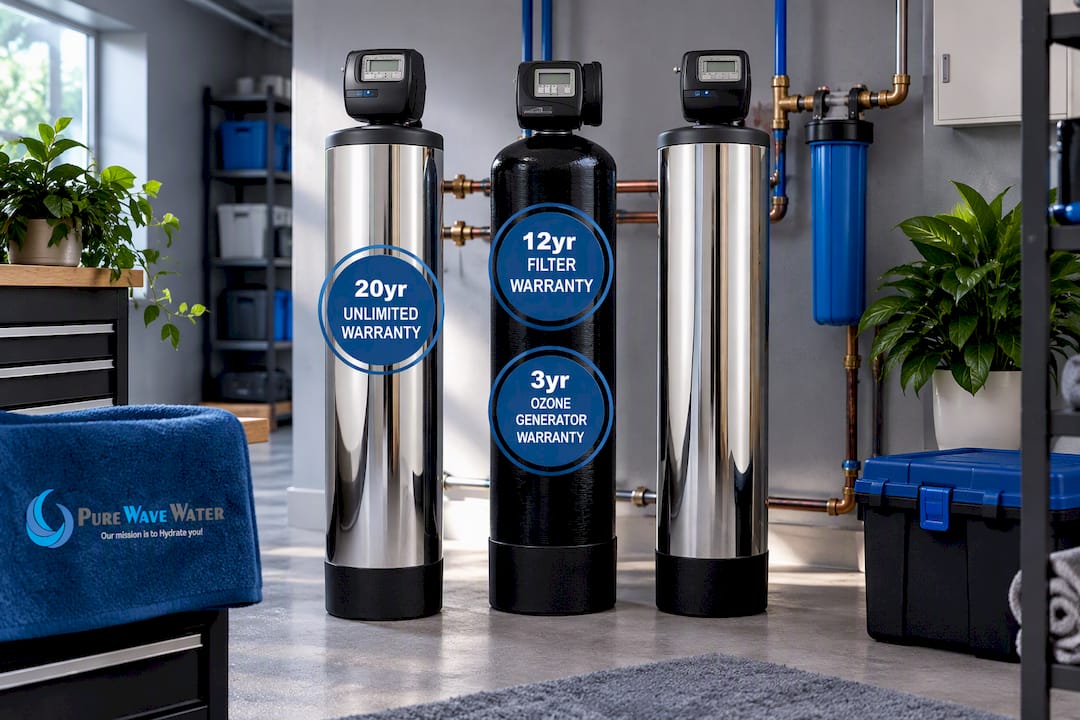
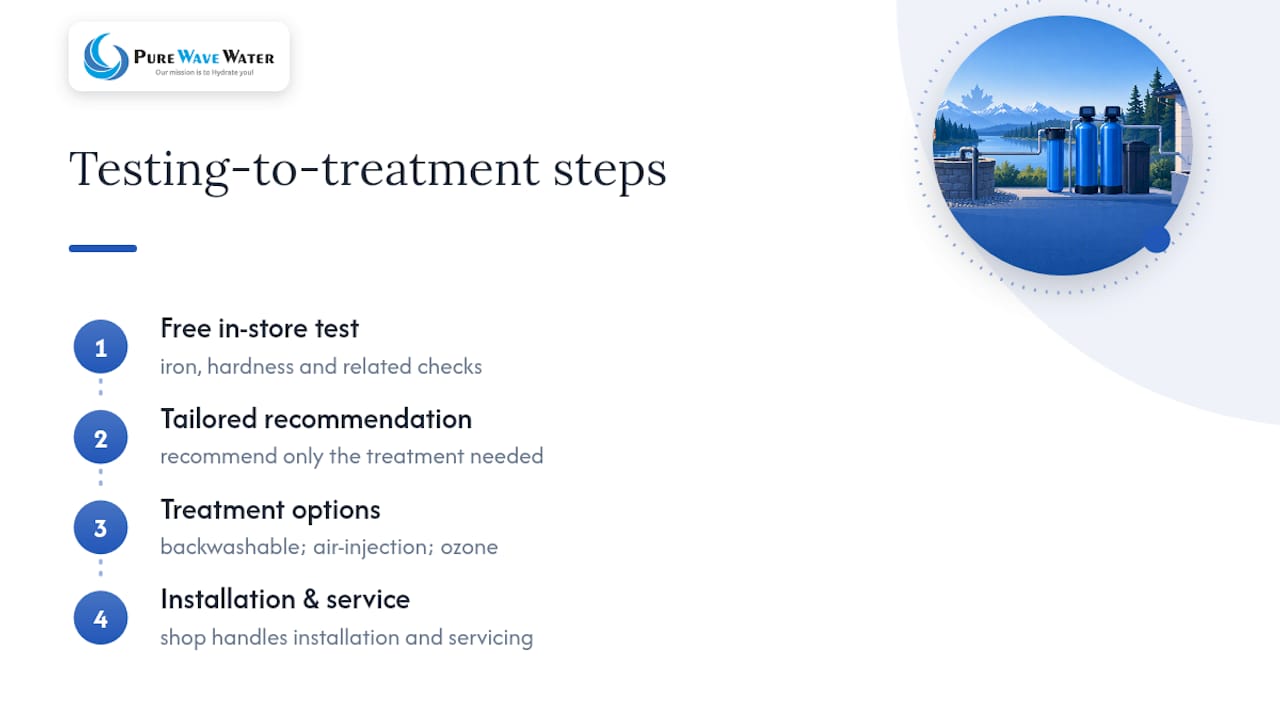
The company starts every manganese case with a free in-store water test for iron, hardness and related concerns, then recommends only the treatment your results actually call for. That’s a meaningfully different starting point than shopping for a filter based on a general description of your symptoms. If your test comes back showing manganese above the aesthetic objective or the health-based limit, technicians can walk you through backwashable, air-injection or ozone-based options from the shop and handle installation and ongoing servicing.
If you already have a recent lab report in hand, book a water testing consultation or browse the shop directly. If you don’t yet have results, that free test is the right first step before buying anything.
This article is general information, not a substitute for advice from a qualified doctor. Consult a qualified healthcare professional about your own circumstances before acting on anything here.
Sources
- Guideline technical document – Manganese (Health Canada)
- Ontario
- Iron and manganese in private water systems (Penn State Extension)
FAQ
How can you remove manganese from well water?
Removal depends on whether manganese is dissolved or already oxidized: options include aeration combined with filtration, oxidizing greensand filters, chemical oxidation followed by filtration, and ion exchange for whole-home treatment, or certified reverse osmosis for drinking water specifically. The correct choice depends on your water’s pH, concentration and co-contaminants like iron or sulphide.
Is it safe to drink well water with manganese?
It depends on the concentration measured in a lab test. Below Health Canada’s aesthetic objective of 0.02 mg/L there’s typically no concern; at or above the maximum acceptable concentration of 0.12 mg/L, treat the water before drinking it, especially if infants are in the household.
What happens if you drink water high in manganese?
High manganese exposure through drinking water is associated with neurological development concerns, particularly in infants and young children, since water-based manganese is absorbed more readily than dietary manganese. Formula-fed infants face the highest risk, as Health Canada explains, because mixed formula can make water a large share of their total exposure.
What are the signs that my well water contains manganese?
Common signs include black or brown staining on laundry and fixtures, dark particles in toilet tanks or ice trays, and a metallic taste in the water. These aesthetic signs can appear well before manganese reaches a health-based concentration, so a lab test is the only way to confirm actual levels.

Pure Wave Water shares educational content about water treatment, water softeners, reverse osmosis systems, UV purification, and filtration solutions. Our guides help readers understand water quality concerns, explore treatment options, and make informed decisions about their water treatment needs.