
A water softener bypass valve reroutes incoming water around the resin tank so it flows straight to your household pipes untreated. In normal operation, that valve stays in the service position and every drop passes through the softener. You move it to bypass only for short jobs, maintenance, winterizing, or outdoor water use, and then return it to service as soon as the task is done.
TL;DR:
- Bypass valves are primarily intended for short-term use such as maintenance, winterizing, or outdoor tasks, not for extended periods, as untreated water can cause scale buildup.
- Most bypass valves can be operated by pushing, pulling, or swinging a handle, and properly labeling the position helps prevent confusion during future use.
- Stuck or leaking bypass valves typically result from stiffened components or worn seals, which are fixable by applying proper force or replacing OEM parts like the Cam & Gear 7283489.
- Leaving a water softener on bypass for more than a few days can lead to hard water issues in household appliances and plumbing, making it unsuitable for prolonged use.
- Professional inspection and repair are recommended if the bypass valve is malfunctioning to ensure proper operation and water quality.
Table of Contents
- What does a water softener bypass valve do?
- When should you use the bypass valve?
- How do you put a water softener in bypass and back to service?
- Why is my water softener bypass valve stuck or leaking?
- How long can you leave a water softener on bypass?
- Pure Wave Water’s approach to bypass valve service and testing
- Get your bypass valve inspected or find the right replacement parts
- Sources
- FAQ
What does a water softener bypass valve do?
Think of the bypass valve as a detour sign built into your plumbing. Its job is to let water skip the resin tank entirely, either because you want untreated water for a specific task or because someone needs to work on the unit without cutting off your household’s water supply. This is a basic design principle borrowed from industrial plumbing, where bypass loops let technicians service equipment without shutting down the whole line.
Most residential softeners use one of three valve styles. Single-handle push/pull type valves are the most common: a T-handle or cone-shaped knob you pull out or push in. Lever-style valves swing a handle from one side to the other, often with a visible arrow or colour indicator. Older or higher-flow systems sometimes use a 3-valve setup with separate inlet, outlet, and bypass valves you open and close individually.
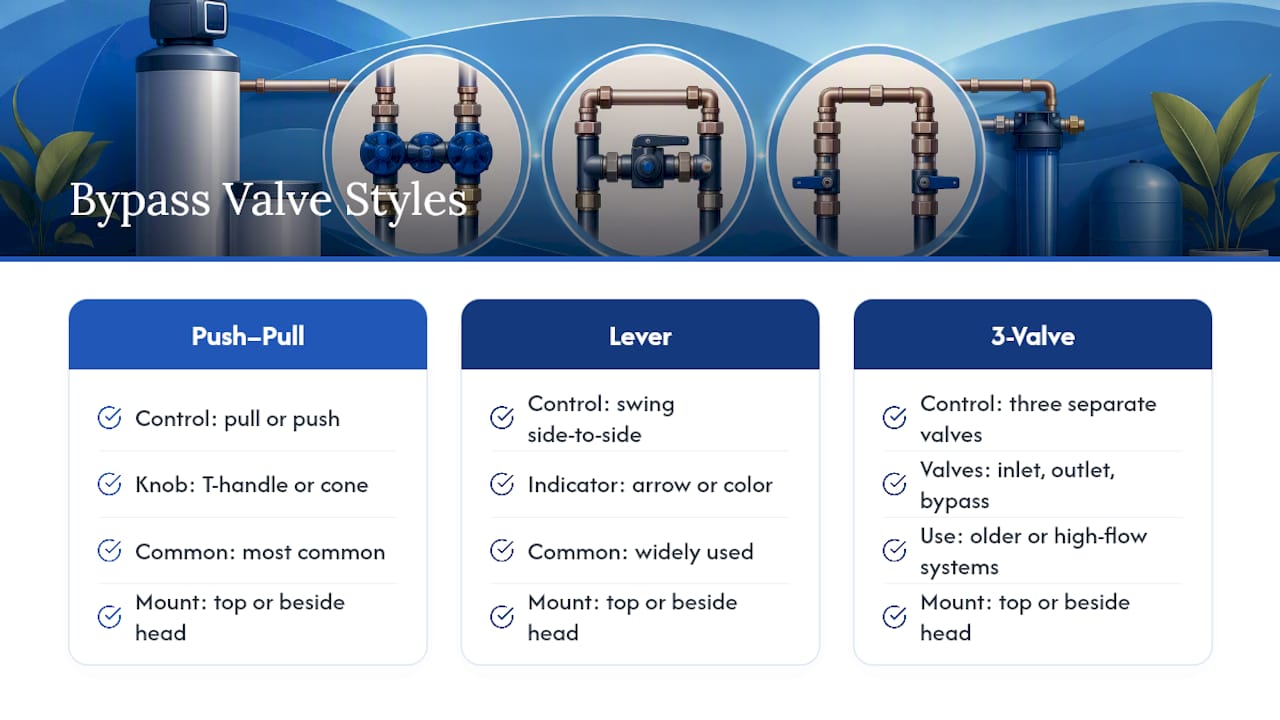
You’ll usually find the bypass valve mounted on top of or beside the control head, where the inlet and outlet pipes connect to the softener. If you’re installing a new unit or reworking your plumbing layout, a Pure Wave Water technician can confirm the best placement for your setup.
When should you use the bypass valve?
Bypass exists for short, specific jobs, not everyday convenience. Reach for it when you need water that hasn’t been through the softener, or when the unit itself needs attention.
- Maintenance or repairs: shutting off flow to the resin tank lets you service the valve, replace a filter, or add salt without disrupting water to the rest of the house.
- Winterizing: cottages and seasonal properties often get bypassed before the softener is drained or shut down for the season.
- Lawn and garden watering, or pool filling: softened water wastes salt on tasks where hardness minerals don’t matter, and can even harm certain plants.
- Short trips away: bypassing briefly avoids unnecessary regeneration cycles while nobody’s home to use water.
- Emergency leaks: bypass can isolate the softener quickly if you spot a leak at the unit itself.
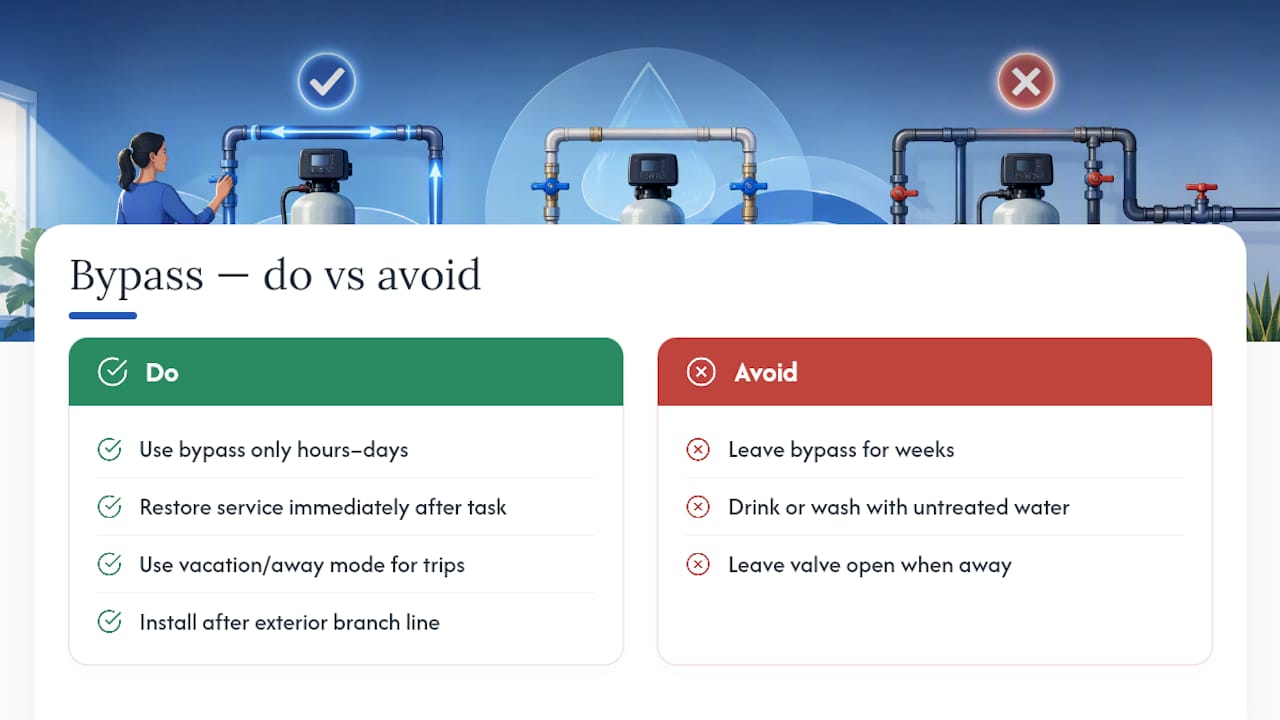
The catch is that bypass mode also means no softening at all, so leaving it engaged for outdoor watering long enough to also run the dishwasher or shower defeats the purpose. If outdoor taps are a recurring need, the smarter fix is plumbing placement, not repeated bypass switching. The EPA recommends installing your softener after the branch line that feeds outdoor faucets, so exterior taps draw untreated water automatically and your softener never has to work overtime, or get bypassed, just to fill a pool.
How do you put a water softener in bypass and back to service?
The exact motion depends on which valve type sits on your unit, but the logic is the same across all three: redirect the flow, confirm the change, then reverse it later.
Single-handle valves
- Locate the handle on top of the control valve, usually a knob or T-shaped grip.
- Confirm normal position first. In service mode, the handle sits pulled OUT; pushing it fully IN engages bypass.
- Push the handle in firmly and evenly until it seats. You should feel a distinct stop.
- To return to service, pull the handle back out to its original position.
Lever-style valves
- Find the lever, typically mounted on the side or front of the valve body.
- Swing it fully toward the bypass marking, often labelled or colour coded.
- Check that it’s seated against the stop, not resting halfway.
- Reverse the motion completely to restore service flow.
3-valve systems
- Open the bypass valve first.
- Close the inlet valve.
- Close the outlet valve.
- To restore service, reverse the order: open inlet and outlet, then close the bypass valve.
Once you’ve switched back to service, run a tap for a minute and do a quick soap test: work a small amount of soap into your hands under running water and check whether it lathers easily. Poor lather or a gritty feel usually means the softener isn’t back online yet.
Pro Tip: Label your bypass valve’s service position with a strip of tape or a paint dot the first time you confirm it. Six months later, when you’re standing in the basement trying to remember which way is “normal,” that fifteen-second habit saves you a guessing game.
Why is my water softener bypass valve stuck or leaking?
A bypass valve that won’t budge, weeps water, or somehow ended up in the wrong position isn’t unusual. Most of these problems have simple fixes.
- Stuck valve: valves that sit untouched for months can stiffen. Apply steady, firm pressure rather than forcing it in one direction; a slight twisting motion often breaks it loose. Manufacturer guidance specifically recommends twisting or turning a stubborn handle instead of hammering or prying it.
- Leaking around the valve body: worn O-rings or a loose connection are the usual culprits. Matching the replacement to the correct OEM part, such as a Cam & Gear 7283489 for 1 inch high-flow systems, and re-torquing fittings to spec prevents repeat leaks.
- Accidentally left in bypass: if your water suddenly feels harder, leaves spots on glasses, or your soap stops lathering well, check the valve position before assuming the softener itself has failed.
- When to call a technician: if the valve won’t move at all, keeps leaking after a seal replacement, or you’re not confident identifying which position is which, professional service beats guesswork with your home’s water supply.
How long can you leave a water softener on bypass?
Bypass is meant for limited durations such as hours or a few days, not extended periods like weeks. Every day it’s engaged is a day your household drinks and washes with untreated water, and a day closer to noticeable scale buildup in your fixtures, water heater, and appliances. The EPA’s guidance on efficient softener operation is built around using bypass sparingly, for defined tasks, then restoring service immediately afterward. That same guidance is why outdoor plumbing placement matters more than most homeowners realize: a softener installed after the exterior branch line rarely needs bypassing at all for lawn or pool use.
If you’re leaving for an extended trip, most modern control heads have a vacation or away mode that pauses regeneration without fully bypassing the unit, which conserves salt and water more effectively than leaving the valve open the whole time you’re gone.
Pure Wave Water’s approach to bypass valve service and testing
We diagnose bypass and hardness issues the same way every time: start with a free in-store water test for hardness and iron before recommending anything. On service calls, our technicians inspect the bypass assembly, replace worn seals, and fit OEM-matched parts like the Cam & Gear 7283489 when a cam has worn down. After any repair, we verify hardness at the tap before calling the job done, because a valve that operates smoothly is only half the fix if the water coming out the other side hasn’t actually improved.
Get your bypass valve inspected or find the right replacement parts
If your bypass valve is stuck, leaking, or you’re just not sure which position is correct anymore, that’s a job worth having checked properly rather than left to guesswork. A local water treatment provider can give you an alternative to ordering random parts online and hoping they fit: a free in-store water test for hardness and iron first, then a recommendation based on what your system actually needs, not a generic upsell.
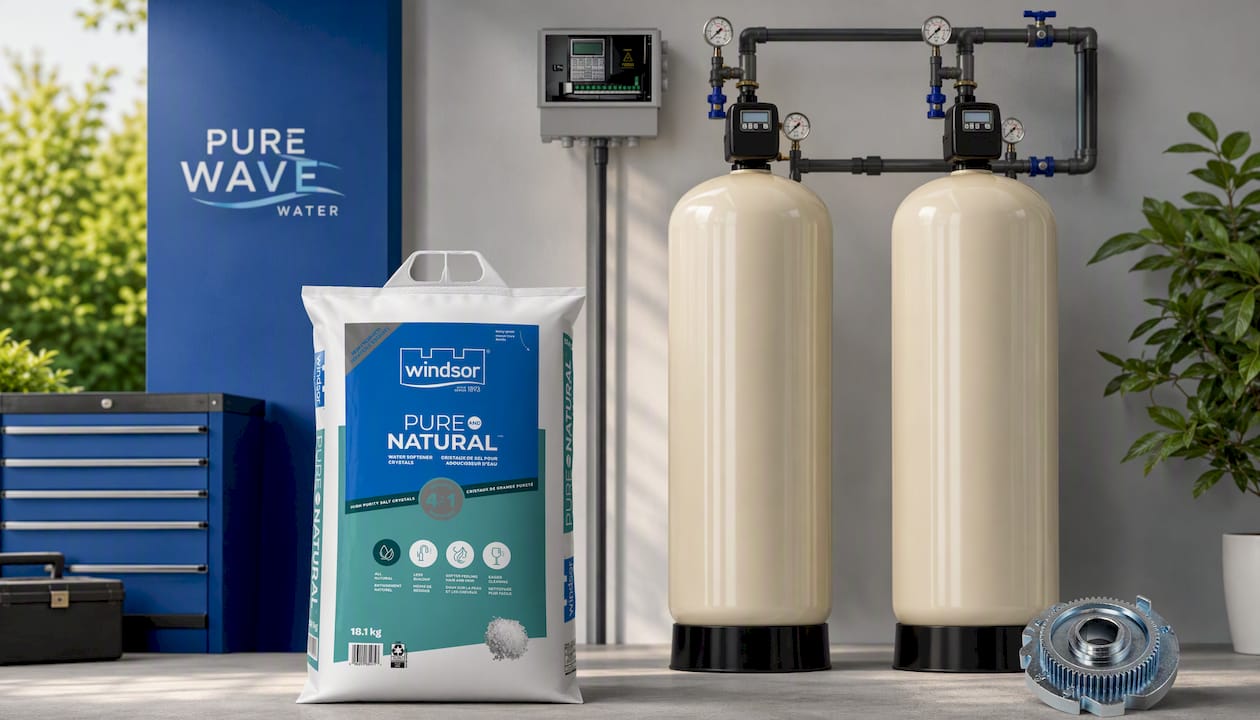
If your current unit is aging out or struggling to keep up with your household’s demand, the 75K Progressive Duplex Water Softener is built for homes that want continuous soft water without a regeneration gap. For a bypass valve repair, the Cam & Gear 7283489 fits 1 inch high-flow systems and resolves the worn-cam leaks that send most bypass valves into early failure. And once your system’s back in service, keeping Windsor Pure Natural Water Softener Salt on hand means you’re never caught mid-regeneration without supply. Book a free water test in-store, or reach out to schedule a service visit and get the right part the first time.
Sources
For deeper reading, see the EPA’s water softener efficiency guide and a practical step-by-step bypass PDF. For broader plumbing layout context, this property owner’s tap-in guide covers related installation considerations.
- Soften water without wasting it: Guide to selecting and maintaining a water-efficient water softener
- How Does a Bypass Valve Work? – Whirlpool
- What is the function of a hydraulic bypass valve? | MIT School of Engineering
FAQ
What is a bypass valve on a water softener?
It’s a control that reroutes incoming water around the resin tank so it reaches your taps untreated, typically used for maintenance, outdoor watering, or emergency shutoffs.
What position should my water softener bypass valve be in?
For normal daily use, the valve should be in the service position, which on single-handle types means the handle is pulled OUT; pushing it IN engages bypass.
Is it okay to bypass a water softener?
Yes, for short specific tasks like winterizing, lawn watering, or maintenance, but leaving it bypassed during regular household use means you’re drinking and washing with hard, untreated water.
How long can I leave my water softener on bypass?
Bypass should last hours to a few days at most; extended bypass leads to noticeable hard water effects and undoes the purpose of having a softener installed at all.
Can Purewavewater help if my bypass valve is stuck or leaking?
Yes, qualified technicians can inspect the valve, replace worn seals or cams with OEM-matched parts, and confirm your water is properly softened again before finishing the job.

Written by the Pure Wave Water team, who test, install and service water treatment systems across Georgetown and Halton Hills.