

UV disinfection works for well water when the water is clear and the source is properly pre‑treated, and it’s one of the most reliable, chemical‑free ways to knock out bacteria and viruses at the point they enter your home. If your well hasn’t been tested recently, that’s the very next step, because turbidity, iron, and manganese can all block UV from doing its job. Water testing and installation services are available in the Georgetown, Halton Hills, Brampton, Milton, and Mississauga area to help get accurate data for your well.
TL;DR:
- Proper pre-treatment is essential for effective UV disinfection, with turbidity below 5 NTU and mineral levels within Health Canada’s thresholds.
- UV systems should be sized based on peak water demand, typically requiring a flow capacity of at least 15 to 22 gallons per minute for residential homes.
- Regular maintenance, including sleeve cleaning and annual lamp replacement, is crucial as UV performance declines gradually over time without visible signs.
- UV disinfection is only effective if installed as the last step in a treatment chain and complemented by suitable pre-filters for particles, minerals, and organics.
- Proper water testing and system design tailored to specific mineral levels and peak flow demands prevent underperformance and ensure safe, chemical-free disinfection.
Table of Contents
- How UV light disinfects well water (and what it can’t do)
- Is your well water ready for UV, or does it need pre-treatment first?
- Sizing a UV system: matching flow, dose, and safety margin
- Where the UV unit belongs in your treatment train
- Keeping your UV system working: maintenance and troubleshooting
- How Pure Wave Water supports testing, selection, and installation
- What actually matters when you’re choosing UV for your well
- Finding the right Viqua UV system for your home
- Sources
How UV light disinfects well water (and what it can’t do)
Ultraviolet disinfection doesn’t kill microorganisms the way chlorine or heat does. UV‑C light at a wavelength around 254 nanometres damages the DNA and RNA inside bacteria, viruses, and many protozoa, scrambling their genetic instructions so they can’t reproduce. A well-designed system delivers enough dose, measured in millijoules per square centimetre, to disable these organisms as water passes through the treatment chamber. A 2022 study on UV‑C irradiation demonstrated that a dose around 40 mJ/cm² effectively inactivated bacterial targets in controlled lab conditions, which is roughly the ballpark many residential systems are designed around.
That mechanism is exactly why UV earns its reputation as chemical-free disinfection for well water. There’s no chlorine smell, no altered taste, and no disinfection byproducts forming in your pipes. For homeowners who’ve dealt with the bleach aftertaste of shock chlorination, that’s a real quality-of-life upgrade.
But UV has firm limits, and skipping past them is where homeowners get burned.
- UV disinfects. It does not filter. It won’t touch dissolved chemical contaminants like arsenic, nitrate, or PFAS, and it does nothing to remove hardness minerals, iron, or manganese from your water.
- UV provides zero residual protection. Chlorine keeps working as water sits in your plumbing; UV only acts in the instant water passes through the lamp chamber.
- Anything that gets into your plumbing downstream of the UV unit, whether from a cracked pipe fitting or a period when the system was offline, isn’t disinfected retroactively.
- Sediment, cloudiness, or mineral film on the quartz sleeve can shield microorganisms from UV light entirely, letting them pass through untouched.
That last point deserves emphasis. UV light travels in a straight line, and anything opaque between the lamp and the water, whether it’s suspended silt or scale buildup on the sleeve, creates a shadow where organisms simply don’t get exposed. This is why UV for well water is never a standalone fix; it’s the last, critical link in a treatment chain that has to be built correctly from the start.
Is your well water ready for UV, or does it need pre-treatment first?
Most wells aren’t ready for UV disinfection straight out of the ground, and that’s normal, not a red flag. The water chemistry that makes well water hard, cloudy, or rust-tinged is precisely the chemistry that blocks UV from working. Health Canada’s guidelines set specific benchmarks that double as practical thresholds for UV performance.
| Parameter | Threshold for effective UV | Why it matters |
|---|---|---|
| Turbidity | Below 5 NTU | Cloudy water scatters and absorbs UV light before it reaches microorganisms |
| Iron | Below recommended Health Canada thresholds | Iron particles coat the quartz sleeve and stain it, reducing light output over time |
| Manganese | Below recommended Health Canada thresholds | Similar fouling effect to iron, plus it darkens water and clogs fine filters |
| Hardness | Below recommended Health Canada thresholds | Scale buildup on the sleeve reduces UV transmittance and forces more frequent cleaning |
Before you spend a dollar on equipment, order a proper water test. At minimum, ask an accredited lab for total coliform and E. coli counts, turbidity, iron, manganese, and hardness. A private well should be tested for bacteria at least once a year, and Health Canada’s guidance on well water treatment is a good reference point if you’re unsure what a “safe” result actually looks like. If you’ve recently had flooding, a plumbing repair, or a change in water taste or colour, test again regardless of when your last sample was taken.
If your results land outside those thresholds, don’t panic. It usually means adding one or two pieces of equipment ahead of the UV unit, not scrapping the whole plan.
- Sediment cartridges handle basic turbidity and grit, and they’re the cheapest, simplest first line of defence for almost every well.
- Iron and manganese oxidation and filtration (often a specialty filter or an air-injection oxidizer) is necessary when either mineral tests above the thresholds above, since a sediment filter alone won’t catch dissolved iron.
- A water softener tackles hardness, protecting not just your UV sleeve but your water heater, fixtures, and appliances from scale buildup.
- Carbon filtration addresses taste, odour, and some organic compounds, useful if your well has a sulphur smell or discoloured tannins, though it isn’t strictly required for UV to function.
Getting this sequence right is less about brand names and more about matching the pre-treatment to what your specific test results show. A well with high iron but soft water needs a different setup than a well with hard water and low iron.
Sizing a UV system: matching flow, dose, and safety margin
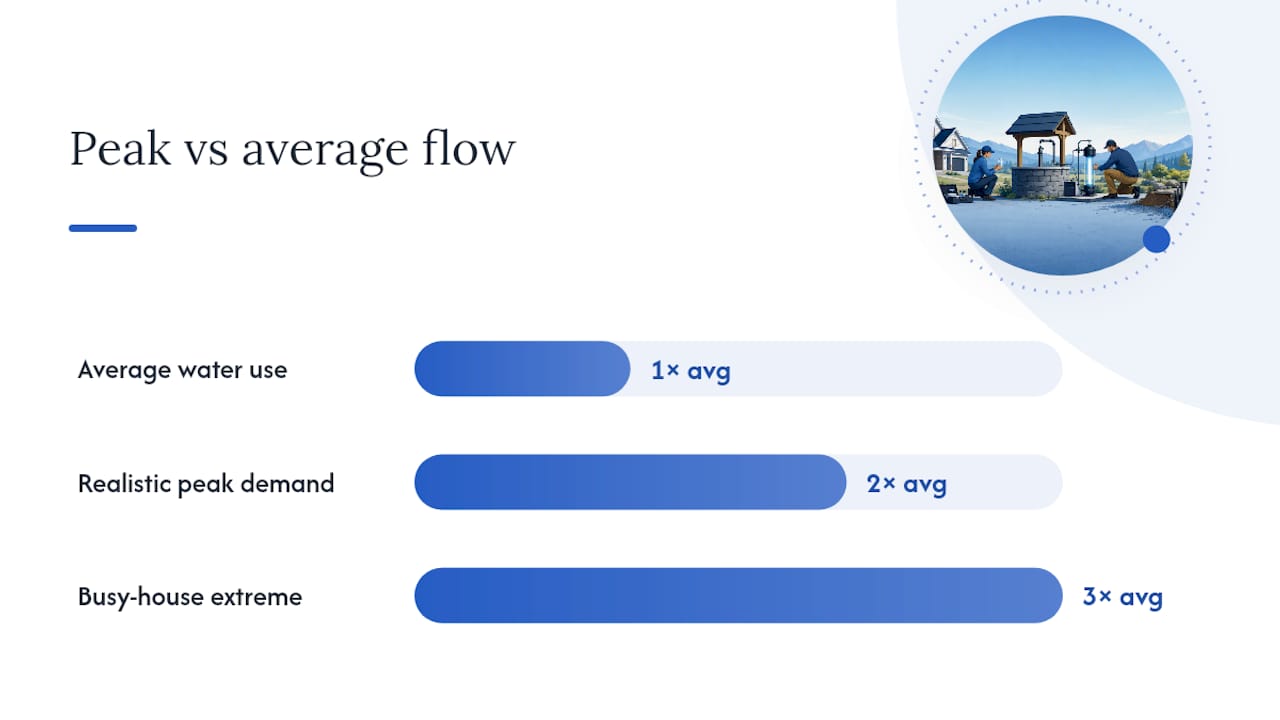
The single biggest sizing mistake homeowners make is designing around average water use instead of peak demand. Your UV system has to handle the busiest moment in your house, not a typical Tuesday afternoon. If two showers are running while the dishwasher fills and someone’s washing the car outside, that combined instantaneous flow, measured in gallons per minute, is the number that matters, and it can be two or three times higher than your average daily draw.
Walk through your fixtures and estimate what could realistically run at once: showers, a washing machine, an outdoor tap, a dishwasher. Add up their flow rates for a realistic peak scenario, then size (or ask your installer to size) the UV system to handle that peak comfortably, not just squeak by.
Dose matters just as much as flow. Bacteria typically require less UV dose to inactivate than some viruses and protozoan cysts, so systems are rated to deliver a validated minimum dose across their entire rated flow range, not just at low flow. This is where NSF/ANSI 55 certification becomes relevant: Class A systems are validated to deliver a minimum dose of 40 mJ/cm² and are rated for water that may contain disease-causing organisms, while Class B systems are intended only as a supplemental treatment for already-disinfected water. That distinction changes which class is appropriate for a private well relying on UV as primary disinfection.
Lamps also lose output gradually over time, and sleeve fouling reduces UV transmittance even between cleanings. That’s why reputable manufacturers build in a safety margin above the bare minimum dose, and why OEM engineering guidance stresses that performance depends on the whole system, lamp output, reactor geometry, flow, water transmittance, sleeve condition, and monitoring, not the lamp’s wattage rating alone.
When comparing systems, prioritize these features over price alone:
- A UV intensity sensor that continuously monitors actual light output, not just an assumption that the lamp is working.
- An audible or visual alarm that triggers before dose drops below the safe threshold.
- An automatic shutoff or solenoid valve that stops flow entirely if UV output falls too low, rather than letting untreated water through silently.
- A stainless steel chamber for durability and easier cleaning compared to lower-grade materials.
- Accessible service points so sleeve cleaning and lamp changes don’t require a plumber for every visit.
- NSF/ANSI 55 Class A certification for anyone relying on UV as the primary barrier against pathogens.
Pro Tip: Write your peak flow estimate on a sticky note before you shop. Salespeople will ask for it immediately, and homeowners consistently underestimate this number by guessing instead of adding up actual fixture flow rates.
Where the UV unit belongs in your treatment train
UV goes last. Every time. The correct sequence for a residential well system generally runs like this:
- Pump and pressure tank, delivering water into the home at consistent pressure.
- Sediment filtration, catching grit, sand, and larger particles first.
- Iron and manganese removal, if your test results call for it, since these minerals will foul everything downstream, including the UV sleeve.
- Water softener, addressing hardness before it can scale up your fixtures or your UV chamber.
- Carbon filtration, if taste, odour, or organics are a concern.
- UV disinfection unit, positioned as the final treatment step before water enters your household plumbing.
Installing UV any earlier in that chain means it’s disinfecting water that still has particles or minerals capable of blocking the light, which defeats the purpose.
A few installation basics matter beyond sequence. The unit needs to be installed indoors, in a space protected from freezing, since a frozen UV chamber can crack. Electrical wiring should route through a dedicated outlet with the alarm circuit wired so a power interruption is impossible to miss. Most importantly, Ontario’s technical bulletin on ultraviolet disinfection recommends a physical fail-safe, typically a solenoid valve, that stops water flow automatically if UV output drops or power fails, rather than relying on a homeowner noticing an alarm light.
That same guidance recommends disinfecting downstream plumbing, meaning shock chlorinating your pipes, water heater, and fixtures, right after a new UV system goes in, or any time a bacteria test comes back positive. Since UV leaves no residual protection, any contamination already sitting in your pipes won’t get cleared just because clean water now flows past it.
Keeping your UV system working: maintenance and troubleshooting
A UV system is only as good as its last cleaning and its most recent lamp change. Unlike a water softener that runs quietly for years with minimal attention, UV disinfection depends on a bulb that degrades and a sleeve that fouls, both invisibly, from the outside.
Build a simple maintenance rhythm around three tasks:
- Monthly: glance at the unit’s indicator light or display, confirm the alarm hasn’t triggered, and check that pre-filters upstream aren’t visibly clogged.
- Every few months: clean the quartz sleeve according to your manufacturer’s schedule, since even water within Health Canada’s thresholds leaves gradual mineral film behind.
- Annually: replace the UV lamp regardless of whether it still glows. Lamp output drifts downward well before the bulb visibly dims, a failure mode that’s easy to miss because the light still looks “on.”
When something seems off, whether that’s an alarm, a taste change, or just gut instinct, work through the problem in order rather than jumping straight to replacing the whole unit.
- Test the water first to confirm whether there’s an actual bacteriological issue.
- Check the condition of your pre-filters and change them if they’re due.
- Clean the UV sleeve if it hasn’t been done recently.
- Replace the lamp if it’s near or past its rated service life.
- Confirm the sensor and alarm are both functioning correctly afterward.
Pro Tip: Keep a small logbook or phone note with your lamp installation date and last sleeve cleaning. UV lamps rarely fail dramatically; they fade, and without a written record, it’s easy to run six months past the recommended replacement window without noticing.
Because UV offers no residual protection, a clean test result today doesn’t guarantee anything about water quality next month if a component starts failing quietly. Retest periodically, and don’t hesitate to call in a technician if the alarm trips more than once or you notice any change in odour, colour, or taste.
How Pure Wave Water supports testing, selection, and installation
Getting from “I think my well might need UV” to a working, correctly sequenced system usually goes faster with someone who does this daily. Water testing, equipment recommendations, professional installation, ongoing service, and replacement parts are available for residential and commercial customers in various Ontario communities, with an online store serving customers nationally.
When you book a test, the process typically starts with a water sample analysis covering the parameters that determine whether UV alone will work or whether pre-treatment comes first, things like turbidity, iron, manganese, and hardness alongside bacteriological screening. From there, a technician can walk you through exactly what your results mean in plain language, recommend the specific pre-treatment your well needs (if any), and size a UV system against your home’s actual peak flow rather than a generic estimate.
- Water testing for bacteriological and mineral content
- Custom equipment recommendations based on your specific results
- Professional installation of UV systems and pre-treatment equipment
- Ongoing service, replacement lamps, sleeves, and filter cartridges
- Support is available in multiple communities and nationally through the online store.
Homeowners who go this route typically move from initial test results to a fully installed system within a matter of weeks, with a follow-up check to confirm everything’s performing as expected once it’s running.
What actually matters when you’re choosing UV for your well
The conventional advice on UV disinfection tends to fixate on the unit itself, wattage, brand, price, as if the lamp were the whole story. That’s backwards. The system’s success is decided upstream, in whether your prefiltration matches your actual water chemistry. A premium UV unit fed cloudy, iron-laden water will underperform a modest unit fed properly pre-treated water every time.
What gets underestimated most is maintenance discipline. UV disinfection has no visible failure mode, no smell, no taste, no cloudiness, which means a fading lamp or fouled sleeve can silently stop protecting your family for weeks before anyone notices. Chemical-free doesn’t mean maintenance-free, and homeowners who treat UV as “install and forget” are taking on more risk than they realize.
Prioritize testing before shopping, prioritize the pre-treatment sequence before the lamp specs, and build a maintenance habit before you need one.
— PureWaveWater
Finding the right Viqua UV system for your home
Once your water test results are in and any needed pre-treatment is sorted, choosing the actual UV unit comes down to matching your home’s peak flow to the right model, not chasing the biggest number on the box.
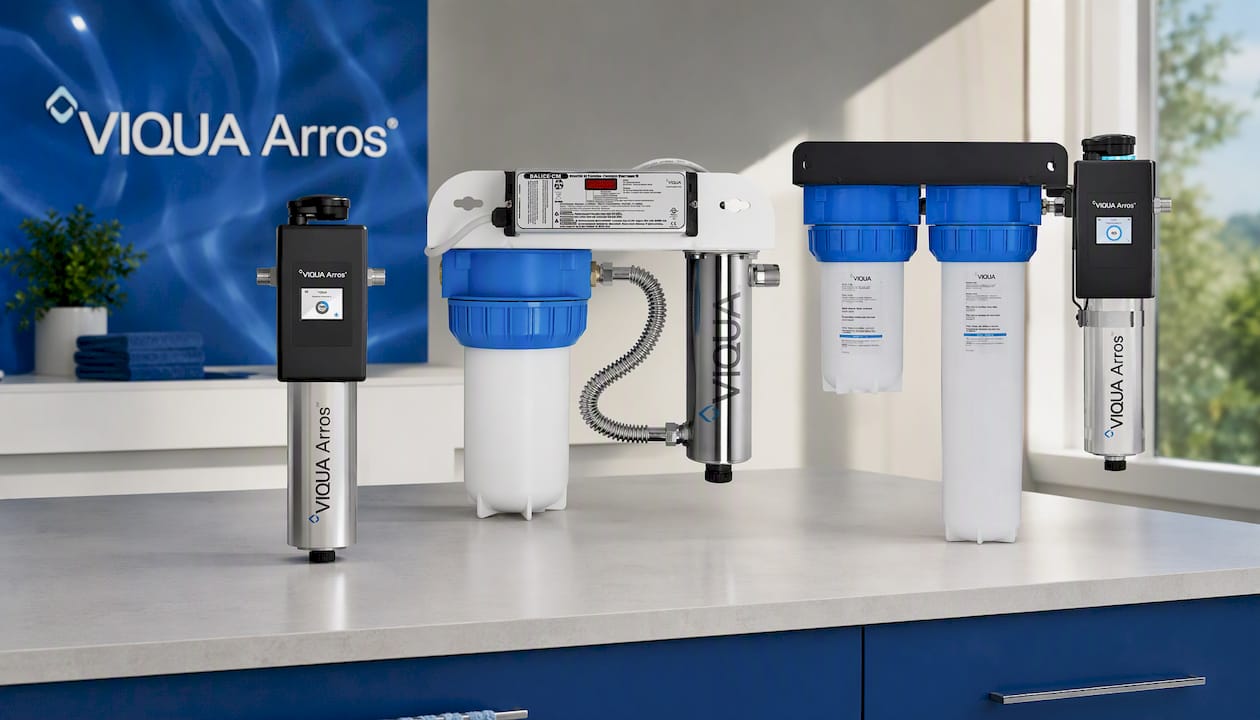
For a typical single-family home, the Viqua Arros 15gpm UV System is the common whole-house pick, sized comfortably for the peak flow most households generate even with multiple fixtures running at once. If your home has a bit more demand or you’re running a larger fixture count, the Viqua VH200F10 UV System is a solid mid-tier option built for standard residential applications. Larger homes, properties with higher simultaneous water use, or homes supplying a secondary suite should look at the Viqua Arros 22gpm UV System, built for higher-capacity peak flow without dropping below validated dose.
None of these choices should happen before testing. Start with a water sample, confirm what pre-treatment (if any) your results call for, and then book installation or order replacement parts through Pure Wave Water’s online store, which ships nationally and services the Georgetown, Halton Hills, Brampton, Milton, and Mississauga area directly.

This article is general information, not a substitute for advice from a qualified doctor. Consult a qualified healthcare professional about your own circumstances before acting on anything here.
Sources

Written by the Pure Wave Water team, who test, install and service water treatment systems across Georgetown and Halton Hills.