

Size a water softener by calculating weekly grain removal: people × 75 gallons a day × hardness in GPG × 7 days. Most households typically need a water softener with a grain capacity in the standard mid-range, though iron and larger families can require a higher capacity. A local test and sizing visit, the kind some water treatment providers offer, removes the guesswork entirely.
TL;DR:
- Most households require a water softener capacity of 32,000 to 40,000 grains based on tested hardness and household size, with larger families or iron-rich water needing higher sizes.
- Iron levels above 2 parts per million should be addressed with a dedicated iron filter before sizing, as iron adds significant load and causes early resin failure.
- Sizing to delivered capacity at an efficient salt setting is more accurate and cost-effective than using the nameplate rating, with a 25% reserve recommended for future growth.
- Peak flow rate must also be considered to ensure water pressure stays adequate when multiple fixtures run simultaneously, often requiring a larger control valve or twin-tank system.
- Regular professional testing that measures all key water chemistry parameters prevents undersizing or oversizing, ensuring optimal regeneration intervals and system longevity.
Table of Contents
- How do you measure your water hardness for sizing?
- How do you calculate your daily softening requirement?
- How do you adjust sizing for iron in the water?
- Delivered capacity vs nameplate: which number should you trust?
- Do you need to check peak flow rate too?
- What happens if you undersize or oversize your softener?
- What should you expect from a professional water test and sizing visit?
- How does daily usage pattern change your sizing math?
- How does household size or business type change the sizing approach?
- Does water temperature affect softener performance and sizing?
- Does system size change your maintenance routine?
- How do you size for future changes in water usage or hardness?
- How do sizing rules differ across softener technologies?
- What does calculator-style sizing get right that bathroom-count rules miss?
- How a water treatment provider can help you get the right size the first time
- Sources
How do you measure your water hardness for sizing?
You can’t size anything without a real number for hardness, and guessing here is where most sizing mistakes start. Water hardness is commonly reported either in grains per gallon (GPG) or parts per million (PPM). To convert PPM to GPG, divide the PPM value by about 17.1, which is the unit used in sizing formulas.
Municipal water reports give you a starting point, but they average results across an entire distribution system. Your tap water, especially from a private well, can run harder or softer than the town average, sometimes by a wide margin.
Your best options for getting an accurate reading:
- A home test kit (strips or a titration kit) for a quick, rough GPG reading
- A certified lab test if you want precision, especially for well water
- A professional in-home test, which also checks for iron, manganese, and pH in one visit
Test for all four: hardness, dissolved iron, manganese, and pH. Iron in particular changes your math, and skipping it is a common reason systems get undersized right out of the gate.
How do you calculate your daily softening requirement?
Once you have a hardness number, the math is straightforward. The standard formula, used by most sizing calculators, is:
- People in the household × gallons per person per day × hardness in GPG = grains removed per day
- Grains per day × 7 = grains removed per week
- Match that weekly figure to a unit’s delivered capacity at your intended salt setting
The default usage figure is 75 gallons per person per day (gppd), which covers typical showering, laundry, and dishwashing. If your household runs a lawn irrigation line through the softener, does frequent large laundry loads, or has teenagers who shower twice a day, bump that to 80 or even 85 gppd.
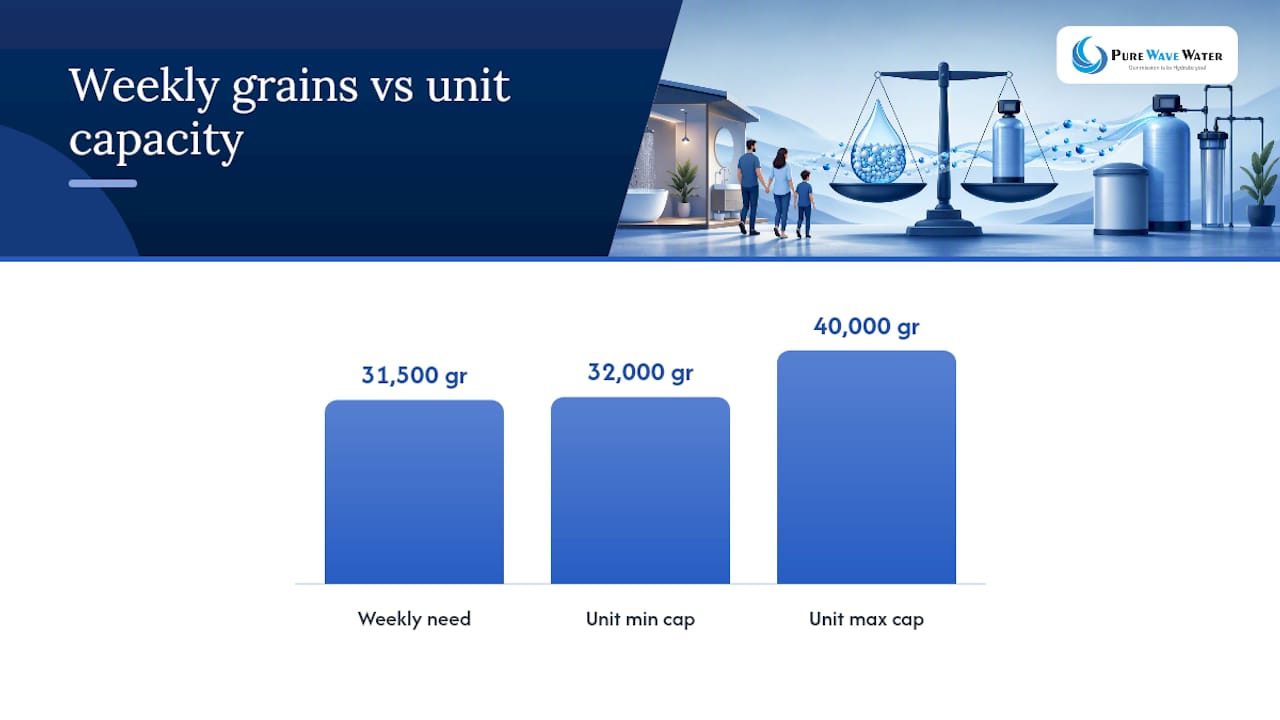
Here’s a worked example. A family of four with water tested at 15 GPG: 4 people × 75 gallons × 15 GPG = 4,500 grains per day. Multiply by 7 days and you get 31,500 grains per week. That number points you toward a 32,000 to 40,000 grain unit, depending on the salt setting you plan to run and how much reserve you want built in.
How do you adjust sizing for iron in the water?
Iron adds hidden load to a softener that hardness alone won’t show you, and it’s the single most common reason a correctly calculated system still regenerates too often. The practitioner rule used across the industry treats every 1 PPM of dissolved iron as roughly 4 to 5 additional grains per gallon of hardness, a figure you add directly into your sizing formula.
To calculate your compensated hardness:
- Take your measured iron in PPM and multiply by 4 to 5
- Add that number to your measured GPG hardness
- Run the daily and weekly formula again using this new, higher number
So if your water tests at 15 GPG hardness with 1.5 PPM iron, your compensated hardness becomes roughly 15 plus 6 to 7.5, landing around 21 to 22.5 GPG. That’s a meaningfully bigger load than the raw hardness number suggests.
Pro Tip: If your iron reading comes back above about 2 PPM, don’t just size a bigger softener. A dedicated iron filter ahead of the softener protects the resin, and skipping it is a common reason resin beads fail early.
Delivered capacity vs nameplate: which number should you trust?
The grain rating printed on the box is measured under conditions you probably won’t replicate at home. Nameplate ratings come from tests run at heavy salt doses, and delivered capacity at an efficient salt setting can run considerably lower than that headline number.
This creates a real trade-off. A smaller resin tank run at a high salt dose can hit the same delivered capacity as a larger tank run efficiently, but you’ll burn through far more salt every month doing it. Most installers now recommend sizing to delivered capacity at an efficient setting and building in roughly a 25% reserve, rather than sizing off the nameplate number and hoping the reserve takes care of itself.
Practical points to weigh when comparing tank sizes:
- A cubic foot of resin delivers noticeably fewer grains at an efficient salt setting than at a high one
- Sizing to the efficient number costs more upfront in resin volume but saves salt and water for the life of the system
- Sizing to the nameplate number under-delivers in practice and shortens your realistic regeneration interval
Ask any supplier for both figures, efficient and high-salt delivered capacity, before you commit to a tank size.
Do you need to check peak flow rate too?
Grain capacity tells you how much hardness a system can remove before regenerating. It says nothing about whether water pressure holds up when three fixtures run at once, and that’s a separate calculation homeowners routinely skip.
Peak flow, measured in gallons per minute (GPM), is the demand created when a shower, a washing machine, and an outdoor tap all draw water simultaneously. Add up the flow rates on your fixtures’ spec sheets, or ask your installer to estimate peak demand for your home’s fixture count.
- Estimate peak GPM by totalling the simultaneous draw from your busiest realistic scenario
- Match that figure against the control valve’s rated service flow, not just the resin tank’s grain rating
- For larger homes, a bigger valve or a twin-tank setup may be necessary even when the grain capacity itself looks perfectly adequate
A softener with plenty of grain capacity but an undersized valve still drops pressure the moment two people shower back to back.
What happens if you undersize or oversize your softener?
A regeneration interval of five to eight days, with seven as the common target, keeps resin working efficiently without wasting salt or water. Stray too far outside that window in either direction and you run into predictable problems.
Undersizing forces frequent regeneration, which wastes salt and water and shortens resin life over time. Oversizing creates its own issues:
- Channeling, where water finds a path through underused resin instead of contacting the full bed
- Stagnant water sitting in an oversized tank between infrequent cycles
- Iron and organics fouling resin that isn’t regenerating often enough to stay clean
A useful red flag: if your calculated achievable regeneration interval exceeds roughly 14 days, the system is very likely oversized for your actual load, even if the grain number on the label looks impressive.
What should you expect from a professional water test and sizing visit?
A DIY test kit gets you close. A professional visit gets you precise, and it catches variables a strip test simply can’t measure. Pure Wave Water offers in-home water testing and expert recommendations covering filtration, softeners, UV disinfection, reverse osmosis, and well water treatment, alongside installation and ongoing service.
A typical sizing visit measures hardness, iron, manganese, and pH directly at your tap rather than relying on a municipal average, then runs the same grains-per-week formula covered above using your household’s real numbers. You walk away with a written recommendation instead of a guess.
Some water treatment providers serve local areas with in-person testing and installation, and also ship water treatment products nationally through online stores…
How does daily usage pattern change your sizing math?
Average daily usage and peak usage are two different numbers, and sizing off the wrong one causes real problems. The 75 gppd figure in the standard formula assumes fairly even usage spread across the week. Real households don’t work that way.
Laundry day often means three loads back to back. Weekend mornings stack multiple showers into a tight window. Garden irrigation, if it’s plumbed through your softener, can spike usage dramatically for a few hours and then disappear for days. Households with this kind of intermittent heavy use benefit from running the calculator with an elevated gallons-per-person figure, closer to 85 gppd, rather than the flat default.
The risk of ignoring usage patterns isn’t catastrophic failure. It’s a system that regenerates mid-week instead of on a clean seven-day schedule, which quietly burns through more salt and water than a household expecting a weekly cycle would anticipate. If your utility bills show usage spikes on specific days, that’s more useful data than any per-person estimate.

Consider also what happens when a system is away from full-time use. A cottage that sits empty for stretches, then hosts a full house for a weekend, has usage patterns nothing like a full-time residence and needs sizing built around the peak weekend, not the empty weekdays.
How does household size or business type change the sizing approach?
A two-person condo and a six-person farmhouse aren’t just different by a multiplier in the formula. They face genuinely different constraints. Smaller households often have physical space limitations that push them toward a compact tank, which then requires an efficient salt setting to hit the delivered capacity they need. Larger families frequently benefit from bigger resin volume simply because the math scales linearly, four extra grains per gallon per person adds up fast across a week.
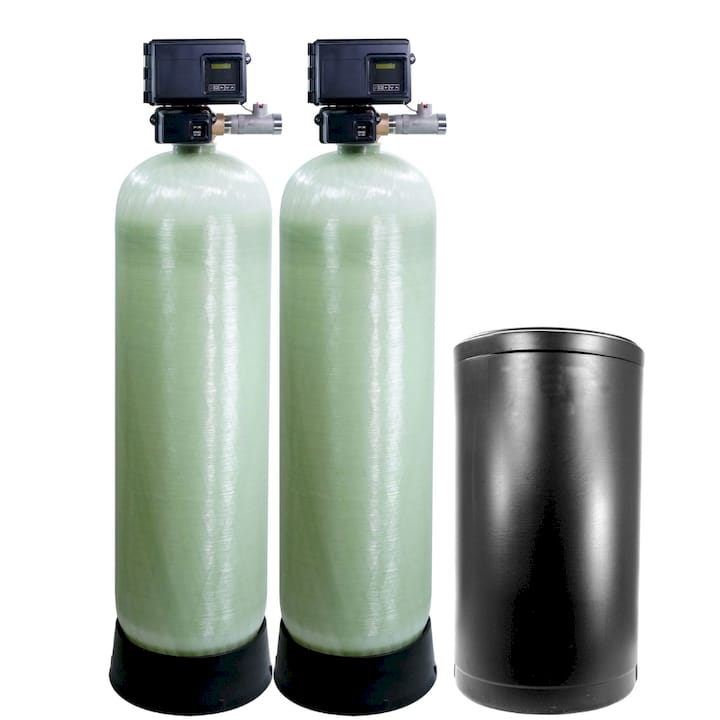
Commercial applications introduce an entirely different scale of demand. A small office with a kitchenette has softening needs closer to a large household. A restaurant, laundromat, or small manufacturing facility can push daily usage into thousands of gallons, and that volume calls for duplex systems that alternate between two tanks so one can regenerate while the other stays in service. Commercial water softener sizing also has to account for usage that doesn’t pause for regeneration, unlike a home where nobody minds if the softener cycles at 2 a.m.
Rental properties and multi-unit buildings sit somewhere in between. Occupancy changes, and a system sized for the current tenant might be badly matched for the next one. Sizing with a built-in reserve matters more here than in a single-family home where usage stays fairly predictable year over year.
Does water temperature affect softener performance and sizing?
Cold water slows the ion-exchange reaction inside a softener’s resin bed, which means the same volume of cold water can leave slightly more hardness behind than the equivalent volume of warm water passing through the same resin. This is a smaller factor than hardness level or daily volume, but it matters in specific situations.
Homes fed by well water in colder climates, or systems installed in an unheated basement or garage, run cooler year round and may need a modest reserve built in to compensate. Winter is also when a poorly insulated system faces the added risk of temperature swings affecting resin performance and system components.
For most households, this isn’t a factor that changes which size band you land in. It’s more relevant as a reason to keep your reserve at the recommended level rather than sizing exactly to the calculated minimum. A system sized with no buffer at all is more exposed to any variable that reduces efficiency, temperature included.
Does system size change your maintenance routine?
Bigger systems don’t necessarily mean more maintenance, but they do mean different maintenance math. A larger resin tank sized correctly to delivered capacity should regenerate on a predictable seven-day cycle, which makes salt refills and resin checks easy to schedule around.
An undersized system regenerating every three or four days burns through salt noticeably faster, meaning more frequent trips to top up the brine tank. An oversized system swings the other way: infrequent regeneration means salt sits in the brine tank longer, and stagnant water sitting in underused resin creates conditions where iron and organic buildup accumulate between cycles.
Either extreme adds maintenance friction that a correctly sized system, running on a clean seven-day interval, avoids. Checking salt levels every two to four weeks and confirming the brine tank isn’t bridging or mushing over are good habits regardless of size, but a well sized system makes that check predictable instead of reactive.
How do you size for future changes in water usage or hardness?
Household water usage rarely stays flat for the full life of a softener, which typically runs 10 to 15 years or longer. A young family adding kids, a home addition with new bathrooms, or a well that shifts in hardness after a dry season are all realistic scenarios worth building room for.
Sizing with a 25% reserve, rather than sizing to the exact calculated minimum, gives you headroom to absorb moderate increases in household size or hardness without needing to replace the system early. If you know a change is coming soon, a bathroom renovation adding a second shower, for example, size for the household you’ll have in two years, not just the one you have today.
Retesting your water every few years is worth doing even if nothing seems to have changed, since well water hardness and iron content can drift over time in ways municipal water rarely does. A system that was correctly sized five years ago may be working harder than it should if your water chemistry has shifted since.
How do sizing rules differ across softener technologies?
Salt-based ion-exchange softeners are what the entire sizing formula in this guide is built around, and they remain the most predictable option to size because delivered capacity, salt dose, and regeneration interval are all well documented across manufacturers and calculators.
Dual-tank or duplex systems change the sizing conversation for larger households and commercial sites. Instead of sizing one tank to cover peak weekly demand, you size two tanks that alternate, which means each individual tank can be smaller while the household or business never goes without softened water during a regeneration cycle. This is the logic behind duplex commercial units built for higher, continuous demand.
Salt-free conditioners and other non-exchange technologies work on a fundamentally different mechanism and don’t use the grains-per-week formula at all, since they don’t remove hardness minerals the way ion exchange does. If you’re comparing a traditional softener against one of these alternatives, you’re really comparing two different jobs, not two sizes of the same job, and the calculator-style sizing in this guide applies specifically to ion-exchange systems.
What does calculator-style sizing get right that bathroom-count rules miss?
The old rule of thumb, one grain capacity size per bathroom or per person, was never wrong exactly. It was just built for an era before accurate home water testing was affordable and easy to access. That rule ignores iron entirely, treats a 10 GPG household the same as a 25 GPG household, and says nothing about the difference between a nameplate grain rating and what a system actually delivers at the salt setting you run.
What the calculator-style approach gets right is forcing every input to come from measurement rather than assumption. Test your hardness. Test your iron. Use your actual household size and a realistic gallons-per-person figure instead of a generic default. Then size to delivered capacity, not the number printed on the box, with a sensible reserve built in.
Where I’d push back on conventional advice: most guides treat the 75 gppd default as gospel, when it’s really a starting point that needs adjusting for irrigation, large families, or heavy laundry habits. And most guides underweight iron compensation, treating it as an afterthought rather than a number that can shift your required size by an entire band. Get the water tested properly first. Everything downstream of that test, the formula, the salt setting, the reserve, is just arithmetic.
— PureWaveWater
How a water treatment provider can help you get the right size the first time
Running the formula yourself gets you close. A measured test and a written recommendation gets you exact, helping households and businesses avoid guesswork on equipment that runs for over a decade. For larger households or homes with elevated iron, the 75K Progressive Duplex Water Softener covers high grain loads without sacrificing a seven-day regeneration target. Commercial sites with continuous demand, restaurants, small manufacturing, multi-unit buildings, are better matched to the Excalibur Duplex 300K Commercial Water Softener with its metered, quick-connect setup built for high-volume use. Once your system is sized and running, keeping it stocked with a consistent, high-purity salt like Windsor Pure Natural Water Softener Salt protects resin life and keeps regeneration performance steady.
If you’d rather skip the manual calculation entirely, book an in-home water test with Pure Wave Water, serving Georgetown, Halton Hills, Brampton, Milton, Mississauga, and the surrounding area, or order salt and parts directly through the online store for delivery across Canada. A written sizing and installation quote takes the guesswork out of a decision you’ll live with for years.
Sources

Written by the Pure Wave Water team, who test, install and service water treatment systems across Georgetown and Halton Hills.