

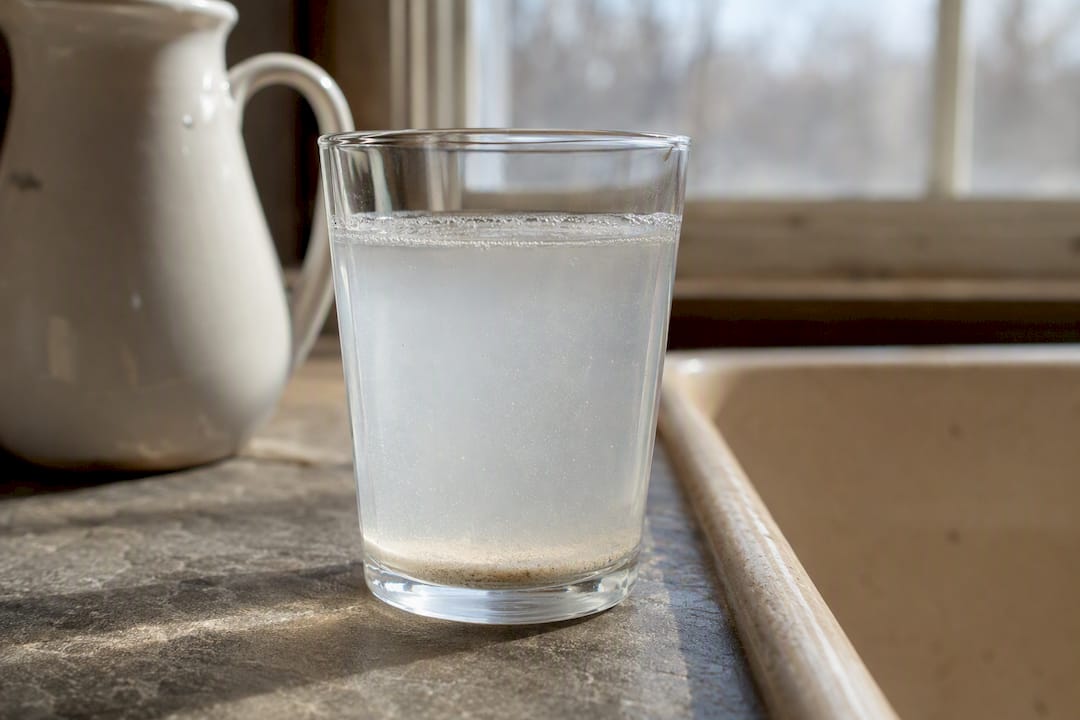
Most cloudy tap water is harmless air, and a simple glass test proves it in under a minute. Fill a clear glass, set it on the counter, and watch. If the haze clears from the bottom up within a few minutes, that’s dissolved air escaping, not a safety problem. If it doesn’t clear, or you see settling particles, work through the diagnostics and testing steps below before you assume the worst.
TL;DR:
- Cloudy tap water caused by trapped air typically clears from the bottom within two to five minutes and presents no health risk.
- Persistent cloudiness, sediment, or discolouration requires lab testing to determine whether minerals, bacteria, or other contaminants are present.
- Flushing the tap, cleaning the aerator, and replacing filters usually resolve aeration issues, but continued problems may need targeted filtration or microbial treatment.
- Well owners should inspect their pressure tank and consider testing for gases, iron, or manganese if cloudiness persists after flushing and aeration checks.
- Most cases do not require treatment for safety, but if cloudiness lasts longer than a day, it warrants further testing and professional assessment.
Table of Contents
- Why is my tap water cloudy? The main causes explained
- How to check the cause at home
- Is cloudy tap water safe to drink or shower in?
- Well water and rural-specific causes
- Fixing cloudy tap water: short-term and long-term solutions
- When to test your water and who to call
- How Purewavewater diagnoses and solves cloudy-water problems
- What most homeowners skip before calling for help
- Ready to test your water and stop guessing?
- Sources
- FAQ
Why is my tap water cloudy? The main causes explained
Cloudy tap water almost always comes down to one of four things: trapped air, temperature or pressure shifts, minerals and sediment, or something happening in your own plumbing. Sorting out which one applies to you starts with understanding how each behaves.
Aeration is by far the most common culprit. Water leaves the treatment plant or your well under pressure, with more air dissolved into it than it can hold once that pressure drops. When it reaches your tap, that trapped air comes out of solution as thousands of microscopic bubbles, giving the water a milky, uniform white appearance. This is the same principle as opening a bottle of pop. The U.S. Geological Survey identifies this as the leading cause of milky tap water, and it’s physically harmless.
Temperature plays a bigger role than most homeowners expect. Cold water holds more dissolved gas than warm water, so cloudiness tends to spike in winter or right after a cold snap, then fade as temperatures climb. High water pressure and thermal shifts, particularly after a municipal main is flushed or repaired, produce the same visual effect.
Mineral and sediment cloudiness behaves differently from aeration, and that distinction matters for your next move:
- Aeration: clears bottom to top, disappears within a few minutes, leaves no residue.
- Mineral or sediment cloudiness: may linger, often settles top to bottom, and can leave a fine layer at the bottom of the glass.
- Discoloured cloudiness (yellow, brown, orange): usually points to iron, manganese, or disturbed sediment rather than air.
Plumbing itself can also be the source. A clogged or scaled aerator on the faucet spout traps air and sediment, a recently drained and refilled water heater pushes trapped air through the hot line, and any nearby plumbing repair can knock loose sediment that had been sitting undisturbed in older pipes for years.
How to check the cause at home
Before you call anyone, spend five minutes running a few basic checks. This is the same first pass a technician would walk you through over the phone, and it usually points you straight to the answer.
- Fill a clear glass from the cold tap and set it on a dark surface where you can watch it closely.
- Watch the clearing pattern. Cloudiness that disappears from the bottom of the glass upward, within two to five minutes, is almost always trapped air.
- Check for residue. If the water stays hazy, or clears from the top down and leaves particles at the bottom, you’re likely looking at sediment or minerals.
- Test multiple taps, both hot and cold, plus an outside spigot if you have one. Cloudiness at every tap suggests a supply-side or well-side issue; cloudiness at just one tap points to that fixture.
- Remove the aerator from the affected faucet and run the water again. If the cloudiness disappears, the aerator itself was trapping air or debris.
- Note any smell or taste change. Aeration has no odour. A metallic, musty, or rotten-egg smell means you should stop testing and escalate to a professional right away.
Pro Tip: Photograph the glass at the one-minute and five-minute marks, and jot down which taps are affected and what time of day it happens. That timestamped record turns a “my water looks weird sometimes” call into a five-minute diagnosis for whoever tests it.
Is cloudy tap water safe to drink or shower in?
When the cause is aeration, cloudy tap water is safe to drink, cook with, and shower in. Utility guidance across North America and the UK consistently backs this up. United Utilities, for instance, states plainly that air-related cloudiness is temporary and poses no health risk, and that guidance mirrors what municipal suppliers here tell customers.
That said, a few signs should change your calculus:
- Cloudiness that persists more than a day or reappears constantly at the same tap.
- Visible particles, grit, or discolouration that doesn’t clear at all.
- Any unusual smell or taste alongside the haze.
- A positive result on a bacterial or coliform test.
Until you’ve confirmed the cause, it’s reasonable to run the tap for 30 seconds before drinking and to avoid using visibly gritty water for infant formula. Worth knowing too: even water that looks perfectly clear can carry particles you can’t see. A global analysis published in PLOS ONE found synthetic fibres in 81% of 159 tap water samples tested worldwide, averaging 5.45 particles per litre. Visual clarity and microscopic purity aren’t the same thing.
Well water and rural-specific causes
Private well owners deal with a few causes that municipal customers rarely see. Air, methane, or other naturally occurring gases can enter well water and create cloudiness or a foaming effect at the tap, especially right after heavy rainfall raises the water table. Sediment, iron, and manganese also get stirred up more easily in a well system than in a municipal main, particularly after the pump has been running hard or a storm has pushed groundwater levels around.
Your pressure tank and pump matter here too. A failing bladder in the pressure tank, or a pump drawing air, introduces bubbles directly into your supply line, and that shows up as cloudy water at every fixture in the house.
If you’re on a well and seeing persistent cloudiness:
- Shut off the pump before inspecting the pressure tank or wellhead, and never open a sealed tank under pressure.
- Check for recent heavy rain, nearby drilling, or pump servicing that lines up with when the cloudiness started.
- Watch for foaming or a rotten-egg smell, both of which point to gas rather than simple air.
- Request a lab analysis for iron, manganese, turbidity, and bacteria rather than guessing from appearance alone.
Fixing cloudy tap water: short-term and long-term solutions
Start with the free fixes. Run the cold tap for a minute to flush trapped air out of the line, especially after any plumbing work or a period the house sat unused. Unscrew and clean the faucet aerator with a soft brush and vinegar to clear mineral buildup. If your water heater was recently drained or is new, flush it according to the manufacturer’s instructions to purge air pockets. Check your pressure tank’s air charge if you’re on a well, since a tank running low on air pushes extra bubbles into your plumbing.
If those steps don’t resolve it, the right next move depends on what’s actually in the water:
- Trapped air with no other symptoms: usually resolves on its own; no filtration needed.
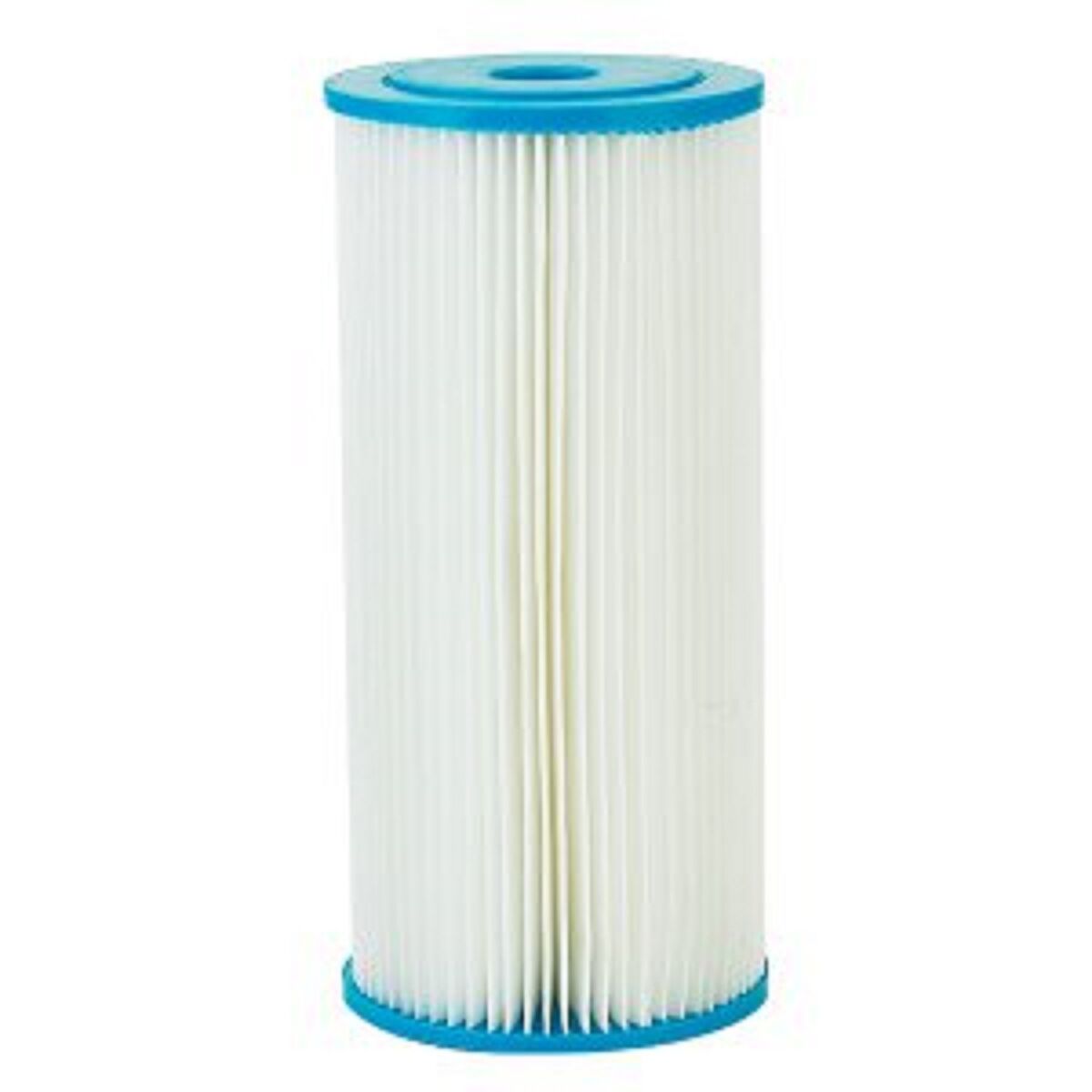
- Sediment or grit: a point-of-use sediment prefilter on the main line catches particles before they reach your fixtures.
- Iron or manganese staining: targeted filtration or a water softener is generally the recommended path, though a lab test should confirm the mineral levels first.
- Hardness contributing to scale and cloudiness: a whole-home water softener addresses this at the source rather than fixture by fixture.
- Microbial concerns (well water especially): UV disinfection treats bacteria and other organisms without adding chemicals.
- Fine particles or dissolved solids you want removed altogether: a reverse osmosis system at the drinking-water tap is the most thorough option, and studies of full-scale treatment systems show removal efficiencies for microplastic mass as high as 97 to 98% at the treatment-plant level, with only low residual concentrations reaching the household tap.
Pro Tip: Match the fix to the symptom, not the other way around. A sediment prefilter won’t touch dissolved iron, and a softener won’t fix trapped air. Test first, then treat.
Maintenance keeps whichever system you choose working the way it’s supposed to. Replace sediment and carbon cartridges on the schedule printed on the housing, typically every three to six months depending on your water volume. Check reverse osmosis membranes annually, since a membrane that’s fouled loses efficiency gradually rather than failing outright. If you run a UV system, replace the lamp yearly regardless of how it looks, since UV output drops well before the bulb visibly dims. And retest your water annually if you’re on a well, since groundwater conditions shift with the seasons and with nearby land use.
When to test your water and who to call
A glass test tells you a lot, but it can’t rule out bacteria, dissolved metals, or gases. When cloudiness persists past a day, recurs often, or comes with any odour, it’s time for a proper lab test rather than more guessing.
Ask a certified lab for a panel covering:
- Turbidity (the actual measurement behind “cloudy,” expressed in NTU)
- Total coliform and E. coli bacteria
- Iron and manganese concentrations
- Total dissolved solids (TDS)
- A methane or dissolved-gas screen, if you’re on a well and noticed foaming
If you’re on municipal water, your local water supplier is required to answer questions about supply-wide issues and often has records of recent flushing or main breaks in your area. If you’re on a private well, that responsibility falls entirely on you, and a certified independent tester or local water treatment technician is the right call.
Before booking a technician, put together a short packet: timestamped photos of the glass test, which taps are affected, whether hot or cold or both, and any smell or taste notes. That packet usually cuts an in-home visit down by half, since the technician isn’t starting from zero.
How Purewavewater diagnoses and solves cloudy-water problems
Free in-store water testing for hardness, iron, and other common quality concerns is available, which means you don’t have to guess before you spend money on a fix. Bring in a sample, and the test result tells you whether you’re dealing with sediment, minerals, hardness, or something that needs a closer look.
From there, the recommendation follows the diagnosis rather than the other way around. Sediment prefilters handle particles and grit. Viqua UV systems address microbial concerns, especially for well water. Reverse osmosis membranes tackle dissolved solids and fine particulates at the drinking-water tap, and whole-home softeners deal with hardness at the source. The typical path is test, get a recommendation matched to what’s actually in your water, then install with cartridge and membrane replacement scheduled going forward.
What most homeowners skip before calling for help
The glass test takes sixty seconds, yet most people skip it and go straight to worrying. Checking more than one tap, hot and cold, catches the difference between a single clogged aerator and a whole-house issue. A timestamped photo, taken before you pick up the phone, tells a technician more than a verbal description ever will. If you’re within reach of a free in-store test, use it before assuming you need a full system.
— CloudSprout16
Ready to test your water and stop guessing?
If your glass test didn’t clear, or you’re seeing sediment, staining, or a smell that shouldn’t be there, the fastest path forward is a free in-store water test at Purewavewater rather than buying equipment on a hunch. A quick sample tells you whether you’re dealing with hardness, iron, sediment, or something microbial, and the recommendation that follows is sized to your actual water, not a generic worst-case fix.
For well owners dealing with microbial risk or gas-related cloudiness, the Viqua VH200F10 UV System covers smaller households, while the Viqua VH410F20 handles higher-flow homes. If sediment is the issue, the UV Dynamics Mini Rack combines prefiltration with disinfection in one unit. For dissolved solids and fine particulates, the Hydrotech R/O Membrane fits most under-sink reverse osmosis systems, and if hardness is contributing to your scale and cloudiness, Windsor Pure Natural Water Softener Salt keeps a softener running properly.
Bring a sample into a Purewavewater location for a free test, book a technician visit for an on-site diagnosis, or order replacement filters, membranes, and salt directly through the Purewavewater shop if you already know what your system needs.
Sources
For deeper reading on cloudy water, the USGS Water Science School explains the aeration process in detail, and the PMC review on microplastics covers treatment-plant removal rates. Contact your municipal utility or a certified local lab for site-specific testing.
- Water Q&A: Why is my drinking water cloudy? | U.S. Geological Survey
- PLOS ONE: Synthetic particles in tap water (2018)
- Study: MPs in drinking water system from source to tap (Springer, 2025)
FAQ
Is cloudy water from a tap safe to drink?
Yes, when the cause is trapped air, which clears from the bottom of a glass within a few minutes and carries no health risk according to the USGS. Persistent cloudiness, sediment, or odour changes warrant testing.
Can I shower in cloudy water?
Showering in air-related cloudy water is safe, since the bubbles causing the haze have no effect on skin or health. If the water smells unusual or leaves visible residue, hold off until you’ve identified the cause.
How do I fix cloudy well water?
Start by checking your pressure tank’s air charge and inspecting for recent pump work, heavy rain, or nearby drilling, then run a lab test for iron, manganese, turbidity, and gas if the cloudiness persists. A sediment filter, UV system, or softener typically follows once the test confirms what’s actually in the water.
How do I clear up cloudy tap water?
Run the cold tap for about a minute to flush trapped air, then clean or replace the faucet aerator if the haze returns at just one fixture. If cloudiness persists across multiple taps or leaves sediment behind, a point-of-use filter or a free in-store water test will confirm whether you need sediment filtration, a softener, or another targeted fix.

Written by the Pure Wave Water team, who test, install and service water treatment systems across Georgetown and Halton Hills.