
If your toilet tank has a red or orange slime on the walls, your water has a swampy smell, or your iron filter keeps fouling, iron bacteria are a likely cause. They are mainly a nuisance. They foul equipment and feed sulphur smell, and by themselves they are not considered a health hazard. They are also stubborn. The usual fix is to shock chlorinate the well, then keep them in check with an air-injection oxidation filter and periodic re-shocking. This guide is for well owners in Halton Hills, Caledon and Erin, and it explains each step.
TL;DR
- Iron bacteria are not the same as dissolved iron or coliform bacteria. They leave red or orange slime and a swampy smell, and they clog filters and softeners.
- They are generally a nuisance rather than a disease risk, but you should still test your well for E. coli and total coliforms on Health Canada’s schedule.
- Shock chlorination knocks them back but rarely removes them for good. Plan on repeating it, and on ongoing control with an air-injection oxidation filter.
- UV does not remove slime that is already in your pipes.
- Bring a photo of the slime and a water sample to our Georgetown store and we will test it for free.
Table of Contents
- What iron bacteria are, and what they are not
- Signs you have iron bacteria
- How iron bacteria get into a well
- Is it safe to drink?
- Shock chlorination: how it works
- Why iron bacteria come back
- Long-term control: oxidation filtration plus a re-shock schedule
- What to do this week
- Our perspective
- Get your well water checked in Georgetown
- FAQ
- Sources
What iron bacteria are, and what they are not
Iron bacteria are naturally occurring microorganisms. They use dissolved iron as an energy source and leave behind slimy red deposits that can coat the well casing, piping and equipment. Alberta Agriculture’s guide describes them as a common nuisance in water wells, and notes that not every iron-staining problem is caused by them.
Three things get confused all the time, and each needs a different fix:
| Problem | What it is | Typical signs | Main treatment |
|---|---|---|---|
| Iron bacteria | Living organisms that feed on iron and build slime | Red or orange slime in toilet tanks, swampy smell, slime clogging filters and softeners | Shock chlorination, then oxidation filtration and periodic re-shocking |
| Dissolved iron | Iron minerals in the groundwater | Clear water that turns orange after standing, rust stains on fixtures and laundry | Iron filtration or, at low levels, a softener (see our guide to iron in water) |
| Coliform bacteria | Indicator bacteria that signal possible contamination | Usually no visible sign at all, only a lab result | Find the source, boil, shock and retest (see coliform in well water) |
Iron bacteria can live in a well that has no dissolved-iron complaint at all, and a well can have plenty of dissolved iron and no bacteria. A lab test for coliform will not tell you whether you have iron bacteria, and slime in the toilet tank does not tell you your water is free of coliform. They are separate questions.
Signs you have iron bacteria
Look for several of these together rather than any single one:
- Slime in the toilet tank. Lift the lid. A red, orange or rusty-brown slimy film on the walls, not just a gritty rust powder, is the classic clue. The Florida Department of Health lists red, slimy growth in a toilet tank as one pointer.
- A swampy, musty or oily smell. It may be a little like cucumber or rotting vegetation, and it is often stronger after the water has sat unused.
- Slime clogging your equipment. Check the sediment filter housing, the softener’s resin and brine tank, aerators and showerheads. Slime that keeps returning after you clean it is a strong sign.
- Rusty stains and an oily sheen. Some wells show a rainbow film on standing water.
- Falling flow. Slime can build up in the well screen, pump and pipes and reduce output over time.
The same sheet warns that these signs can also come from sulfate, hydrogen sulfide, manganese, pipe corrosion or sulfur bacteria. That is why a photo and a test matter more than guessing. If the rotten-egg smell is the dominant complaint, our page on sulphur smell in water walks through how to isolate it. Iron bacteria can feed that smell too, which is one reason the two often show up together.
How iron bacteria get into a well
They may occur naturally in groundwater, but they are more often introduced during well construction or maintenance, through contaminated components, drilling water or equipment, or poor construction. Researchers also believe that drilling a well can change the subsurface environment in a way that boosts the activity of bacteria already in the groundwater.
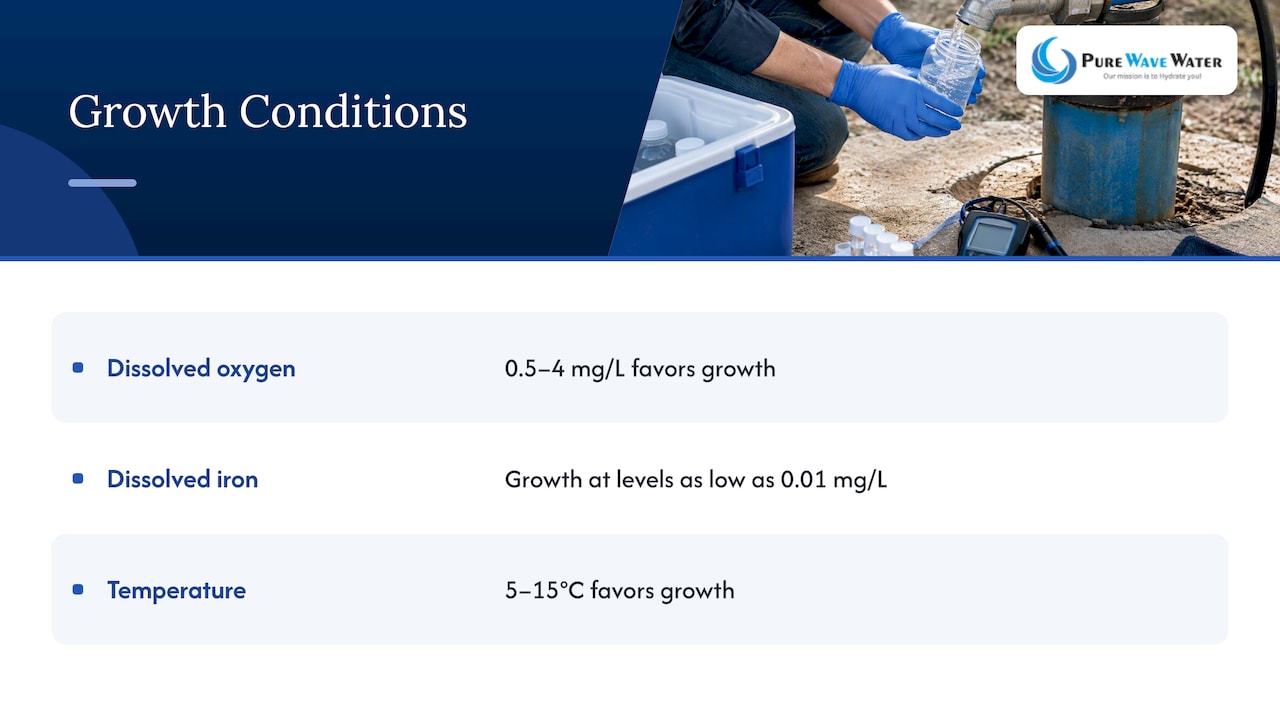
Once inside, they thrive where conditions suit them. Alberta Agriculture reports growth is favoured by low dissolved oxygen (0.5 to 4 mg/L), dissolved iron at concentrations as low as 0.01 mg/L, and temperatures between 5 and 15°C, which is a fair description of many groundwater wells. Southern Ontario wells with iron-bearing water are therefore a natural fit. This also explains why a well can run clean for years and then develop a problem after a pump replacement, a new pressure tank or any work that opens the system. Ask whoever works on your well whether they disinfect their equipment first. Sanitizing drilling equipment between job sites is one of the main preventive practices.
Is it safe to drink?
Iron bacteria are not considered a health hazard, which is why they are treated as a nuisance. That does not mean you can ignore your well’s water quality. Private well owners in Canada are responsible for monitoring their own water. Health Canada recommends testing for general water quality parameters, including iron, every 2 years, and for microbial indicators (E. coli and total coliforms) every 6 months. Your public health unit can point you to an accredited laboratory.
Slime and staining can also hide a different problem. Cloudy, brown or rusty water has several possible causes, and a step-by-step approach to diagnosing brown tap water helps you rule out plumbing causes before you blame the well. If a lab result ever shows E. coli, treat that as a separate and more serious issue and follow the steps for coliform.
Shock chlorination: how it works
Shock chlorination adds concentrated chlorine to the water in the well casing. Some of it moves into the surrounding aquifer. The chlorinated water is then run through the whole plumbing system and left to sit for a set time before it is flushed out. Alberta Health Services says the water should only be drunk after flushing, and after a sample taken at least 7 days later shows no bacteria.
The broad sequence looks like this:
- Plan ahead. Chlorinated water is not for drinking, cooking or laundry while the treatment runs. Arrange alternative water, and expect to be without normal use of your taps for a day or so.
- Prepare the system. Bypass or isolate carbon filters, softeners, and any water treatment equipment that chlorine could damage, and follow each manufacturer’s guidance. Chlorine also reacts with some media.
- Dose the well. The amount depends on the well’s depth, diameter and water volume. This is where a calculation error causes trouble, so it is a good job for a licensed well contractor or a technician who does it regularly.
- Circulate and distribute. The chlorinated water is run through every tap, hot and cold, until you smell chlorine, then left to stand for the contact time in your guidance.
- Flush responsibly. Discharge the water away from septic beds, streams and gardens, and keep chlorine out of your septic system as far as you can.
- Retest. Wait and sample as the guidance says before drinking.
One point from the Alberta guidance is worth noting: if biofilm is making chlorine less effective, a licensed well driller may need to scrub it away before chlorination. A heavy slime layer shields the organisms beneath it, which is why one treatment sometimes disappoints.
Why iron bacteria come back
Shock chlorination does not always work. If the source is never found or fixed, the well can be contaminated again. Even when it works, the same Alberta Agriculture guide says it does not completely eliminate iron bacteria but can hold them in check, and suggests repeating the procedure each spring and fall for control.
There are three practical reasons for recurrence:
- The bacteria are native to the aquifer or are still living in the formation around the well, so chlorine only reaches part of them.
- Biofilm in old pipes and the pressure tank protects survivors.
- The conditions that favour them, dissolved iron and low oxygen, have not changed.
That last point is the key to long-term control. Chlorine is a reset. It does not alter the water chemistry.
Long-term control: oxidation filtration plus a re-shock schedule
For most wells, the dependable approach is a two-part plan.
1. Shock the well, then re-shock on a schedule. Spring and fall is the commonly cited pattern. Some owners find they can stretch it out, and others need it more often. Watch the toilet tank and filter housings. Slime coming back is your signal.
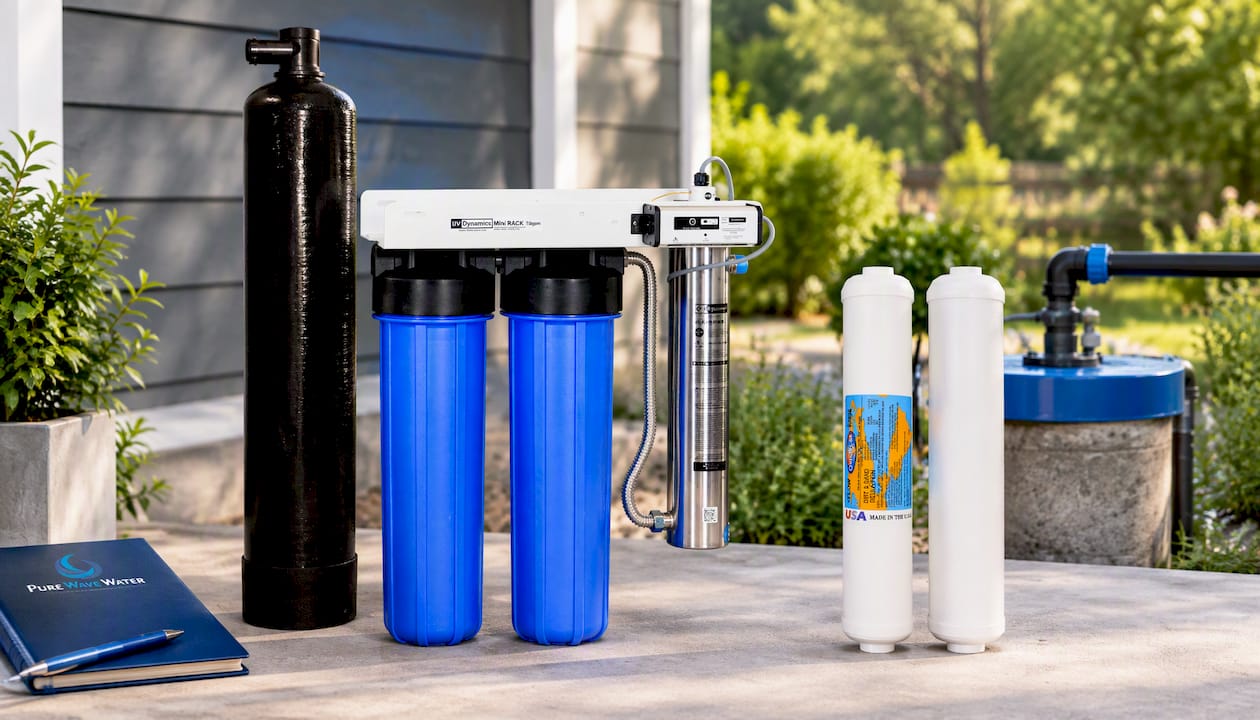
2. Oxidize and filter the iron. An air-injection oxidation filter draws air into the top of a tank, which converts dissolved iron (and manganese and hydrogen sulphide) into solid particles that the media bed traps and backwashes to drain. It removes the food supply that feeds the bacteria downstream of the filter, protects your softener and fixtures, and cuts the sulphur smell. We stock the Zentec Superior Air Injection hybrid capsulate filter for iron, sulphur and manganese, which is an in-stock option for exactly this job.
Two cautions apply:
- An oxidation filter is not a disinfectant. It treats the iron, not the organisms in the well, so it works alongside shock chlorination, not in place of it.
- A filter needs enough backwash flow and a drain, so the well’s yield and your plumbing need to be checked first. We confirm this before recommending a system.
If slime tends to foul your existing softener, treat the iron before the softener, not after. A softener is built for hardness, and heavy iron or slime will coat the resin. If you are weighing both, our Ontario water softener cost guide explains why testing first prevents buying the wrong equipment.
Why UV is not the answer to slime
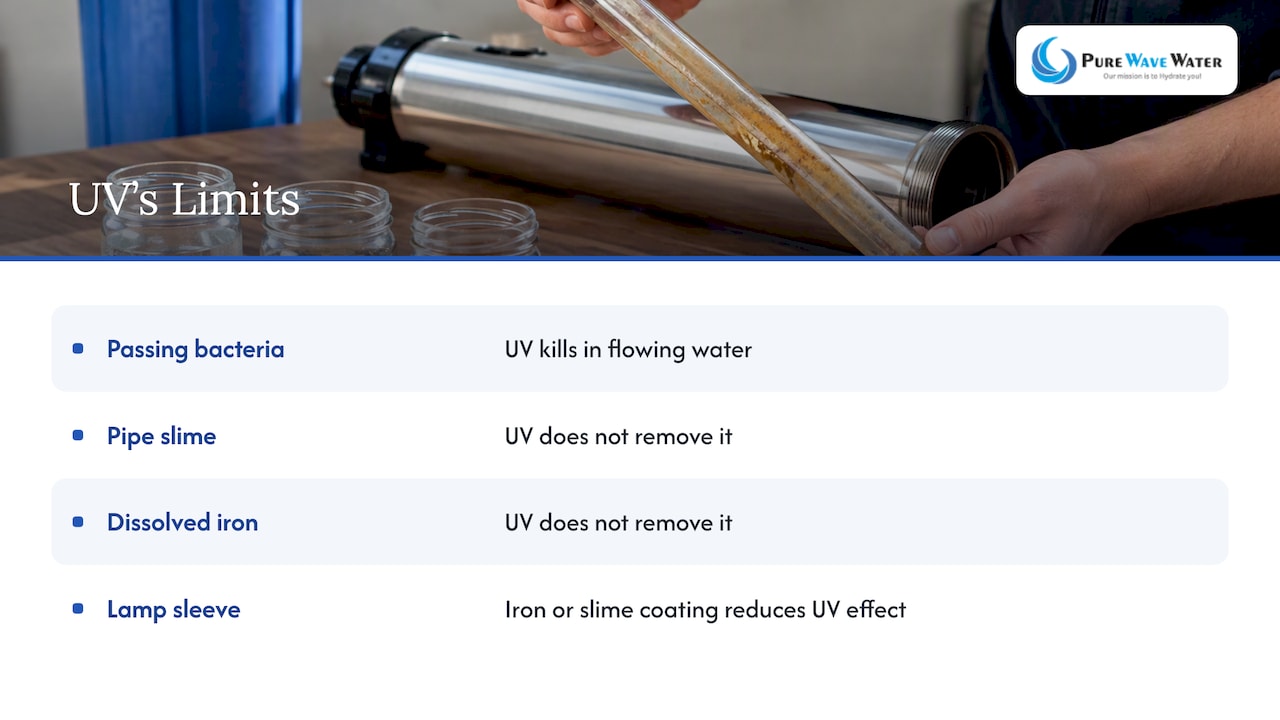
UV is a good tool for killing bacteria in the water passing through it. But light travels in a straight line, and anything it cannot reach stays untreated. UV does not remove slime that is already in your pipes, and it does not remove dissolved iron. Iron and slime can also cloud or coat the lamp sleeve and reduce its effect. So UV can be a sensible final barrier after the well is shocked and the iron is removed, if your test results call for it, but it is not a cure for iron bacteria.
What to do this week
A simple order of operations saves money:
- Take a photo of the slime in the toilet tank, filter housing or softener brine tank.
- Collect a water sample. If you want a lab result for coliform, use an accredited lab’s bottle and instructions, since they are specific about sampling.
- Have the water tested for hardness, iron and other concerns. We do this free in store.
- Decide on the order: shock the well, retest, then install or service the iron filter.
- Put the spring and fall re-shock on your calendar.
Our perspective
We have served Georgetown and the surrounding area since 1995, and the pattern we see most is the same: a homeowner buys equipment for the symptom they can see, whether that is a softener for stains or a carbon filter for smell, and the real cause is something sitting upstream. With iron bacteria, the equipment gets blamed for failing when it is really being coated by slime.
So we start with a test and a conversation. We ask what you see and smell, look at your photo, and test the water. Then we recommend only the treatment you actually need. Sometimes that is only a shock and a filter service. Sometimes it is an air-injection filter. We do not push a bigger system than the water calls for.
We also install and service systems, including most major brands, so a filter that someone else sold you can still be checked, and we give written quotes. If you would like help getting the shock done safely, or setting up consumables for the filter, we are a phone call away.
— CloudSprout16
Get your well water checked in Georgetown
We are Pure Wave Water in Georgetown, Ontario, and we offer free in-store water testing for hardness, iron and other water-quality concerns. Our technicians handle installation, repair and servicing of water treatment systems, and you can browse filters, media, chemicals and test kits in our online shop. If you are in Halton Hills, Caledon or Erin, bring a photo of the slime and a water sample, and we will tell you what we see.
Book or drop in through our free water test page, or call us at 905-702-2700.
FAQ
Are iron bacteria in my well dangerous to drink?
Iron bacteria are not considered a health hazard. They are a nuisance that causes slime, staining and odour. You should still test for E. coli and total coliforms every 6 months, as Health Canada recommends for private wells, because slime does not tell you anything about those.
How often should I shock chlorinate for iron bacteria?
Alberta Agriculture suggests repeating the procedure each spring and fall to hold the bacteria in check. It does not completely eliminate them. If slime returns sooner, or you can go longer between treatments, adjust to what your well does, and add oxidation filtration to improve your odds.
Will a water softener or UV light get rid of iron bacteria?
Neither will. A softener can be fouled by slime and is not designed to remove it. UV treats the water passing through the lamp but cannot clean slime already in your pipes. An air-injection oxidation filter and a shock chlorination routine address the actual problem.
How is iron bacteria different from coliform bacteria?
Iron bacteria feed on iron and make slime, and they are mostly a nuisance. Coliform bacteria are indicators of possible contamination and need a lab test to detect. If a test shows E. coli or coliform, follow our guidance on coliform in well water.
Sources
- Shock Chlorination and Control of Iron Bacteria, Alberta Agriculture
- Iron and Sulfur Bacteria: a Slimy Problem, Penn State Extension
- Iron Bacteria in Wells, Michigan EGLE
- Well water and your health: Test your well water, Health Canada
- Shock chlorinating private wells, Alberta Health Services
- Well water facts: odor and staining, Florida Department of Health
- Diagnose brown tap water checklist
Recommended

Pure Wave Water shares educational content about water treatment, water softeners, reverse osmosis systems, UV purification, and filtration solutions. Our guides help readers understand water quality concerns, explore treatment options, and make informed decisions about their water treatment needs.