PFAS are a large family of long-lasting synthetic chemicals, and Health Canada now has a drinking water objective for them: 30 ng/L for the sum of 25 specific PFAS, set in August 2024. If you are on municipal water in Ontario, your municipality is responsible for monitoring it. If you have a private well, the only way to know what is in your water is to test it through an accredited lab. If a test finds PFAS, a reverse osmosis, activated carbon or ion exchange system designed for PFAS removal can reduce them. Boiling will not.
This guide explains what the numbers mean, what Ontario has said, how to test, and how to choose a treatment system without overbuying. We are Pure Wave Water, a Georgetown water treatment company that has served Halton Hills homes since 1995, so we also say plainly what our free in-store test does and does not cover.
TL;DR
- Health Canada’s objective is 30 ng/L for the sum of 25 PFAS. Ontario’s older interim advice was 70 ng/L for the sum of 11 PFAS.
- Boiling does not remove PFAS. Reverse osmosis, granular activated carbon and anion exchange can, when the system is designed and certified for it.
- Private well owners in Halton Hills, Caledon and Erin need an accredited lab test. PFAS is not part of our free in-store test, but we can help arrange extended lab testing.
- Look for certification that names PFAS reduction on the spec sheet, not just a general “filters contaminants” claim.
Table of Contents
- What PFAS are and why they show up in water
- What Health Canada’s 30 ng/L objective means
- Ontario’s interim advice: 70 ng/L for 11 PFAS
- What PFAS in water can do to health
- How to find out if your water has PFAS
- What removes PFAS, and what does not
- Does reverse osmosis remove PFAS?
- Will a Brita filter remove PFAS?
- Special situations: infants, pregnancy and breastfeeding
- A step-by-step plan for Ontario homeowners
- Our perspective
- Reverse osmosis from Pure Wave Water
- FAQ
- Sources
What PFAS are and why they show up in water
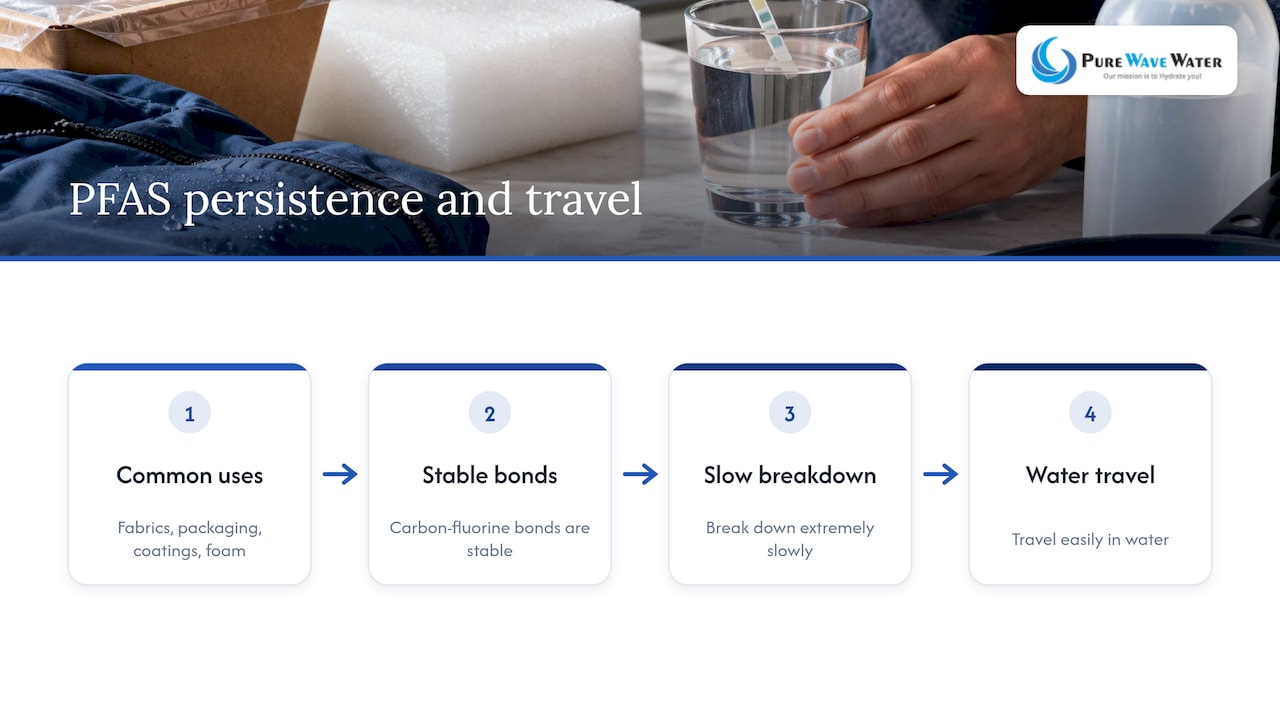
Per- and polyfluoroalkyl substances (PFAS) are man-made compounds used for decades in non-stick coatings, stain-resistant fabrics, food packaging and firefighting foam. Their carbon-fluorine bonds are very stable, which is why they are nicknamed “forever chemicals”. They break down extremely slowly and travel easily in water.
Ontario’s environment ministry describes PFOS and PFOA as the best-known of roughly 12,000 catalogued PFAS, and it runs monitoring programs, including a study of municipal landfills, to understand how widespread they are in the province.
A detection is not the same as a hazard. Health Canada notes that PFAS are present across Canada at levels generally below the objective. The practical question for your household is whether your own tap or well is an exception, and that is a measurement question, not a guess.
What Health Canada’s 30 ng/L objective means
In August 2024 Health Canada replaced earlier guidance with an objective of 30 ng/L (nanograms per litre, or parts per trillion) for the sum of 25 PFAS. Three points help you read it correctly:
- It is an objective, not a legal limit. Health Canada describes it as a precautionary approach based on concentrations that can be reliably measured and achieved by treatment.
- It is a sum. The 25 compounds are added together, so a lab report listing many PFAS needs to be totalled, not read line by line.
- Lower is better. Health Canada’s own wording is that the lower the PFAS levels in drinking water, the lower the potential risk. Going above the objective does not mean someone will become ill.
An Ontario study of drinking water systems from 2012 to 2016 found PFAS were commonly detectable at low levels. According to the objective document, PFOA was found in 73% of systems and PFOS in 50%. Detection at trace levels is not the same as exceeding 30 ng/L.
Ontario’s interim advice: 70 ng/L for 11 PFAS
Before the federal objective, Ontario issued interim advice in 2017: drinking water should not exceed 70 ng/L for the sum of 11 PFAS, with the aim of keeping levels as low as reasonably achievable. You will still see that figure quoted in older municipal notices and lab reports.
The two numbers are different yardsticks. The federal objective is lower and covers more compounds, so a result that sits under 70 ng/L for 11 PFAS may still be worth comparing against 30 ng/L for 25. When you receive a lab report, ask which list of compounds it covers before comparing it to either figure.
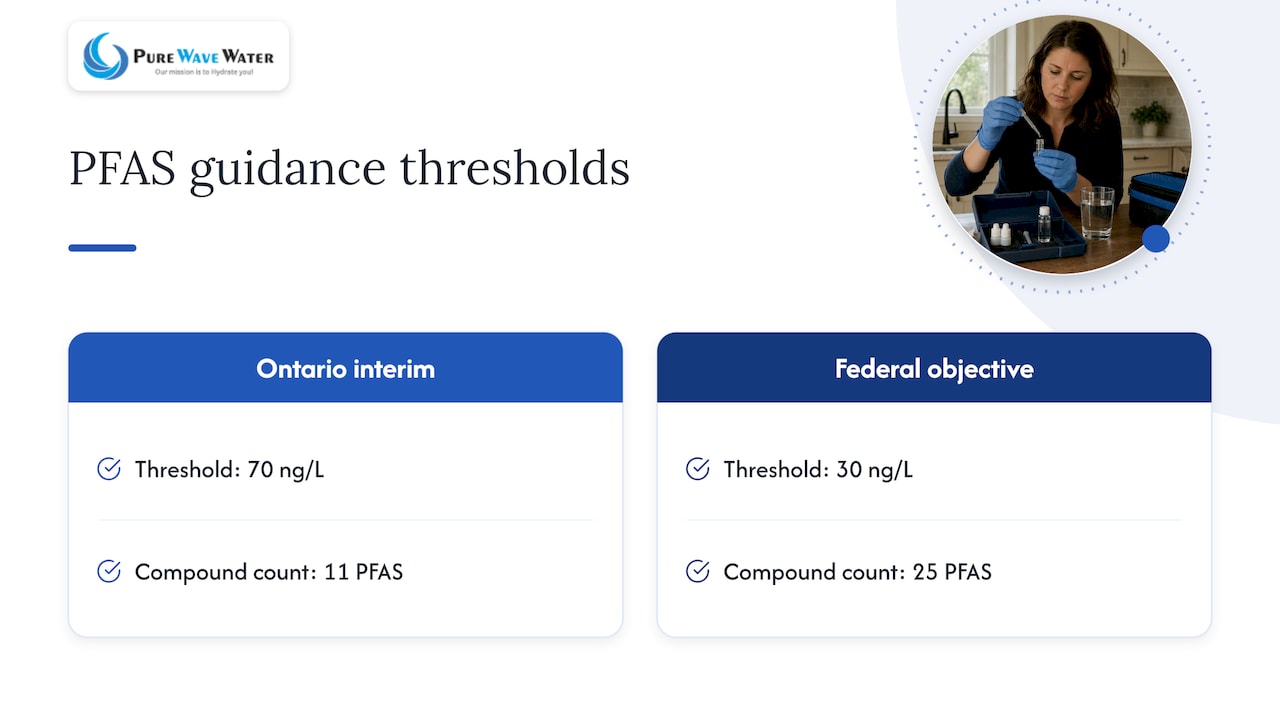
We make no claim about any specific Halton water supply exceeding these values. For municipal water, the town or region publishes its own results, and that is where to look first.
What PFAS in water can do to health
The research on health effects is still developing, and it is mostly about long-term exposure at higher levels. The U.S. Centers for Disease Control and Prevention lists the associations seen with high exposure: higher cholesterol, changes in liver enzymes, a reduced vaccine response in children, higher risk of high blood pressure or pre-eclampsia in pregnancy, and small decreases in infant birth weight, along with higher risks of kidney or testicular cancer.
These are findings about high exposure, not predictions for your household. The reason Health Canada sets a low objective is to keep everyday exposure well below the range where effects have been observed.
One reassurance from Health Canada’s guidance: bathing, showering and washing dishes with PFAS-contaminated water are unlikely to significantly increase health risks, because skin absorption is minimal. That is why treatment usually focuses on the water you drink and cook with, not on the whole house.
How to find out if your water has PFAS
You cannot see, smell or taste PFAS. Clear, good-tasting water can contain them, and a water that tastes of chlorine can be free of them. Only a lab test answers the question.
Municipal water
Health Canada advises that if you are concerned, you contact your municipality, local drinking water authority or local public health authority. They can tell you whether PFAS have been tested in your supply and what the results were.
Private wells in Halton Hills, Caledon and Erin
If you own a private well, nobody tests it for you. You are responsible for sampling it through an accredited laboratory, and you should ask specifically for a PFAS panel, because standard well tests for bacteria and nitrates do not include it.
A few practical tips for a useful result:
- Ask the lab which PFAS compounds the panel covers, and whether it reports the 25 in Health Canada’s objective.
- Follow the lab’s sampling instructions exactly. PFAS are in many consumer products, so labs usually supply their own bottles and handling rules to avoid contaminating the sample.
- Sample from the tap you drink from, and note whether the water passes through a softener or filter first.
- Keep the report. A baseline is useful later to confirm that a treatment system works.
What our free in-store test covers
Our free in-store water test checks hardness, iron and other everyday water-quality concerns. PFAS is not part of that test. What we can do is help you arrange extended lab testing through an accredited lab, and then explain the report in plain terms. If you also notice rotten-egg smells, staining or specks, those are different problems with their own fixes: see our guides on sulfur smell in water and manganese in well water.
What removes PFAS, and what does not
Health Canada states that PFAS can be removed with an activated carbon filter, a reverse osmosis system or an ion exchange system designed for PFAS removal. Boiling will not remove PFAS, and it can concentrate them slightly as water evaporates.
| Method | How it works | Typical use at home | What to check |
|---|---|---|---|
| Reverse osmosis (RO) | Forces water through a fine membrane that rejects dissolved compounds | Under-sink system at the drinking tap | Certification for PFAS reduction (NSF/ANSI 58), filter and membrane schedule |
| Granular activated carbon (GAC) | PFAS stick to the surface of the carbon | Under-sink or whole-home tank | Certification, contact time, how soon the carbon is spent |
| Anion exchange | Charged resin swaps PFAS out of the water | Whole-home or point-of-entry systems | Resin designed for PFAS, replacement schedule |
| Boiling | Heats water | None | Does not remove PFAS |
| Water softener alone | Swaps calcium and magnesium for sodium | Hardness control | Not a PFAS treatment |
Two cautions from Health Canada’s technical material are worth knowing. No single treatment removes a wide range of PFAS under all conditions, so a combination may be needed. And treatment media do not last forever: the same source says source-water characterization is needed to estimate how long media will last before breakthrough. In practice, that means your lab results and your filter-change schedule matter as much as the hardware.
Does reverse osmosis remove PFAS?
Yes, a reverse osmosis system can remove PFAS when installed at the tap, and Health Canada’s advice is to look for NSF/ANSI Standard 58 certification for PFAS removal and to follow the manufacturer’s installation and maintenance instructions.
That last point is where most real-world problems arise. An RO system is a set of parts working together: sediment and carbon pre-filters, the membrane, and a storage tank with a faucet. If pre-filters are left too long, flow drops and performance suffers. Our RO filter replacement schedule and parts are covered on our RO filter replacement page, and you can buy a reverse osmosis 3 pack of filters online.
Here is how we advise customers to choose:
- Read the spec sheet, not the box front. We only call a product PFAS-certified if its spec sheet says so. If a model is not certified for PFAS reduction, it may still be a good filter for chlorine taste or sediment, but it is not the product to rely on for PFAS.
- Match the system to a test result. A lab report that shows PFAS well below 30 ng/L may call for a different decision than one close to or above it.
- Treat the drinking tap first. Because skin contact is a minor route, a point-of-use RO at the kitchen tap is the common starting point. Whole-home treatment is a bigger project and makes sense when the source water itself is the concern, as with some wells.
- Plan for upkeep. Filters and membranes are consumables. A system that is installed and forgotten is not doing the job you bought it for.
RO also improves taste and reduces many dissolved minerals, which is why it is a favourite for kettles and espresso machines. Our guide to reverse osmosis for coffee explains that side of it.
Will a Brita filter remove PFAS?
Not unless the specific model is independently certified for PFAS reduction. Standard jug filters are generally sold for taste, chlorine and some metals, and certification for those things does not cover PFAS. Check the certification listed for your exact model. If it does not name PFAS reduction, do not count on it. If it matters to your household, a certified RO system or a PFAS-rated carbon system is a more dependable route.
Special situations: infants, pregnancy and breastfeeding
Health Canada notes that people who are pregnant or breastfeeding, or who are preparing infant formula, may choose another drinking water source such as bottled water while PFAS is a concern in their supply. If you are in one of these groups and have a positive PFAS result, speak with your family doctor or local public health unit about your specific situation.
A step-by-step plan for Ontario homeowners
- Find your water source. Municipal supply or private well changes who tests and who pays.
- If municipal, ask for results. Contact your municipality or public health unit and ask whether PFAS have been measured and how the results compare with the 30 ng/L objective.
- If on a well, book an accredited lab PFAS panel. Call us at 905-702-2700 and we can help arrange extended lab testing.
- Read the report as a sum. Add the 25 compounds in the federal objective and note the lab’s detection limit.
- Choose treatment based on the result. Most households start with a certified RO at the kitchen tap.
- Install and document. Keep the model’s spec sheet and installation date.
- Maintain and retest. Replace filters on schedule and retest after the system has been running, especially on wells.
Our perspective
We have been testing and treating water in Georgetown and Halton Hills since 1995, and the same principle applies to PFAS as to hardness or iron: measure first, then treat only what is actually there.
That is why we are clear about the limits of our free in-store test. It covers hardness, iron and other common concerns, and PFAS needs an accredited lab. We would rather help you arrange the right lab test and read the result than sell you a system on a worry.
When the result does call for treatment, we think a properly installed reverse osmosis system at the kitchen tap is the most practical place to begin for most households, because it treats the water you drink and cook with. Our own technicians install and service systems, and they can work on most major brands as well as the ones we sell. You get a written quote, and we keep supporting you with the filters and membranes the system needs.
Good PFAS protection is not a single purchase. It is a tested starting point, a certified system, correct installation and a filter schedule you actually follow.
CloudSprout16
Reverse osmosis from Pure Wave Water
If your test result or your own caution points to treating the drinking water, we can supply, install and service reverse osmosis in Georgetown and across Halton Hills. Browse the Sureflo Preferred reverse osmosis system or our full shop, then check the spec sheet for the certifications you need. We will not say a product removes PFAS unless its documentation does.
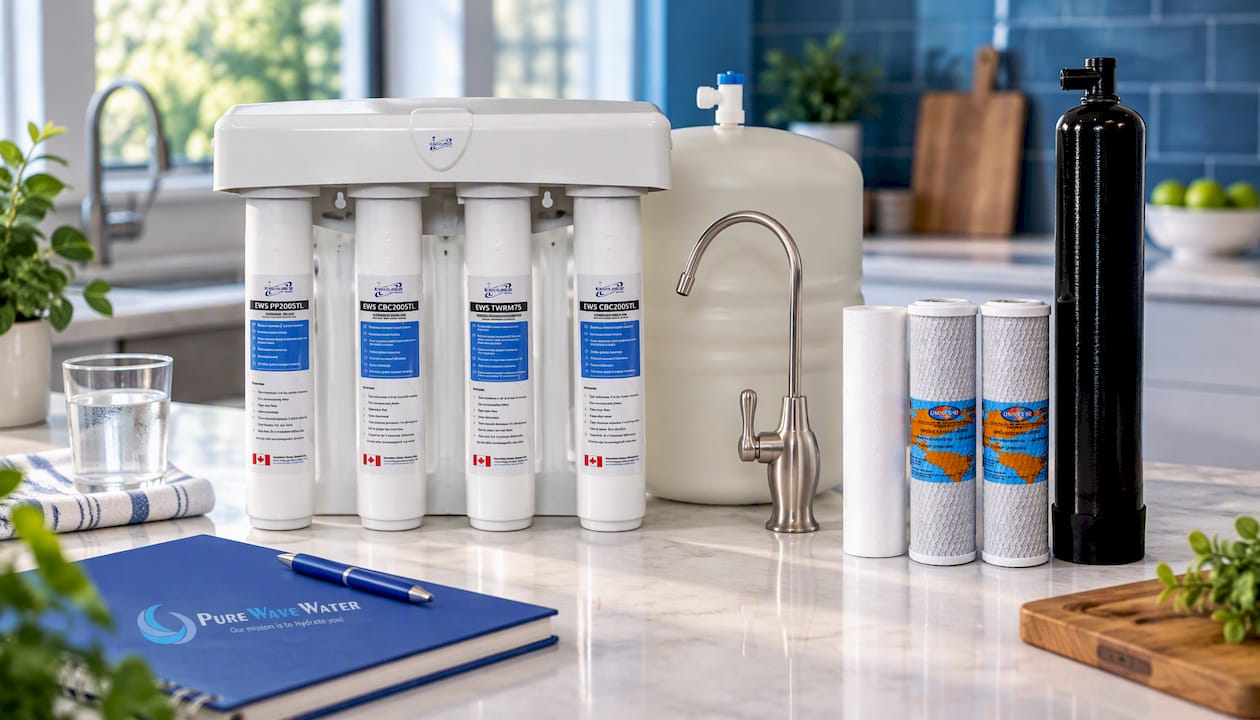
Our technicians handle professional installation and ongoing servicing. Visit us at 333 Mountainview Rd S, Georgetown, call 905-702-2700, or request a reverse osmosis installation quote.
FAQ
Does Canadian tap water have PFAS?
Trace levels of PFAS are found in water across Canada, generally below Health Canada’s 30 ng/L objective. Whether your own supply has any is a question for your municipality’s test results or, on a private well, for an accredited lab.
Can I remove PFAS by boiling water?
No. Boiling does not remove PFAS. Use a treatment system certified for PFAS removal, such as reverse osmosis, activated carbon or ion exchange designed for the purpose, and follow the manufacturer’s maintenance instructions.
Is PFAS included in your free in-store water test?
No. Our free test covers hardness, iron and other everyday water-quality concerns. For PFAS, an accredited lab is needed, and we can help you arrange extended lab testing and understand the results.
Is it safe to shower in water that contains PFAS?
Health Canada advises that bathing, showering and household tasks such as dishwashing are unlikely to significantly raise health risks, because absorption through the skin is minimal. Drinking and cooking water is the main focus.
What is the difference between Ontario’s 70 ng/L and Health Canada’s 30 ng/L?
Ontario’s 2017 interim advice is 70 ng/L for the sum of 11 PFAS. Health Canada’s 2024 objective is 30 ng/L for the sum of 25 PFAS, so it is lower and covers more compounds.
Sources
- Water talk: Per- and polyfluoroalkyl substances (PFAS) in drinking water, Health Canada
- Objective for Canadian drinking water quality: PFAS, Health Canada
- Draft objective for PFAS in drinking water: treatment considerations, Health Canada
- Minister’s Annual Report on Drinking Water (2023), Ontario
- Chemicals That Can Contaminate Tap Water, CDC
Recommended

Pure Wave Water shares educational content about water treatment, water softeners, reverse osmosis systems, UV purification, and filtration solutions. Our guides help readers understand water quality concerns, explore treatment options, and make informed decisions about their water treatment needs.