Yes, test your well this fall. A basic diagnostic screening for hardness, iron, pH, hydrogen sulfide, and total dissolved solids (TDS) gives you a first read on what is happening in your water. If those numbers come back elevated, order a private lab panel with numerical results before you buy any equipment. Free in-store screening is a solid starting point, but it is not a bacterial safety certificate.
TL;DR:
- Elevated iron above 0.3 mg/L often causes staining and requires a private lab test for precise measurement before treatment.
- Hardness exceeding 7 gpg or roughly 120 mg/L suggests scaling issues and calls for a properly sized water softener.
- Retesting after heavy weather or plumbing changes ensures seasonal groundwater shifts do not lead to inappropriate treatment.
- Installing treatment equipment out of sequence, such as a softener before iron removal, can damage systems and reduce lifespan.
- Basic free screening highlights issues but must be followed by detailed lab analysis and professional advice for effective solutions.
Table of Contents
- Fall pre-test checklist before you collect a water sample
- What basic screening covers versus a private lab panel
- How to read the numbers that decide your treatment
- Which treatment matches your results, and in what order
- Why a diagnostic-first approach with a technician pays off
- What Ontario guidance actually covers for private wells
- Where to send samples for lab analysis in Ontario
- Fall diagnostic check for Ontario wells: the perspective conventional advice misses
- Start your fall screening with Purewavewater
- Sources
- FAQ
Fall pre-test checklist before you collect a water sample
Before you drive a jar of well water anywhere, spend fifteen minutes with a notebook. Treatment-relevant test results only mean something when you can connect them to what has actually been happening at your well and in your plumbing.
Start with the basics of the well itself, then move to what has changed recently.
- Well basics: depth, approximate age, pump type (submersible or jet), and the date of your last service or pump inspection.
- Plumbing changes: any new fixtures, water heater replacement, softener bypass valves, or pipe repairs in the last twelve months.
- Weather and site events: heavy rain, a rapid spring or fall thaw, local flooding, nearby construction or excavation, and any livestock or septic activity close to the wellhead.
- Taste and odour: note whether the smell is sulphur (rotten egg), chlorine-like, metallic, or musty, and whether it is constant or comes and goes with hot water use.
- Appearance: discolouration (yellow, orange, black), visible sediment, staining on fixtures, scale buildup on kettles or shower heads, and soap scum that will not rinse clean.
- Sampling points: decide whether you are testing raw water straight from the wellhead or treated water after an existing softener or filter, and note which tap you used and why.
Photograph any staining, cloudy water, or sediment the day you notice it. A simple dated timeline (when the smell started, when the staining appeared, when the water turned cloudy after rain) turns a vague complaint into a data point your technician or lab can actually use.
Pro Tip: Keep a small notebook or phone note titled “well log” and add one line every time something changes. Six months from now, that log is worth more than your memory when a technician asks, “When did this start?”
What basic screening covers versus a private lab panel
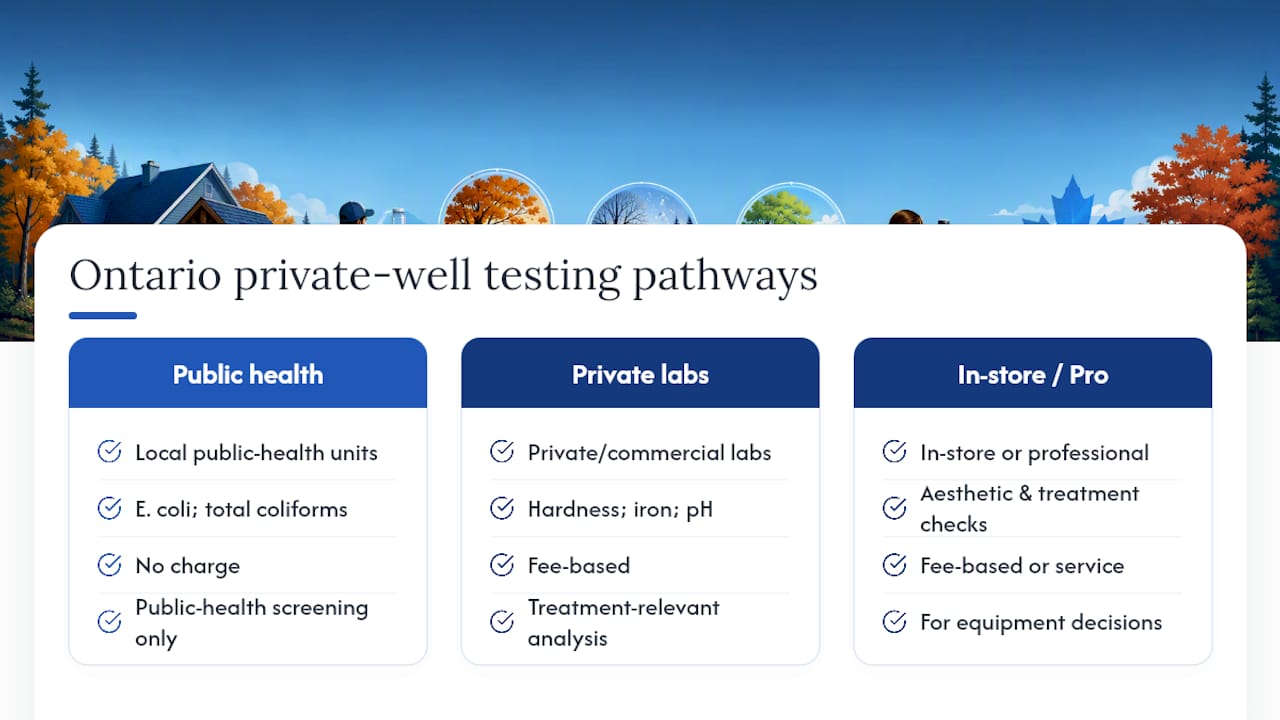
In-store screening (the kind Purewavewater offers at no cost) typically checks hardness, a simple iron test, and quick pH. It is fast, useful, and a genuinely good first step. What it is not is a full numerical lab report, and Ontario guidance is clear that public-health bacterial screening and private-lab chemical or mineral analysis are two separate processes with two separate purposes.
A private lab panel gives you actual numbers, in mg/L or grains per gallon (gpg), for iron, manganese, hardness, pH, hydrogen sulfide, and TDS, plus nitrates when your property or neighbours raise that concern. Here is how to sequence it:
- Start with basic screening to flag obvious issues (visible iron, high hardness, off pH).
- If screening shows anything elevated, order a private lab panel for numerical values, not just qualitative flags.
- Add specialized tests (metals, PFAS, arsenic) only if your symptoms, well depth, or regional geology point that way.
- Sample both raw water at the wellhead and treated water at a tap if you already run a softener or filter, so you can see what your current system is actually doing.
- Retest seasonally and again after any major plumbing work or heavy weather event, since public-health guidance recommends testing at least three times a year.
Method detection limits matter here too. A lab result of “non-detect” is not the same as absolute zero, and it is worth understanding what threshold your lab used before you rule anything out.
How to read the numbers that decide your treatment
Numbers only help you if you know what they mean. A few thresholds show up constantly in Ontario well reports, and each one points toward a different fix.
- Iron above 0.3 mg/L often causes the orange or reddish staining you see on sinks, tubs, and laundry, according to the Ontario Ground Water Association.
- Hardness above 7 gpg (roughly 120 mg/L) is typically classed as hard water, the kind that leaves scale on kettles and makes soap harder to rinse.
- Low pH can mean corrosive water that eats away at pipes and fixtures over time, and it usually calls for an acid neutralizer rather than a softener.
- Hydrogen sulfide (that rotten-egg smell) points toward oxidizing or adsorptive treatment, not a simple carbon filter alone.
- High TDS can reduce reverse osmosis performance and complicate some treatment choices, since very high dissolved solids load the membrane faster.
Roughly 5 to 10% of water test results can be thrown off by sampling or lab error, so a borderline or surprising reading is worth retesting before you commit to a major purchase.
If a number sits right on a threshold, do not treat it as final. Send a second sample, ideally to a different accredited lab, before you size a system around it.
Which treatment matches your results, and in what order
Once you have real numbers, the mapping to equipment is fairly direct, but sequence matters as much as the equipment itself. Installing a softener before you deal with iron, for example, can foul the resin and shorten its life fast.
- Hardness → water softener, sized to your gpg reading and household flow rate.
- Iron and manganese → oxidation filtration (often greensand-type media) ahead of anything else in the line.
- Low pH → acid neutralizer, placed early in the sequence to protect downstream equipment.
- Taste and odour → carbon filtration, usually positioned after oxidation and hardness treatment.
- Drinking-water polishing → reverse osmosis, such as the Sureflo® Preferred Reverse Osmosis System, typically installed at a single tap.
- Disinfection, when bacterial control is genuinely needed, comes through UV treatment, but only after appropriate screening confirms it is warranted.
A typical staging order runs sediment prefilter, then iron and oxidation filtration, then acid neutralizer if pH is low, then softener, then carbon polishing, with UV or RO as final steps. Skip that order and you risk clogging or damaging equipment downstream. Every stage also carries its own upkeep: softener salt, oxidation media replacement, UV lamp changes, and RO membrane swaps all run on their own lifecycle.
Pro Tip: No single device solves every well-water problem. A softener will not fix iron staining, and a carbon filter will not correct low pH. Testing first is what keeps you from buying the wrong piece of equipment twice.
Why a diagnostic-first approach with a technician pays off
Guessing at treatment from taste and appearance alone is how homeowners end up with oversized or mismatched systems. Matching equipment to actual contaminant concentrations and flow rate is what prevents that costly mistake.
Purewavewater’s free in-store water testing covers hardness, iron, and other common water-quality concerns, and it exists specifically so you can get that first numerical read before spending on a system. From there, the recommendation follows your results, not a one-size-fits-all package. Bring your well log, your photos, and a sample, and the screening tells you which direction to go next.
That screening is a diagnostic tool for sizing and product selection. It does not test for bacteria and should never be read as confirmation your water is safe to drink.
What Ontario guidance actually covers for private wells
Ontario does not run a single mandatory testing schedule for private well owners the way municipal water systems face regulated monitoring. What exists instead is a mix of public-health guidance, conservation authority resources, and voluntary best practices aimed at helping well owners manage their own water quality.
Public-health units across the province distribute sample bottles and process bacteriological testing at no charge, but that program is built around E. coli and total coliform screening, a public-health function separate from the treatment-focused testing this article covers. For aesthetic and treatment-relevant parameters like hardness, iron, and pH, the responsibility shifts to private labs and in-store or professional screening services.
The Ontario Ground Water Association publishes resources on well construction, maintenance, and water testing that many well owners use as a reference point. Local public-health units also often post guidance on well maintenance, wellhead protection, and when to retest after flooding or construction nearby.
None of this constitutes a fixed legal testing requirement for aesthetic parameters. It is a patchwork of recommendations, and the practical takeaway is the same one that runs through this whole guide: test seasonally, retest after major events, and get numerical results before buying treatment equipment.
Where to send samples for lab analysis in Ontario
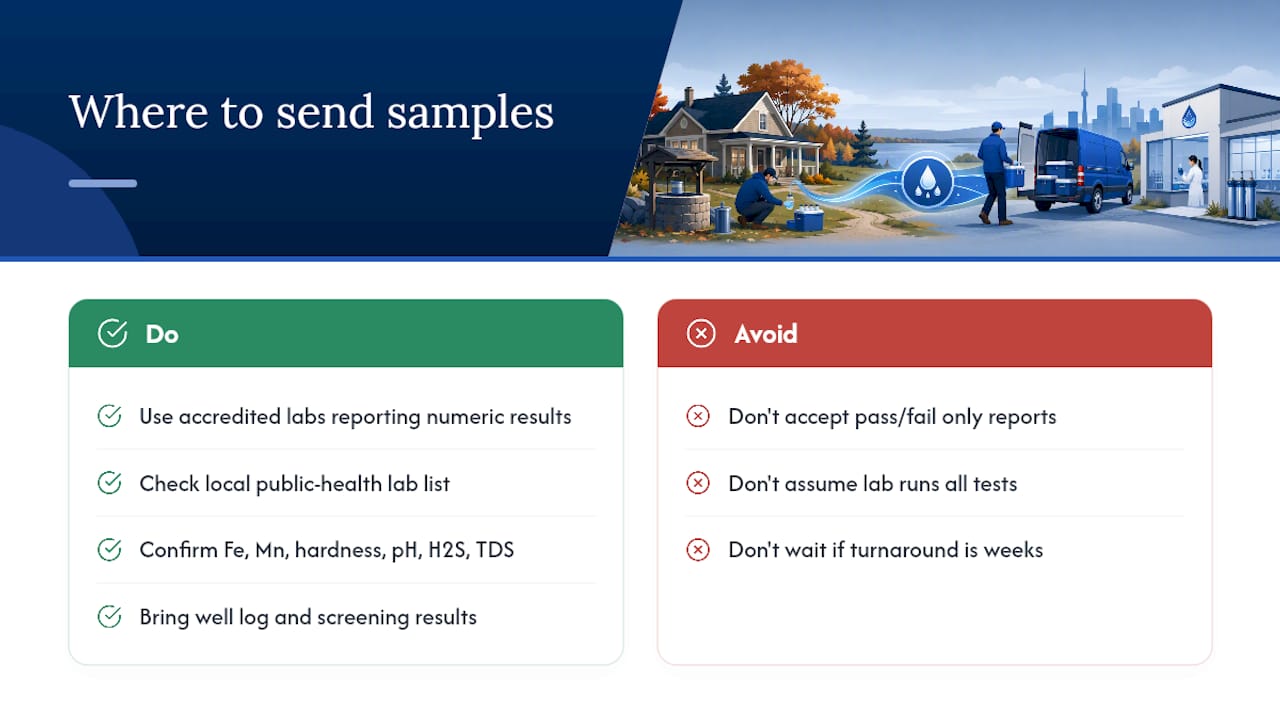
Once basic screening flags something worth investigating further, you need an accredited lab that reports numerical values, not just pass/fail statements. Look for a lab that lists its accreditation status clearly and reports results in mg/L or gpg with a stated method detection limit for each parameter.
Public-health unit websites often maintain lists of accredited private laboratories that accept walk-in or mail-in samples for chemical and mineral testing. These lists change, so checking your local unit’s current page before sampling is worth the two minutes it takes.
When you contact a lab, ask directly whether it reports numerical results for iron, manganese, hardness, pH, hydrogen sulfide, and TDS, since some labs specialize narrowly and may not run every parameter your well needs. Ask about turnaround time too. Fall is a busy season for well testing across the province, and results that take three weeks to arrive are less useful if you are trying to make an equipment decision before winter.
Bring your well log and screening results with you when you drop off or ship a sample. A lab technician who knows you already saw elevated iron on a basic screen can flag anything in the full panel that looks inconsistent, which is exactly the kind of borderline result worth a second sample before you trust it.
Fall diagnostic check for Ontario wells: the perspective conventional advice misses
Most well-water advice treats testing as a one-time event: test once, get a filter, move on. That is backwards. Groundwater conditions shift with the seasons, and a single reading from July tells you very little about what your well is doing after a wet fall or a hard freeze.
The bigger gap in conventional advice is the gap between appearance and proof. Clear, good-tasting water with a low TDS reading feels safe. It is not proof of anything on its own, and TDS alone cannot validate water quality without numerical mineral and chemical data behind it. Homeowners who stop at “it tastes fine” are the ones most likely to end up retrofitting a system two years later because nobody looked at the actual numbers.
What should change: treat fall testing as a checkpoint, not a chore. Log your symptoms honestly, get numerical results before buying anything, and retest before you assume a borderline number is real. That habit costs you an afternoon. Skipping it costs you an oversized softener or a filter that never solves the smell you called about.
— CloudSprout16
Start your fall screening with Purewavewater
A genuine alternative to guessing your way through a treatment purchase is available: a free in-store screening that tells you what your water actually needs before you spend a dollar on equipment. Bring your well log, the photos of any staining or sediment, and a sample from your wellhead or kitchen tap, and the screening covers hardness, iron, and the other common concerns homeowners bring in every fall.
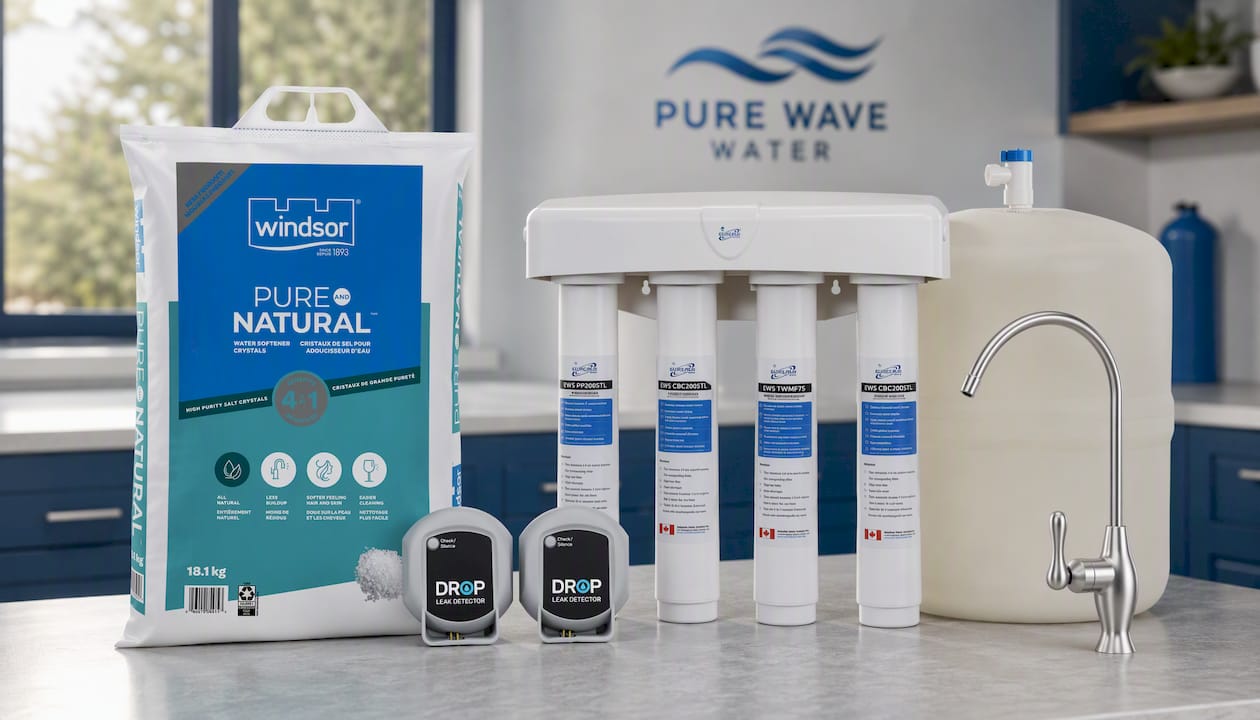
If your numbers come back elevated, the next step is a private lab panel for full numerical results, followed by a technician assessment and a written proposal that matches equipment to what your water actually needs. Maintaining a softener already installed? Stock up on Windsor Pure Natural Water Softener Salt before the winter driving season makes trips harder. Worried about frozen or leaking supply lines this winter? A set of DROP Leak Detectors gives you an early warning before a small drip becomes a flooded basement. And if your lab panel shows high TDS or you simply want cleaner drinking water at the tap, the Sureflo® Preferred Reverse Osmosis System is built for exactly that polishing step. Browse the full range of consumables and systems at the Purewavewater shop to see what fits your results.
Sources
- Ontario Ground Water Association: well water testing resources
- Ontario
- Public Health Grey Bruce: private drinking water guidance
- How to choose a well water treatment system (Well Water Wise)
FAQ
Do I need to test my well water every fall?
Seasonal testing, including a fall check, helps you catch changes tied to weather and groundwater shifts before winter locks in a problem. Public-health guidance suggests testing at least three times a year plus after major weather events.
Is a free in-store water test the same as a safety certificate?
No. Purewavewater’s free in-store screening checks hardness, iron, and similar treatment-relevant parameters, but it does not test for bacteria and is not a bacterial safety certificate.
Can I tell if my well water is safe just by its taste or clarity?
No. Clear, good-tasting water can still carry elevated minerals or chemicals that only show up in numerical lab results, so appearance and taste alone cannot confirm water quality.
What is the difference between basic screening and a private lab panel?
Basic screening gives you a quick read on hardness, iron, and pH, while a private lab panel provides full numerical mg/L or gpg values across more parameters, which is what you need to size treatment equipment correctly.

Written by the Pure Wave Water team, who test, install and service water treatment systems across Georgetown and Halton Hills.