Chloramine is a disinfectant some municipal systems add to tap water, made by combining chlorine with ammonia. Health Canada has not set a drinking water guideline value for it, but many homeowners still want it gone for taste, smell, aquariums, or simple preference. It is harder to remove than chlorine. Boiling, letting a jug sit, and basic chlorine filters mostly do not work. Catalytic carbon, used correctly, does. If you live in Georgetown or elsewhere in Halton Hills, whether you have chloramine at all depends on which part of town you are in.
TL;DR
- Chloramine is chlorine bonded with ammonia. It lasts longer in pipes than free chlorine, which is why some utilities use it.
- At the levels used in municipal supplies, Health Canada and the US EPA treat it as safe to drink. Removal is a choice about taste, smell and specific uses, not an emergency.
- Boiling, standing water and standard chlorine-only filters do not remove it. Catalytic activated carbon, with enough contact time, does.
- Reverse osmosis (RO) can work, but only when it has good catalytic carbon pre-filters, which also protect the membrane.
- In Georgetown, some neighbourhoods get well water treated with chlorine and others get lake-based water. We can test yours for free in our store.
Table of Contents
- What chloramine is and why utilities use it
- Is chloramine in tap water bad for you?
- Does your tap water have chloramine?
- How long does chloramine stay in tap water?
- What does not work
- What does work: catalytic carbon
- Does RO remove chloramine?
- Our perspective on chloramine
- Get tested, then choose
- Maintenance: keeping chloramine out for good
- FAQ
- Sources
What chloramine is and why utilities use it
Chloramines are disinfectants most commonly formed when ammonia is added to chlorine, according to the US EPA’s overview of chloramines. They stay active in the distribution system for longer than free chlorine, so a utility can keep a protective residual at the far ends of a large network without the water smelling as strongly of pool chemicals.
That is the trade-off. The same stability that helps the utility is what makes chloramine awkward for a homeowner. Free chlorine escapes if you leave a jar of water on the counter, and a basic carbon filter grabs it quickly. Chloramine does neither.
Is chloramine in tap water bad for you?
For drinking, the regulators say no at the concentrations used. Health Canada’s consultation document on chloramines reviews the science, and its draft position is that a numerical guideline is no longer considered necessary. The substance has very low toxicity at the concentrations found in municipal supplies, and residuals in Canadian systems are generally kept below 4 mg/L. The EPA takes a similar view: in its monochloramine health questions it says water that meets regulatory standards is safe and does not need to be removed.
That does not mean every household is indifferent to it. Common reasons people choose to remove chloramine:
- Taste and smell. A faint swimming-pool or chemical note, especially in cold water.
- Aquariums and ponds. Chloramine is a known problem for fish. Dechlorinating drops or conditioners made for chloramine are the usual route, and your pet store can advise on the product.
- Home brewing, coffee and cooking. Chemical notes can show up in the finished product.
- Dialysis and medical uses. This is a special case. If anyone in your home does home dialysis, your care team and the equipment supplier set the water treatment requirements. Do not rely on a general-purpose household filter.
- Sensitive skin. Some people feel their skin is drier with disinfected water. Evidence varies, so treat this as a personal trial rather than a promise.
If your water smells like rotten eggs, or looks cloudy, or has black specks, that is a different problem. See our guides on sulfur smell in water and black specks in water before buying anything for chloramine.
Does your tap water have chloramine?
There are three practical ways to find out.
- Read your utility’s water quality report. Municipal systems publish them annually. Look for the list of treatment chemicals, and for a line showing combined or total chlorine alongside free chlorine.
- Call your water supplier. They will tell you which disinfectant serves your street.
- Test it. Free chlorine and total chlorine can be measured with a simple test. If total chlorine is clearly higher than free chlorine, the difference is combined chlorine, mostly chloramine. We offer free in-store water testing, so you can bring a sample rather than guess.
What this means in Georgetown
Georgetown is a mixed case. Halton Region’s 2025 Georgetown drinking water report describes a well-based system and notes that as of 5 November 2024 a section of Georgetown was connected to the Halton Region lake-based distribution subsystem, with Lake Ontario water pumped in. Earlier Halton reporting on the Georgetown well fields lists chlorine as the disinfectant used for the Princess Anne and Lindsay Court wells. The lake-based part of the Halton network uses chloramination, so the answer can differ between neighbours on different supply zones.
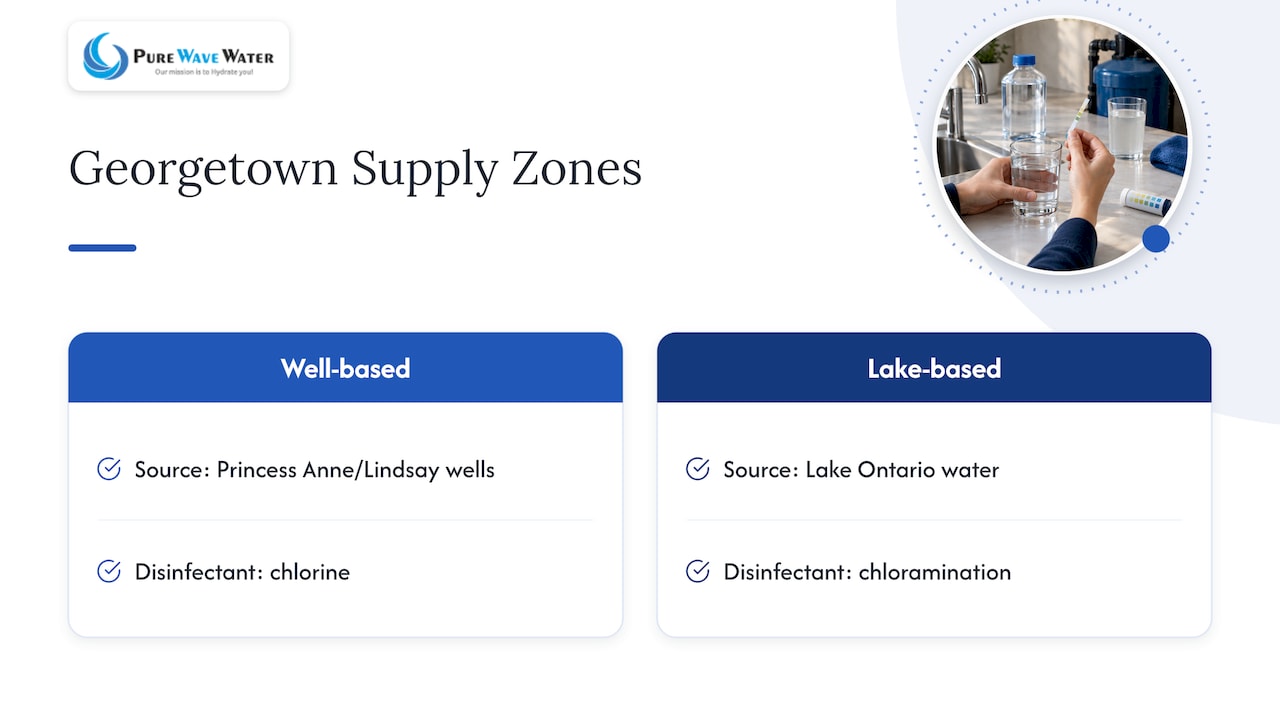
If you moved recently, or your supply zone changed, do not assume what your old street had. Check the current report for your address, or ask Halton Region. If you are on a private well, none of this applies: no municipality is adding disinfectant, and your priorities are bacteria, hardness, iron and manganese. Our guides on coliform in well water and manganese in well water cover those.
How long does chloramine stay in tap water?
Much longer than chlorine. Chlorine can dissipate from an open container in hours to a day, depending on the amount and conditions. Chloramine can persist for days. We do not have a single authoritative figure to give you, and it varies with temperature, container, and the chloramine concentration, so the practical answer is this: do not count on standing water to solve it.
What does not work
The EPA’s guidance and the main filtration references agree on the basics. These methods are generally ineffective for chloramine:
- Boiling. It does not drive off chloramine the way it reduces free chlorine.
- Letting water sit. Too slow to be useful.
- Standard carbon filters sized for chlorine only. Chloramine passes through too quickly for them.
An aquarium conditioner is a different matter. Those products chemically neutralize chloramine for fish, but they are not for drinking water and they do not leave the water treated for your kitchen.
What does work: catalytic carbon
The most common household answer is catalytic activated carbon. Its surface is treated to speed up the breakdown of chloramine, so it works in a realistic contact time. The relevant certification is NSF/ANSI 42, which covers aesthetic effects such as chlorine and chloramine taste and odour. Look for a filter whose packaging or datasheet states chloramine reduction under that standard. A plain claim of “removes chlorine” is not enough.
Two practical rules follow from how carbon works:
- Contact time matters. The slower the water moves through the carbon, the more chloramine is removed. A large whole-house tank or a drinking-water cartridge with plenty of carbon will outperform a small, fast-flow filter.
- Carbon is consumed. Capacity runs down, and performance drops with it. A cartridge that is overdue will let chloramine through, and it can become a place for bacteria to grow if neglected. Replace on the manufacturer’s schedule.
Point-of-use or whole-home?
| Option | Best for | Things to know |
|---|---|---|
| Under-sink catalytic carbon filter | Drinking and cooking water only | Lower cost of entry, small footprint, cartridge changes on a schedule |
| Under-sink reverse osmosis with catalytic carbon pre-filter | Best-tasting drinking water, plus reduction of dissolved solids | Needs space and a drain connection, a storage tank, and regular filter and membrane changes |
| Whole-home catalytic carbon tank | Showers, laundry and every tap | Larger system, sized to your flow rate and household, usually installed professionally |
| Fridge or jug filter | Small households, renters | Check the stated chloramine reduction, as many only claim chlorine |
A whole-home system is worth considering if you notice the smell in the shower or want to treat every tap. For most households, though, drinking water is the point, and that is where an under-sink option makes sense.
Does RO remove chloramine?
It can, but the carbon stage does the heavy lifting. A residential RO system is usually a train of filters: a sediment stage, one or more carbon stages, then the membrane, then often a final polishing carbon stage. The pre-filters protect the membrane from chlorine-type oxidants. A technical bulletin from a membrane manufacturer gives general recommendations for removing chloramine before membranes, because the oxidant can damage standard thin-film composite membranes over time.
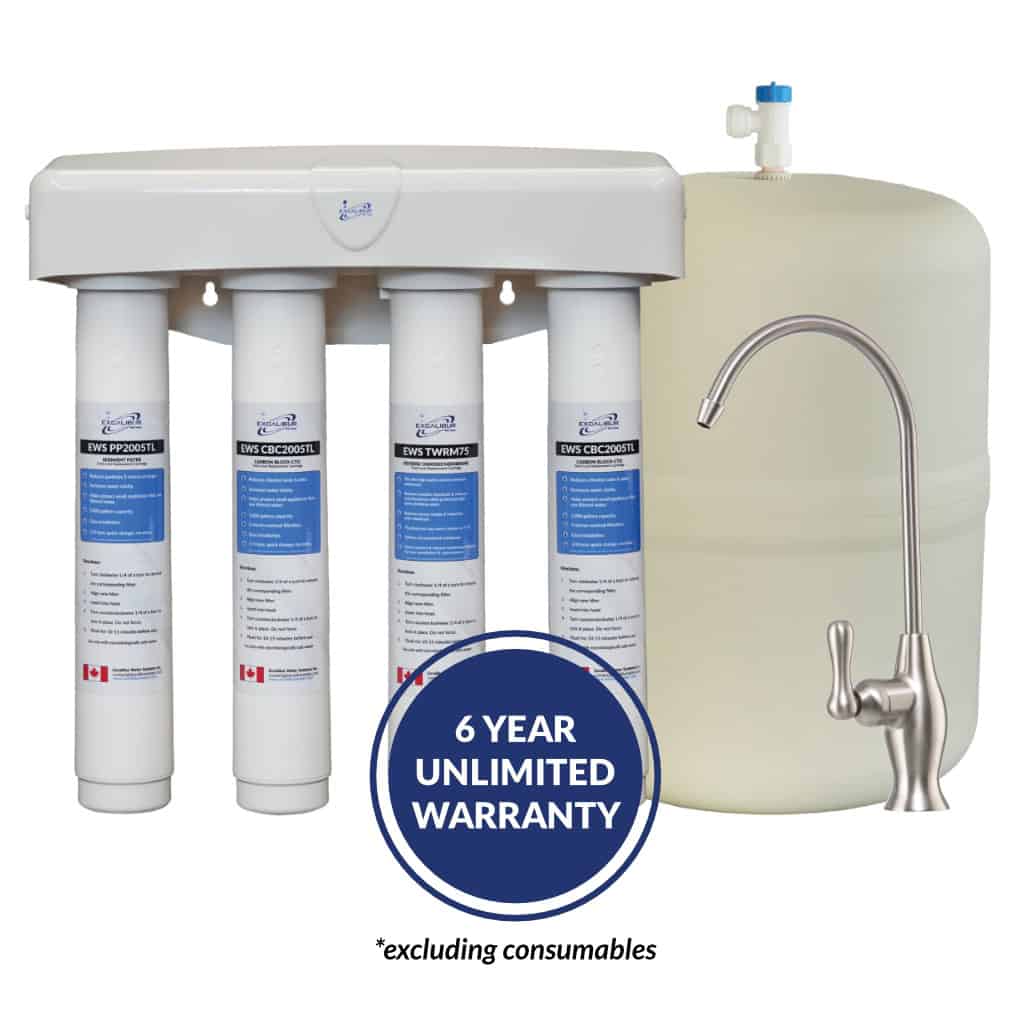
So the right question is not just “is this an RO system?” but “what carbon is in front of the membrane, and how often is it changed?” If you have chloramine and an RO unit with a small, generic carbon block, your membrane may wear faster and your water may still taste of it. Upgrading to a catalytic carbon pre-filter, and changing it on time, is usually the first fix.
If you are comparing home RO systems more broadly, this Swedish guide to choosing a home reverse osmosis system is a useful extra read on system types and what to look for, even though it is written for a different market.
A simple checklist before you buy
- Confirm which disinfectant your address receives.
- Decide whether you want drinking water only, or every tap.
- Check the datasheet for NSF/ANSI 42 chloramine reduction, not just chlorine.
- Ask about the pre-filter carbon type and the replacement interval.
- Test hardness and iron too. Scale and iron can clog carbon and membranes, and may call for a softener or other pre-treatment first. Our guide to water softener costs in Ontario explains why testing comes before buying.
Our perspective on chloramine
Most of the chloramine questions we hear are really taste questions, so we start there. Someone says the water tastes like a pool. We ask where they live, test for free and total chlorine, and check hardness and iron at the same time. Often chloramine is not the only thing going on, and treating it alone leaves the scale or the staining untouched.
We also think the filter market oversells. A jug or faucet filter labelled “removes chlorine” has often disappointed customers on chloraminated supply. Our approach is the opposite of a bigger-is-better pitch: we recommend only the treatment the test supports. That may be a catalytic carbon cartridge, an RO system with the right pre-filters, or, for some Georgetown homes on the well-based supply, nothing for chloramine at all.
For the system itself, our own technicians can install and service it, including most major brands, and we quote in writing. The thing people forget is the consumables. A catalytic carbon stage does its job only while it is fresh, so we stock replacement filters, cartridges and membranes and can tell you the right interval for your household.
— CloudSprout16
Get tested, then choose
If you are in Georgetown or Halton Hills and not sure whether you are on chloraminated water, start with our free in-store water testing. Bring a sample and we will go through what the results mean for your taste, scale or staining concerns.
When you are ready, browse our reverse osmosis systems, filters and housings. Two places to start:
- The Sureflo® Preferred Reverse Osmosis System, an under-sink drinking water system.
- The Reverse Osmosis 3 Pack Filters, if you already have a system and its pre-filters are due.
If you want it fitted properly, see our installation and repair services.

Maintenance: keeping chloramine out for good
A chloramine solution is only as good as its last filter change. A simple routine:
- Write the install date on the housing. Sediment and carbon stages are usually replaced on a schedule set by the maker, commonly around every six to twelve months, but follow your system’s manual.
- Change sooner if taste returns. A pool-like note coming back is the clearest sign the carbon is spent.
- Replace the RO membrane on its own, longer schedule. If the carbon was neglected, the membrane may need replacing sooner.
- Sanitize when you change filters if your manual calls for it.
If you have a water softener as well, keep its salt and service up to date, as hardness affects everything downstream. Our guide to choosing water softener salt can help.
FAQ
Can I remove chloramine by boiling water?
No. Boiling does not reliably remove chloramine the way it can reduce free chlorine, and standing water is also ineffective. Use catalytic activated carbon, ideally certified under NSF/ANSI 42 for chloramine reduction.
Does a basic chlorine filter remove chloramine?
Usually not well. Filters designed only for free chlorine let much of the chloramine pass because they lack catalytic carbon and contact time. Check that the product states chloramine reduction specifically.
Is chloramine safe to drink in Canada?
Health Canada has not set a numerical guideline because chloramine has very low toxicity at the levels found in municipal water, and most Canadian systems keep residuals below 4 mg/L. If you have a medical reason such as home dialysis, follow your care team’s instructions on water treatment.
How do I know if my Georgetown water has chloramine?
Check Halton Region’s current water quality report for your supply zone, or call the Region. Parts of Georgetown are on the lake-based system, which is chloraminated, while the well-based areas use chlorine. We can also test a sample for free and total chlorine in our store.
Sources
- Health Canada: Chloramines in drinking water, guideline technical document for public consultation
- US EPA: Chloramines in drinking water
- US EPA: Common health questions related to monochloramine
- Halton Region: 2025 Georgetown drinking water quality report
- Halton Region: 2023 Georgetown drinking water quality report
- MANN+HUMMEL technical bulletin: pretreatment for chloramine
Recommended

Pure Wave Water shares educational content about water treatment, water softeners, reverse osmosis systems, UV purification, and filtration solutions. Our guides help readers understand water quality concerns, explore treatment options, and make informed decisions about their water treatment needs.