Reduce the calcium and magnesium in your water, usually with a water softener, and soap scum stops forming. We treat the hardness that causes the reaction, not just the residue it leaves behind. Health Canada sets clear hardness thresholds, and a softener certified to NSF/ANSI 44 is one treatment option.
TL;DR:
- Test hardness and iron before buying; water above 200 mg/L as CaCO3 is poor, while levels above 500 mg/L are unacceptable for most domestic uses.
- Choose an NSF/ANSI 44 certified softener sized to household demand, and confirm its performance with accredited lab tests before and after installation.
- Sodium chloride and potassium chloride both regenerate resin; if either mineral is a dietary concern, consider bypassing the softener for the kitchen drinking tap.
- Reverse osmosis and ultrafiltration provide a mineral reduced drinking tap, while an ion exchange softener treats hardness throughout the home’s water supply.
- A softener helps prevent new soap scum but will not dissolve existing residue; visible improvement may take longer when scale has already built up.
Table of Contents
- Softeners, membranes, and which product fits each job
- How water softening prevents soap scum in the first place
- Choosing a system: certification, sizing, salt, and filters
- When you’ll see results, and what upkeep looks like
- Your next steps: test, choose, install
- What testing first actually gets you
- Get your water tested and stop soap scum for good
- FAQ
- Sources
Softeners, membranes, and which product fits each job
Soap scum forms when dissolved minerals in your water react with soap. Removing those minerals before they reach your fixtures can help prevent it.
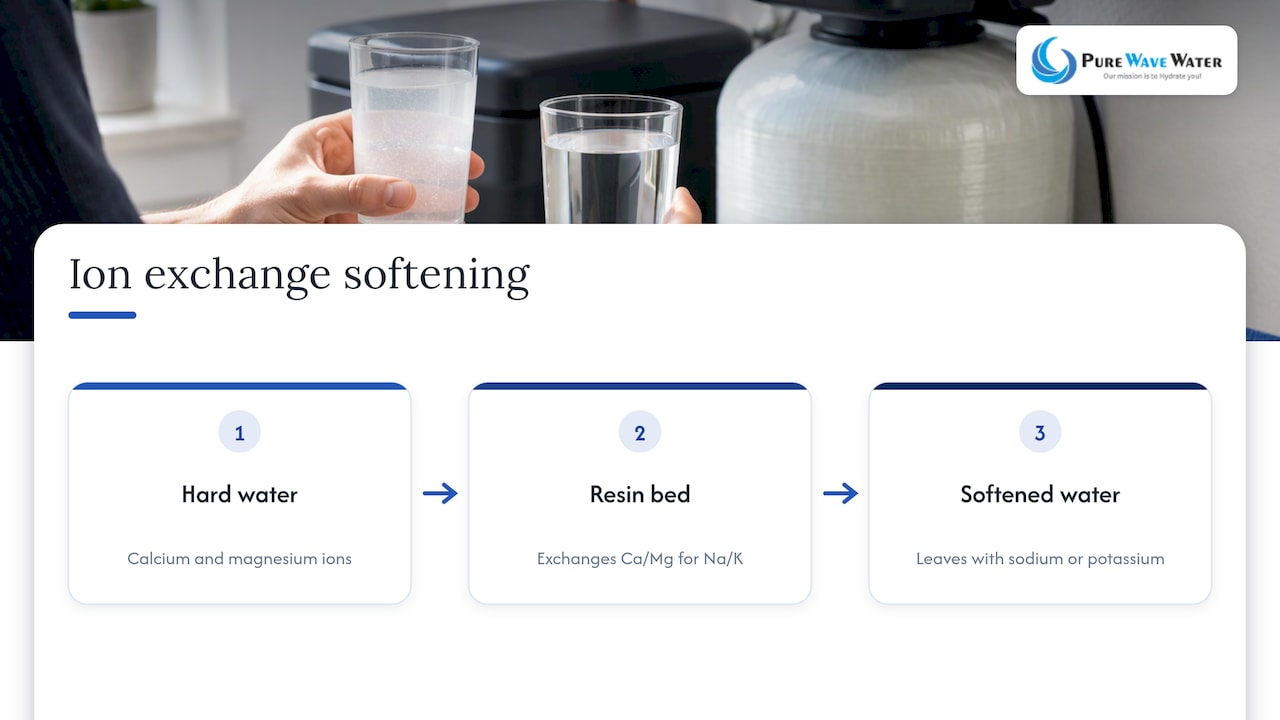
Ion-exchange water softeners are a household solution for reducing hardness. They swap calcium and magnesium for sodium or potassium as water passes through resin beads, so soap no longer has anything to react with. For homes dealing with soap scum on glass doors, fixtures, and tile, a correctly sized softener may help address the problem.
Reverse osmosis and ultrafiltration systems can play a complementary role. They can provide a dedicated, mineral-reduced tap for drinking and cooking if you’d rather not add sodium or potassium to the water you drink.
Here’s how our catalogue maps to each approach:
- Whole-home softening: softener models like the 75K Progressive Duplex Water Softener for higher-demand households, plus Windsor Pure Natural or Windsor Clean & Protect salts for ongoing regeneration.
- Drinking-water protection: point-of-use systems such as the Sureflo® Preferred Reverse Osmosis System or the Excalibur Ultrafiltration Drinking System.
- Replacement consumables: membranes like the Hydrotech R/O Membrane, 25GPD or 75GPD, and Reverse Osmosis 3 Pack Filters for routine servicing.
How water softening prevents soap scum in the first place
Hardness is the total concentration of dissolved calcium and magnesium ions in your water. Health Canada considers water above 200 mg/L as CaCO3 to be poor, and anything above 500 mg/L unacceptable for most domestic purposes, a threshold echoed in the Guideline Technical Document on hardness.
Soap scum isn’t dirt in the usual sense. It can form when calcium and magnesium ions react with soap, leaving residue on tile, glass, and skin instead of rinsing away. Harder water can contribute to more residue.
Ion exchange interrupts the reaction before it starts. As water flows through the softener’s resin bed, calcium and magnesium are swapped out for sodium or potassium ions, which don’t form the same insoluble compound with soap. The operational parameters guidance and potassium guidance document both describe this substitution as the mechanism behind softening.
One caveat worth knowing: softeners may not be designed to remove iron, and iron can affect the resin over time. If your water has a metallic taste or rust-coloured staining, test for iron alongside hardness before you choose equipment.
Choosing a system: certification, sizing, salt, and filters
A softener is only as good as its certification and its fit for your household. Start with the standard that matters most.
- Certification: look for NSF/ANSI 44 on any cation-exchange softener, and confirm results with accredited lab testing before and after installation, as Health Canada recommends.
- Sizing: match the unit’s capacity and flow rate to your household’s hardness level and water usage. Larger households or properties with continuous demand, such as a farm or a home with a secondary suite, may need a system suited to their usage, such as the 75K Progressive Duplex Water Softener.
- Salt choice: sodium chloride and potassium chloride are both options for regenerating softener resin. The potassium guidance document notes that potassium-based softening can add meaningful potassium to treated water, so bypassing the softener for your kitchen tap is worth considering if either mineral is a health concern. Our guide to softener salt choices walks through the trade-offs in more detail.
- RO and UF add-ons: membrane ratings indicate a system’s production capacity, and replacement needs depend on the manufacturer’s guidance and system condition.
Pro Tip: If anyone in your home has concerns about sodium or potassium intake, consult a healthcare provider about drinking softened water or consider bypassing the softener for the main drinking tap.
When you’ll see results, and what upkeep looks like
Some homeowners may notice less soap scum after installing a properly sized softener, though existing scale buildup may take longer to clear. Health Canada recommends confirming performance with accredited post-installation testing rather than judging by appearance alone.
Keeping a softener performing well doesn’t take much, but it does take consistency:
- Check and top up salt levels as needed.
- Arrange resin and service checks as recommended by the manufacturer or installer.
- Replace RO membranes and filters on the manufacturer’s recommended interval rather than waiting for a drop in output.
- Re-test hardness as needed, especially if your water source changes.
Routine testing is the simplest way to know your system is still doing its job, not just running.
Your next steps: test, choose, install
Before buying anything, test your water for hardness and iron. An accredited lab or an in-store test gives you a real number in mg/L as CaCO3, which keeps you from over- or under-sizing a system, a point the operational parameters guidelines emphasize directly.
From there, work through a short checklist:
- Record your hardness result in mg/L as CaCO3 and note whether iron is present.
- Flag any household dietary sodium or potassium concerns before choosing a salt type.
- Choose a softener certified to NSF/ANSI 44, sized to your household’s demand.
- Decide whether you need RO or ultrafiltration for a dedicated drinking-water tap.
Once you know what you need, you can explore a complete system with local installation and servicing, or replacement parts and membranes for an existing setup.
What testing first actually gets you
We’ve worked with Georgetown-area homeowners on hardness and water quality, and testing can help match equipment to the measured water conditions. Free in-store testing helps match the fix to the actual mg/L reading instead of a guess.
A properly selected softener may help reduce soap use and residue on glass shower doors and chrome fixtures. Results for skin and hair can vary. None of that requires aggressive scrubbing routines, just water that no longer reacts against the soap in the first place. If you’re unsure where your water stands, that’s exactly what a test is for.
— CloudSprout16
Get your water tested and stop soap scum for good
We offer free in-store water testing for hardness, iron, and other common concerns, then recommend only the treatment your results actually call for. If a softener is the right fit, we carry both Windsor Pure Natural and Windsor Clean & Protect salts, along with softener models sized for everything from a small household to a high-demand property. For households that want a dedicated drinking-water tap alongside whole-home softening, the Sureflo® Preferred Reverse Osmosis System and Excalibur Ultrafiltration Drinking System are both options worth a look, and replacement RO filters keep an existing system running at full performance.
Our local technicians handle installation, repair, and ongoing maintenance on our systems, with a written quote before any work begins. If hard water stains have already reached your windows, our partners at Blue Brothers cover when that calls for a professional. Book a free water test or browse our full product shop to get started.
FAQ
Does a water softener remove soap scum that’s already there?
A softener can help prevent new soap scum from forming by reducing the minerals that react with soap, but it won’t dissolve residue already on your fixtures. Our guide to removing limescale covers safely clearing existing buildup once your water is treated.
How hard does my water need to be before soap scum becomes a problem?
Health Canada considers hardness above 200 mg/L as CaCO3 to be poor. Soap scum may be noticeable at different hardness levels in different homes. Testing your own water gives you the exact number rather than a general estimate.
Is potassium chloride safer than sodium chloride for softener salt?
Neither is inherently safer; the right choice depends on your household’s dietary needs. Health Canada’s guidance notes potassium-based softening can add meaningful potassium to treated water, so bypassing the softener for drinking water is worth considering either way.
Can I use reverse osmosis instead of a water softener to stop soap scum?
Reverse osmosis can treat water at a tap, while an ion-exchange softener can treat hardness in a home’s water supply. Which approach fits depends on the treatment need.
How do I know my new softener is actually working?
The most reliable way is accredited lab testing before and after installation to confirm your hardness level has dropped into an acceptable range, a step Health Canada recommends for any treatment device. Visible results, such as less residue and easier lathering, may follow, though the timing can vary.
Recommended

Pure Wave Water shares educational content about water treatment, water softeners, reverse osmosis systems, UV purification, and filtration solutions. Our guides help readers understand water quality concerns, explore treatment options, and make informed decisions about their water treatment needs.