
White flakes in your tap water are most often mineral scale: calcium and magnesium that came out of solution, usually after the water was heated, and then broke loose from a water heater, pipe or faucet. They are usually a nuisance rather than a health hazard, but the pattern matters. Where the flakes show up (hot water only, one faucet, or the whole house) points to the source, and a few simple home checks will narrow it down before you spend anything.
This guide walks you through those checks, explains the other possible culprits (tank liner, resin beads, faucet parts, air), and covers when a water test is the sensible next step, whether you are on municipal water in Georgetown and Halton Hills or on a private well.
TL;DR
- Most white flakes are calcium and magnesium scale from hard water, often shed by the water heater or pipes.
- Check hot versus cold water, and one faucet versus every tap. The location is the best clue to the source.
- Crush a flake and drop it in vinegar: fizzing points to mineral or tank-liner material, not plastic or soap.
- Hardness itself is not a health concern, but flakes that come with odour, colour change or a well should be tested.
- A free in-store water test tells you whether you actually need a softener, a filter, or just a cleaned aerator.
Table of Contents
- What the white flakes usually are
- Diagnose it at home in about ten minutes
- Are white flakes in tap water safe to drink?
- Municipal water versus a private well
- What to do about it, by cause
- When a water test is worth it
- Perspective: what we see at the counter
- Get your water tested in Georgetown
- FAQ
- Sources
What the white flakes usually are
Health Canada’s operational guidance explains the chemistry. Calcium and magnesium dissolved in water can precipitate out as hydroxide and carbonate salts and form scale on the inside of hot-water-bearing pipes and appliances. Heat makes this worse, which is why hot water systems are the usual starting point. When a piece of that scale detaches, it travels to your glass as a white or off-white flake.
That is the most common explanation, but not the only one. The main candidates are:
- Scale from the water heater. Mineral crust builds on the heating element and tank walls, then flakes off, especially when the tank is disturbed or drained.
- Scale from pipes. Pipe scale is a buildup of naturally occurring calcium and magnesium carbonates, and it can detach from the inside of plumbing, sometimes after pressure changes or turbulence from water line work.
- Hot-water-tank liner. Some tanks have a ceramic-type lining that can shed small white or brown particles as it ages.
- Water softener resin beads. If you have a softener, a damaged distribution system can let tiny resin beads through.
- Faucet or fixture parts. Deteriorating rubber washers and aerator debris can produce particles, as can mineral crust at the spout.
- Air bubbles. Not a flake at all, but milky water that looks cloudy.
The City of Ottawa lists several of these together: hot-water-tank liner ceramic, water-main sediment, faucet rubber and softener resin beads as possible sources of particles, with cloudy water often caused by air.
Diagnose it at home in about ten minutes
You do not need equipment for the first pass. Work through these steps in order and write down what you see.
- Fill a clear glass from the cold tap. Look at it in good light and set it down for a couple of minutes.
- Repeat with the hot tap. Use a second clean glass.
- Try a different faucet. Compare the kitchen, a bathroom and, if you have one, a laundry sink or outdoor tap.
- Remove the aerator. Unscrew the tip of the faucet, look for crusty white deposits, and rinse it.
- Collect a few flakes on a paper towel. Let them dry.
- Crush one with a spoon and drop a piece in white vinegar. Watch for fizzing.
Read the pattern
American Water’s guidance treats the location of the particles as the primary diagnostic indicator: whether they are restricted to hot water, to specific faucets, or present throughout the whole home. In practice that translates as follows.
| What you see | Most likely source | First step |
|---|---|---|
| Flakes in hot water only | Water heater scale or tank liner | Flush the tank per the manufacturer’s instructions, then retest |
| Flakes at one faucet only | Aerator or fixture parts | Clean or replace the aerator and check washers |
| Flakes at every tap, hot and cold | Pipe scale, very hard water, or source water | Test hardness and sediment |
| Flakes began right after street or plumbing work | Disturbed pipe scale or main sediment | Run cold water for several minutes, clean aerators, watch for a week |
| Tiny round beads, you own a softener | Resin beads | Have the softener inspected promptly |
| Cloudy, not flaky; clears from the bottom up | Air bubbles | No action needed |
The vinegar and spoon test
Ottawa notes that white or brown particles that crush easily with a spoon and fizz in vinegar may be ceramic from a hot water tank liner. A flake that dissolves or fizzes is carbonate-based, which fits scale. A flake that stays rubbery, bends or does not react is more likely plastic, rubber or a resin bead. Keep a sample in a labelled jar or sealed bag so a technician can look at it.
Is it air?
If the water looks milky rather than flaky, fill a glass and wait. Milky water that slowly clears after filling a glass is air, and the cloudiness rises from the bottom as the bubbles escape. It is harmless and common after plumbing work or in cold weather when water warms up in the house.
Are white flakes in tap water safe to drink?
In most cases, yes. A city utility in Ohio states that white or gray particles from hot-water-tank conditions pose no health risk. Health Canada describes general parameters such as hardness as not harmful, but able to affect taste, smell, colour, plumbing or appliances. Its guidance also says you may safely drink water that is above an aesthetic or operational objective, and that you can treat it to prevent scaling or improve taste and smell.
That said, “probably harmless” should not become “never checked”. Take it further if any of these apply:
- You are on a private well and have not tested recently.
- The flakes come with a rotten-egg smell, orange or black staining, or a sudden change in taste.
- The particles are not mineral (they do not fizz, they are soft, slimy or rubbery).
- Someone in the home is immunocompromised, or you are preparing infant formula and want certainty.
- The flakes are in cold water at every tap and appeared without any plumbing work nearby.
If you are on municipal water and the flakes appear suddenly at every cold tap, call your water supplier (in Halton Hills, that means the Region of Halton’s water services) and report what you are seeing. They can tell you about main work or flushing in your area.
Municipal water versus a private well
The route to answers differs, because on a well the responsibility sits with you.
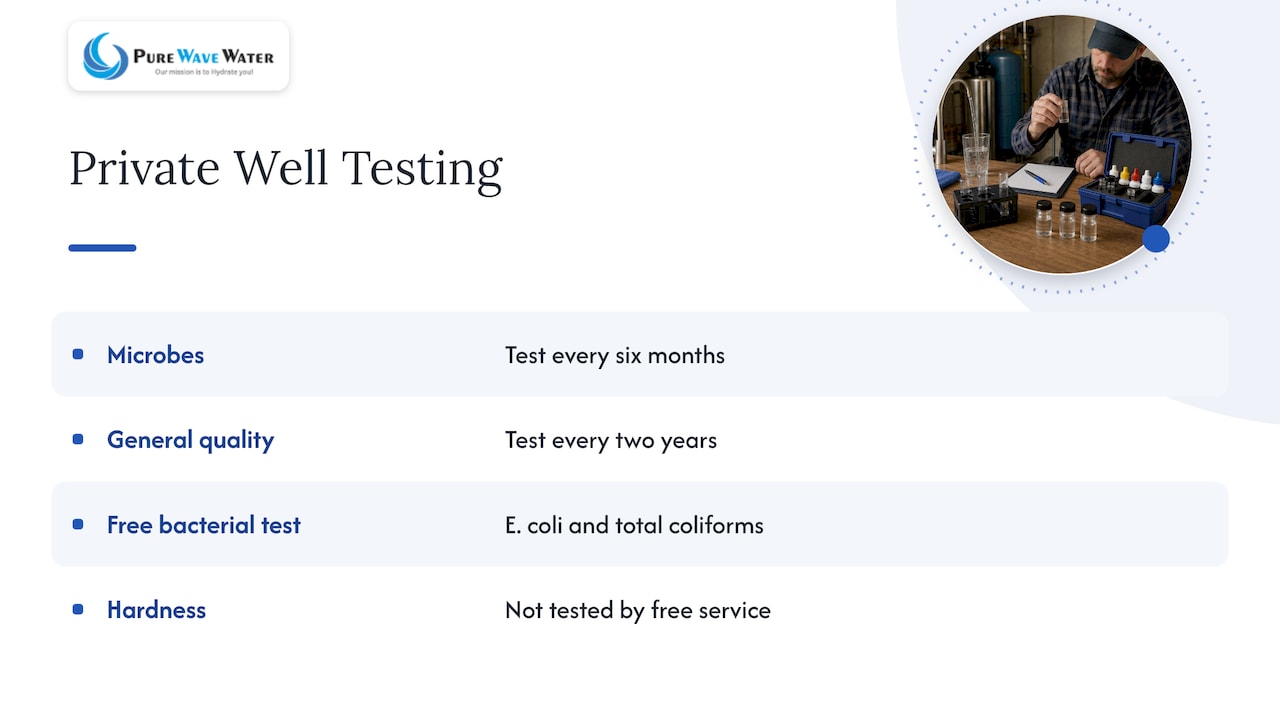
Health Canada says private well owners are responsible for monitoring and maintaining their water quality. Its general advice is to test a well for microbes every six months and for general water quality, including hardness, every two years, through an accredited lab or your public health unit.
The Government of Ontario notes that Public Health Ontario offers free, voluntary testing of private wells for bacterial indicators (E. coli and total coliforms), but this service does not test chemical parameters like hardness. So a clean bacterial result does not tell you why you have white flakes. The same page adds that more testing is warranted during unusual events such as spring melt, and that properly constructed deeper wells tend to have more stable water levels than shallow ones.
If your concern with a well is bacteria rather than minerals, our guide to coliform in well water covers the boil, shock and retest sequence. If you are also seeing dark particles, the smear test for black specks is the place to start, and for grit or silt, see three quick signals that pinpoint sediment.
What to do about it, by cause
Scale from a water heater
If the flakes show up mostly in hot water, American Water suggests flushing the heater according to the manufacturer’s instructions. Follow your tank’s manual, and turn off power or gas as it directs. If the tank is old and the flaking keeps returning after a flush, the liner or element may be failing, and a plumber or technician should assess whether repair or replacement makes sense.
Scale at the faucet
Clean the aerator: unscrew it, soak it in white vinegar, rinse and refit it. Particles that accumulate in aerators are a signal, not a fix, so if they come back within weeks, the source is upstream. For the safe way to deal with crust on fixtures and glass, see how to remove limescale safely.
Hard water throughout the house
When scale is the cause everywhere, the root problem is hardness. Health Canada’s operational guidance notes that residential treatment units can reduce these substances, and that water softeners are best for hardness, calcium and magnesium, provided they are maintained to the manufacturer’s specifications.
A softener swaps calcium and magnesium for sodium or potassium so scale cannot form in your heater and pipes. Two related reads will help you plan: water softener costs in Ontario and which softener salt to choose. If you are also fighting streaky residue in the shower, soap scum and what 200 mg/L hardness means explains the link.
Sediment and grit mixed with the flakes
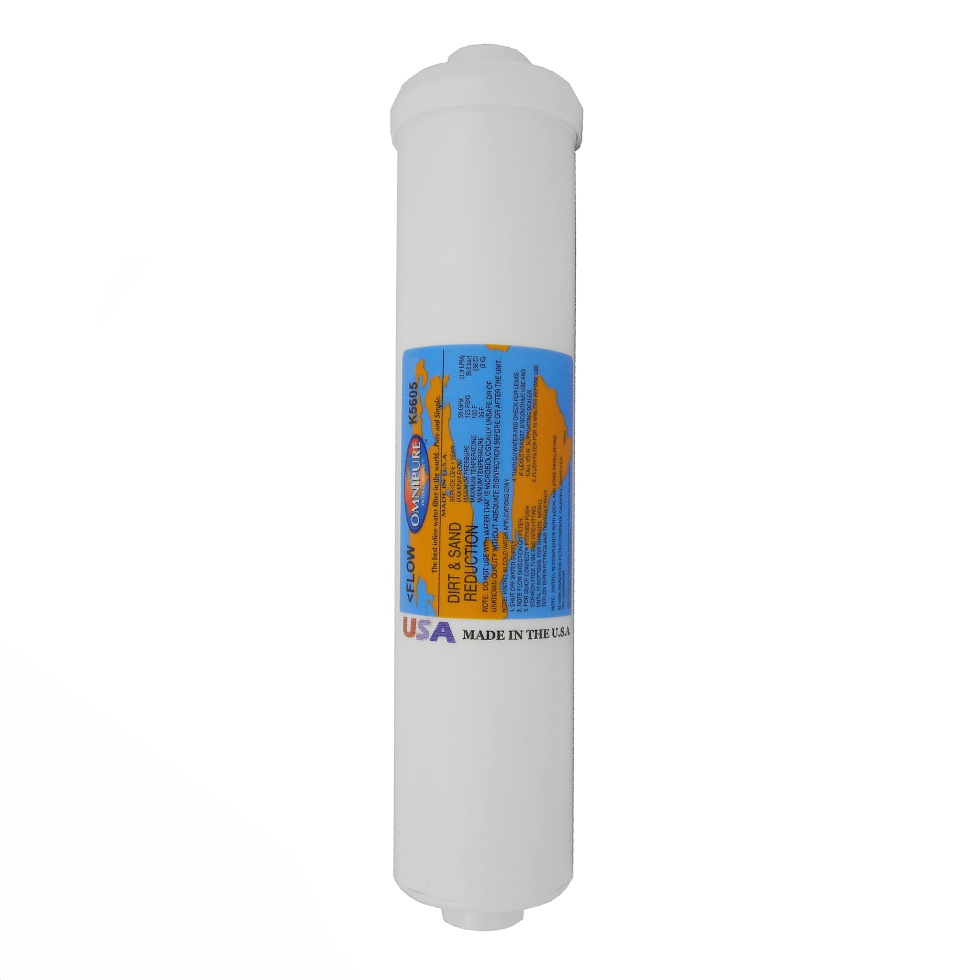
If your water carries fine grit alongside the flakes, a sediment pre-filter protects fixtures, softeners and RO membranes. A cartridge such as the Omnipure K5605-JJ sediment filter is the kind of replacement part that fits this role. Make sure the housing and micron rating match your system before ordering.
Resin beads
If you own a softener and find small, round, tan or translucent beads, treat that as a service call. Beads in the water mean the internal distributor or screen may be damaged, and the resin bed will lose capacity until it is repaired. The beads themselves are not the main worry; the failing softener is.
Drinking water that you simply want cleaner
Even after the source is handled, some households prefer filtered water for drinking. A point-of-use reverse osmosis system, such as the Sureflo Preferred Reverse Osmosis System, treats the water at one tap for drinking and cooking. For a short-term fix, faucet water filter types and how to clean them are worth understanding, though a faucet filter will not stop scale forming in your heater.
When a water test is worth it
Guessing is the expensive route. A softener sized for the wrong hardness, or a filter chosen for a problem you do not have, costs more than a test ever will. A test reads hardness, iron and other parameters so the recommendation fits the water coming out of your tap.
A test makes sense when:
- the flakes are everywhere in the house, not one faucet;
- you see scale on kettles, faucets, showerheads and glass as well;
- you are on a well and cannot remember the last hardness result;
- you are considering any treatment equipment and want to know what size and type you actually need.
Bring a sample in a clean glass jar, along with a few flakes if you saved them. Note whether they show up in hot, cold or both, and whether you already have a softener or filter.
Perspective: what we see at the counter
We have been helping customers with water problems since 1995, and white flakes are one of the questions where a short conversation saves the most money. People often arrive convinced they need a whole-house system when a cleaned aerator or a flushed heater would settle it. Others have lived with scale for years and never connected it with the dry skin, soap scum and shortened appliance life they have also noticed.
Our approach is to test first and recommend only the treatment the water actually calls for. Hardness, iron and other concerns can be checked with a free in-store water test, and that result decides the next step: nothing, a repair, a filter, or a softener. If equipment is needed, our own technicians install and service it, and we can service most major brands as well as the systems we sell. You get a written quote and ongoing support for consumables such as filters, cartridges and salt.
Our honest advice: do not buy treatment based on a photo of a flake. Keep a sample, note where it appears, and let the numbers guide the purchase.
— CloudSprout16
Get your water tested in Georgetown
If you are in Georgetown or elsewhere in Halton Hills, bring a sample to us and we will test it for hardness, iron and other water-quality concerns at no charge, then explain what the result means in plain terms. When treatment makes sense, our technicians handle installation and repair, and you can browse softeners, reverse osmosis units, filters and replacement parts in our online shop.
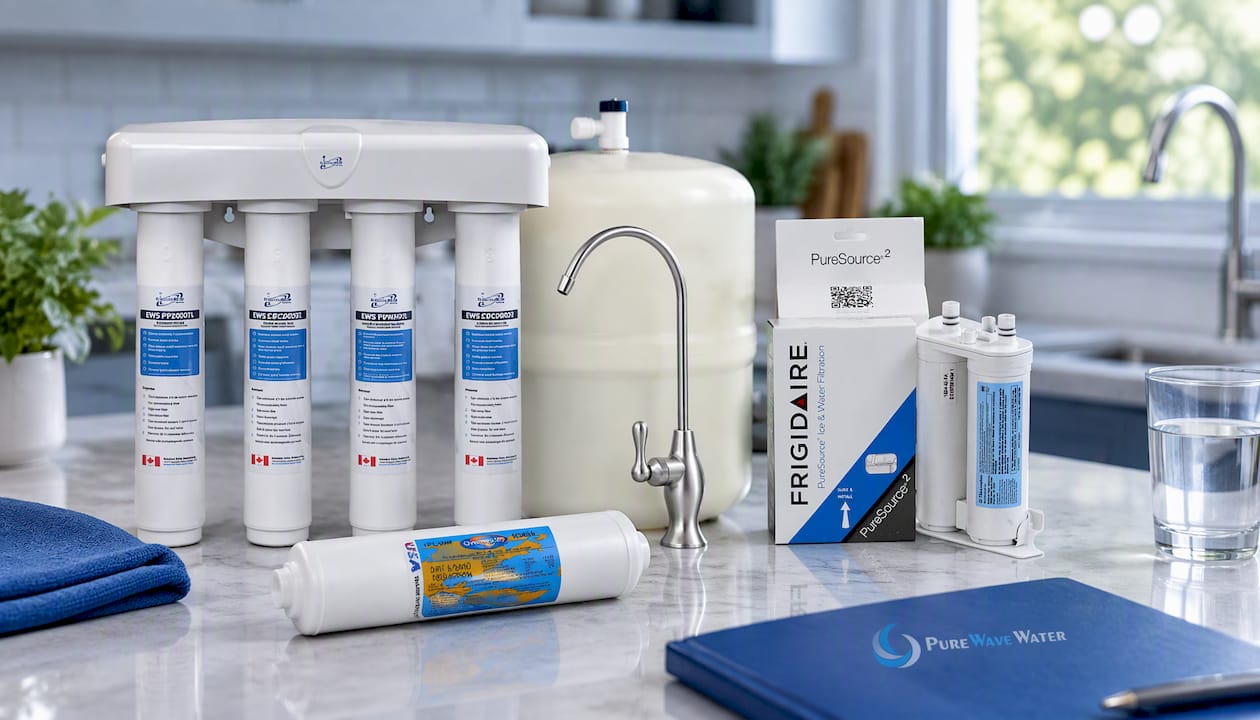
If you would rather start with a conversation, visit Pure Wave Water and tell us what you are seeing at the tap.
FAQ
What are the white particles in my tap water?
The most common answer is calcium and magnesium scale, often shed from a water heater or pipes. Other possibilities include hot-water-tank liner, faucet parts, softener resin beads and, for cloudy water, air. Check whether the particles appear in hot water only, at one faucet, or everywhere.
Can I drink water with white flakes in it?
If the flakes are mineral scale or tank liner, they are generally considered an aesthetic and plumbing problem rather than a health risk. You may want to filter the water for comfort, though. If you are on a well, or the flakes come with a smell, colour or taste change, test the water first.
Why is my water cloudy and white when it first comes out?
Milky water that clears from the bottom of the glass upward is almost always air bubbles. It is harmless and tends to follow plumbing work or temperature changes. If the cloudiness does not clear after a few minutes, something else is suspended in the water and testing is worthwhile.
Will a water softener stop white flakes?
If hard-water scale is the source, a properly sized softener reduces the calcium and magnesium that form it, so new scale stops building up. It will not remove flakes already loose in your heater or pipes, and it will not help if the cause is a failing tank liner or faucet part. Test your hardness before deciding.
How often should I test my water?
For a private well, Health Canada’s guidance is every six months for microbes and every two years for general quality, including hardness. Test more often after unusual events such as spring melt or flooding. Municipal customers can check their supplier’s reports and test at home only if something changes.
Sources
- Taste, odour and appearance, City of Ottawa drinking water FAQ
- Guidelines for Canadian Drinking Water Quality: Operational Parameters (PDF)
- Guidelines for Canadian Drinking Water Quality: Operational Parameters, Health Canada
- Particles in Water, American Water (PDF)
- Water Quality FAQs, Anchorage Water and Wastewater Utility
- Common Water Quality Issues, City of Toledo
- Well water and your health: Test your well water, Health Canada
- Testing and treating private water wells, Government of Ontario
- Faucet water filters: types, installation and cleaning guide
Recommended

Pure Wave Water shares educational content about water treatment, water softeners, reverse osmosis systems, UV purification, and filtration solutions. Our guides help readers understand water quality concerns, explore treatment options, and make informed decisions about their water treatment needs.