Hard water can leave minerals on your hair, and the evidence says it probably increases breakage over time. You can treat the buildup with a chelating shampoo and a moisture mask. You can prevent it by reducing the minerals before the water reaches your head. Start by finding out how hard your water actually is, because the right fix depends on the number.
TL;DR
- A 2025 systematic review found more calcium and magnesium on hair exposed to hard water, plus moderate-certainty evidence of reduced tensile strength. Evidence for other hair effects, such as dullness and texture, is weaker.
- Existing buildup is usually treated with a chelating shampoo once or twice a week, followed by a moisturizing mask. Over-cleansing can make dryness worse.
- Hair care manages the symptoms. A shower filter or a softener reduces the minerals themselves.
- Hard water may aggravate dry skin and eczema, but it does not cause eczema, and a softener is not a treatment for it.
- A free in-store water test at Pure Wave Water tells you your hardness before you spend money on any fix.
Table of Contents
- What hard water does to hair
- Signs your hair is reacting to hard water
- How hard is your water?
- Removing mineral buildup from hair you already have
- Can your hair recover?
- Hard water, dry skin and eczema
- Fixing the cause: from showerhead to whole home
- Our perspective
- Get the number, then choose the fix
- Practical habits that protect hair
- FAQ
- Sources
What hard water does to hair
Hardness comes from dissolved calcium and magnesium. When you wash, those minerals meet shampoo and soap, and some of them stay behind on the hair shaft and scalp. Health Canada notes that hard water increases soap consumption and that hardness ions precipitate as scale in hot-water pipes and appliances. The same chemistry is at work on a smaller scale on your head.
What the research shows is more specific than the marketing around it. A 2025 systematic review of nine hair studies found higher calcium and magnesium deposition on hair exposed to hard water. It also reported a moderate-confidence reduction in tensile strength, and concluded hard water probably increases premature breakage. Confidence in the other hair findings was very low.
The individual studies are not unanimous, which is typical of lab work on hair:
- A 2016 scanning electron microscopy study washed hair in water at 212.5 ppm calcium carbonate for 30 days. It found a ruffled cuticle surface, higher calcium deposition (0.804% against 0.26% in distilled water) and reduced hair thickness.
- A 2018 study of 70 hair samples found a significant drop in tensile strength after hard-water treatment compared with deionized water.
- A 2013 study using the same hardness level found no statistically significant difference in tensile strength or elasticity over 30 days.
The honest summary: minerals clearly deposit on hair, and breakage is the most likely consequence. How noticeable it is for you depends on your water, your hair type and how often you colour or heat-style.
Signs your hair is reacting to hard water
No single sign proves it, but a cluster of them, especially if they started after a move or a change in water source, is worth investigating.
- Hair feels coated, stiff or rough once dry, even after a thorough rinse.
- Shampoo lathers poorly and you use more of it than you used to.
- Hair feels sticky or slightly tacky after a shower, as if conditioner never fully rinsed out. Mineral and cleanser residue are common causes.
- Colour fades faster, or light hair looks dull or brassy.
- More breakage or frizz than your routine would explain.
- A dry, tight or itchy scalp.
Look at the rest of the house too. White scale on faucets and showerheads, cloudy glassware, soap scum on tile and a kettle that furs up quickly all point to the same cause. If the scale is the problem you notice most, our guide to removing limescale safely explains how to clean it and when a hardness test makes sense.
How hard is your water?
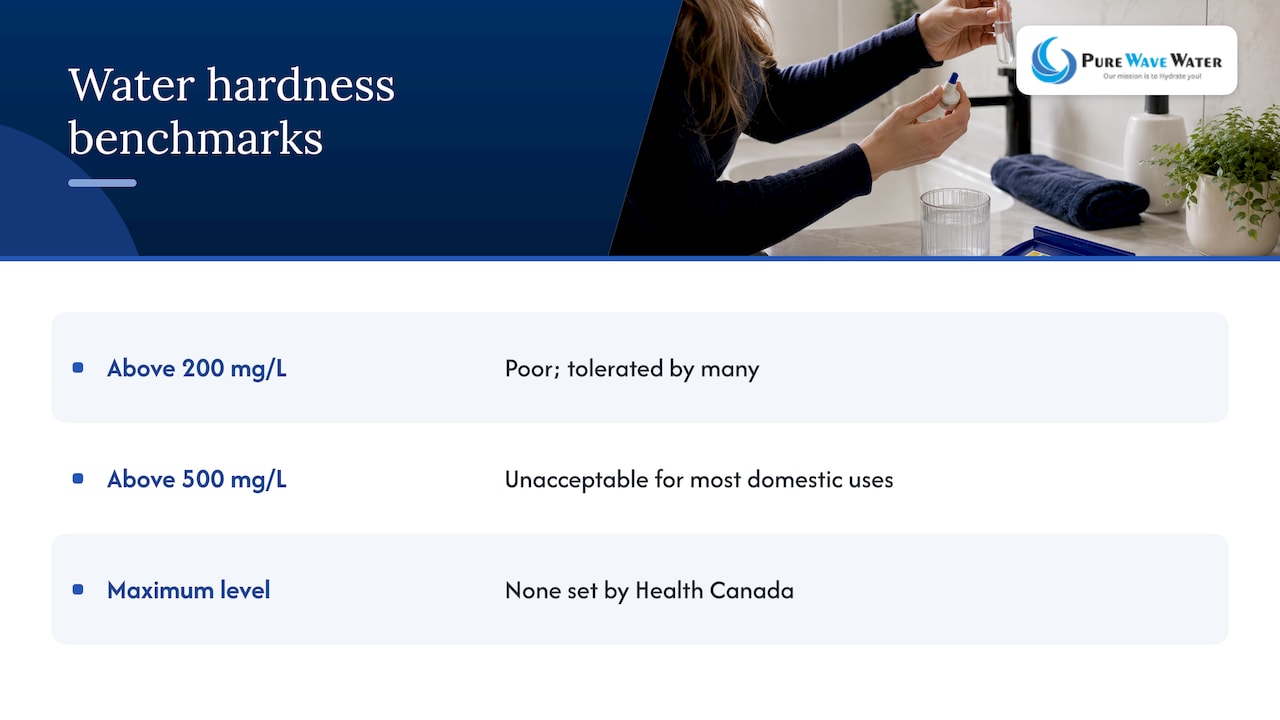
Health Canada has not set a maximum acceptable level for hardness. Its guideline document says water above 200 mg/L is considered poor but is tolerated by many consumers, and water above 500 mg/L is unacceptable for most domestic purposes. Health Canada also states that calcium and magnesium have low potential for toxicity through drinking water. Hardness is mainly an aesthetic and practical issue, not a health hazard.
Hardness varies a great deal across the country, and even between neighbouring properties on different supplies. Municipal customers can often find hardness in their annual water quality report. Rural homeowners on private wells have no such report, and Health Canada advises that private wells and other individual sources should be tested regularly. Well water in southern Ontario commonly passes through limestone, so it is worth measuring rather than guessing.
To get a number, bring a sample to our Georgetown store. We test for hardness, iron and other concerns at no charge. If you want a quick reading of total dissolved solids at home, a TDS-3 meter is a simple tool, though note it measures dissolved solids overall and does not replace a hardness test.
Removing mineral buildup from hair you already have
If your hair already feels coated, treat the deposit first, then fix the cause.
Use a chelating shampoo, sparingly
A chelating shampoo contains ingredients such as EDTA, citric acid or phytic acid (sodium phytate) that bind mineral ions so they can be rinsed away. Vogue’s 2026 expert review of shampoos for hard water describes these ingredients and warns that over-cleansing can worsen dryness. A Canadian salon’s guidance suggests using one once or twice a week, with a regular sulphate-free shampoo on other wash days and a deep moisture treatment after each chelating wash.
A clarifying shampoo is a milder option that removes general product and mineral residue. Chelating products are formulated specifically to bind mineral ions, which is why they suit hard-water areas better.
Follow with moisture
Chelating products remove the deposit and leave the hair open and thirsty. A hydrating conditioner or mask afterward restores slip and softness. Leave it on for the time stated on the label, then rinse thoroughly.
Rinse well
A Toronto-area salon recommends finishing with filtered or bottled water to wash off remaining minerals and help prevent film. It is practical for a short-term fix, though it adds effort every wash.
A simple weekly routine
| Wash day | Product | Follow-up |
|---|---|---|
| Day 1 | Chelating shampoo | Deep moisture mask |
| Day 2 or 3 | Gentle sulphate-free shampoo | Regular conditioner |
| Day 4 or 5 | Gentle sulphate-free shampoo | Regular conditioner |
| Day 6 or 7 (optional) | Second chelating wash if hair still feels coated | Deep moisture mask |
Adjust to your hair. Fine hair may need only one chelating wash a week. Coloured hair is often more delicate, so ask your stylist before using a strong chelating product.
Can your hair recover?
In most cases, yes, within limits. Deposits can be removed, and once they are gone, conditioners and treatments can reach the hair again. Professional salon guidance describes hard-water damage as manageable and reversible with the right approach. Hair that has already broken or split cannot be repaired, only trimmed, so expect new growth to be your best evidence of progress.
If you notice patchy hair loss, a very itchy or flaking scalp, or sore skin, see your family doctor or a dermatologist. Those symptoms have many possible causes, and water is rarely the only one.
Hard water, dry skin and eczema
Many people who ask about their hair are also noticing tight, dry skin after showers. Health Canada’s technical document treats hardness as mainly an aesthetic issue, while the clinical literature supports a plausible effect on skin. Hard water can leave mineral or soap residue and disturb the skin barrier, increasing water loss, particularly when cleansers are involved. That makes dry skin worse for some people, and sensitive skin is most affected.
Eczema deserves a careful answer. The Eczema Society of Canada says hard water may dry the skin more and aggravate atopic dermatitis, but does not cause eczema, and that triggers differ from person to person. A softener is not an established treatment for existing eczema. If you or your child has eczema, talk to your doctor or dermatologist about your skin care plan. Reducing hardness is something you can do alongside that plan, not instead of it.
Some practical habits help dry skin in hard-water homes:
- Use a fragrance-free, soap-free cleanser rather than bar soap.
- Keep showers short and lukewarm.
- Pat dry and moisturize while the skin is still damp.
Fixing the cause: from showerhead to whole home
Hair products deal with what has already landed. To stop minerals arriving, you have three levels of treatment.
| Option | What it does | Best for | Limits |
|---|---|---|---|
| Shower filter | Reduces some minerals at one outlet | Renters, light hardness, a first step | Covers only that shower. It is not a replacement for chelating shampoo. |
| Water softener (point of entry) | Exchanges calcium and magnesium for sodium or potassium for the whole house | Owners with scale, soap scum and dry skin throughout the home | Needs salt and periodic servicing |
| Reverse osmosis (drinking tap) | Removes minerals, including calcium and magnesium, from drinking water | Drinking and cooking water | Treats one tap, not your shower |
A shower filter can help reduce mineral content, and hair professionals recommend one as a supporting step. The mineral load is greatest at the whole-house level, though, which is why a softener is the usual answer when the problem shows up on your hair, skin, fixtures and appliances alike. For a general look at how point-of-entry softeners compare with shower filters, see this overview of water softener installation costs. Prices differ by region, so ask us for a written Ontario quote.
On certification, Health Canada recommends choosing treatment devices certified to the applicable NSF/ANSI standard: NSF/ANSI 44 for cation-exchange softeners and NSF/ANSI 58 for reverse osmosis. Ask for the certification of any unit you consider.
Two more points matter. First, reverse osmosis removes minerals from drinking water, but Health Canada notes that in Canada food is a more important mineral source than drinking water for most people. Second, if you already have a softener and your hair still feels off, the cause may be something else, such as iron, chlorine or sediment. A test sorts that out. Our guides on soap scum and 200 mg/L hardness and softener costs in Ontario show what sizing and budgeting look like once you have your numbers.
Our perspective
We see the same pattern in Georgetown and across Halton Hills: someone spends months and a good deal of money on shampoos, then walks in with a water sample and finds hardness is the missing piece. Hair care is worth doing, but it is a cleanup job. If minerals arrive with every shower, the routine never really ends.
That is why we start with a free in-store test and a plain recommendation. If your hardness is modest and your main concern is one shower, a filter and a good chelating routine may be all you need. If scale, soap scum and dry skin show up all over the house, a properly sized softener is usually the better investment, and we will quote it in writing. We only recommend the treatment the test supports.
Our technicians install and service the systems we sell, and most major brands as well, and we stock salt, filters, cartridges and membranes so you are not left hunting for consumables later.
CloudSprout16
Get the number, then choose the fix
Bring a water sample to Pure Wave Water in Georgetown for a free in-store test of hardness, iron and other concerns. We will explain the result, recommend only what you need, and, if a softener or filter makes sense, give you a written quote and arrange installation by our own technicians. If you prefer to shop first, browse softeners, filters and drinking water systems in our store, or see our installation and repair services.
If you already own a softener, check that you are using the right salt. Our guide to softener salt choices covers what to buy and why testing comes first.
Practical habits that protect hair
Whatever you decide on treatment, small habits cut the load on your hair:
- Rinse longer than you think you need to, so shampoo and conditioner leave no film.
- Use less product, more thoroughly distributed. Hard water makes products cling, so extra does not mean cleaner.
- Avoid scrubbing a dry scalp. Use fingertips, not nails.
- Wash your showerhead regularly. Scale can block the spray holes and change how the water hits your hair.
- Schedule trims to remove split ends that deposits have made brittle.
- Keep a note of what you changed and when, so you can tell whether the water or the products made the difference.
FAQ
Does hard water cause hair loss?
The research reviewed here points to breakage, not loss from the follicle. A 2025 systematic review concluded hard water probably increases premature breakage. If you see thinning at the scalp or patches, see your doctor, because many other causes are more likely.
Does hard water cause dry skin?
It can contribute. Mineral and cleanser residue may disturb the skin barrier and increase water loss, especially in sensitive skin. Health Canada describes hardness mainly as an aesthetic concern, so effects vary between people. A soap-free cleanser and prompt moisturizing help whatever your water.
Will a water softener fix my eczema?
Not on its own. The Eczema Society of Canada says hard water does not cause eczema but may make dryness and flare-ups worse for some people. Speak with your doctor about treatment, and treat softening as a possible supporting step.
Why does my hair feel sticky after a shower?
A tacky feel often comes from residue: shampoo or conditioner that has combined with minerals and not fully rinsed away. Rinse longer, use less product and try a chelating shampoo once a week. If it persists, get your water tested.
Sources
- Health Canada: operational parameters technical document (hardness, soap use, skin)
- Guidelines for Canadian Drinking Water Quality: hardness guideline
- Health Canada: Drinking water and health, treatment
- The Effects of Hard Water on Human Hair: A Systematic Review (2025)
- Scanning electron microscopy of hair treated in hard water (2016)
- Effects of Hard Water on Hair (2013)
- Hard water and hair tensile strength study (2018)
- Eczema Society of Canada: hard water and eczema
- Vogue: shampoo for hard water
- Hard water hair care routine from a Canadian salon
- Protecting hair from Toronto’s hard water
- Water softener installation costs and hiring guide
Recommended

Pure Wave Water shares educational content about water treatment, water softeners, reverse osmosis systems, UV purification, and filtration solutions. Our guides help readers understand water quality concerns, explore treatment options, and make informed decisions about their water treatment needs.