Most bad-tasting tap water comes down to a short list of causes: disinfectant (chlorine), seasonal algae in the source water, metals from household plumbing, new plastic or rubber parts, or minerals and sulfur in well water. The taste itself tells you where to start. Metallic usually points to pipes or iron, a swimming-pool taste to chlorine, earthy or musty to algae, and plastic to new or stagnant tubing. A few minutes of testing at home will tell you whether the problem is in the municipal supply, your plumbing or your well, and that decides the fix.
TL;DR
- Work out where the taste comes from first: compare hot and cold water, try another tap, and try a clean glass in another room.
- Chlorine and seasonal earthy tastes in municipal water are common, and the City of Toronto says water remains safe to drink during its late-summer algae events.
- A metallic taste often comes from copper or iron. Health Canada sets an aesthetic objective of 1 mg/L for copper.
- A sudden change in taste, smell or colour that does not clear after flushing deserves a call to your water utility or public health unit, and well owners should test.
- Once you know the cause, the fix is usually a filter matched to it, not a bigger system than you need. We test water free in-store in Georgetown.
Table of Contents
- Start with the taste you actually have
- Five quick checks before you spend anything
- Chlorine and chloramine: the pool taste
- Earthy or musty taste: algae and geosmin
- Metallic taste in water
- Water that tastes like plastic
- Rotten eggs, grass, dirt and other smells
- When bad taste means call someone
- Fixes that match the cause
- Our perspective
- Get your water tested in Georgetown
- FAQ
- Sources
Start with the taste you actually have
People describe bad water in different words, and the words matter. Use this table as a first sorting step, then confirm with the checks in the next section.
| What you notice | Most likely cause | Where it usually starts |
|---|---|---|
| Pool or bleach taste | Chlorine or chloramine disinfectant | Municipal supply |
| Earthy, musty, “muddy” | Geosmin from algae or soil microbes | Source water, often late summer |
| Metallic, bitter, coins | Copper, iron or manganese | Plumbing or well water |
| Rotten eggs | Hydrogen sulfide | Usually well water or a water heater |
| Plastic, rubber, chemical | New or stagnant plastic or rubber parts | Hoses, tubing, new fixtures |
| Salty or flat | Dissolved minerals | Well water, softener settings |
The causes are not exclusive. A home on a municipal supply with old copper plumbing can have chlorine and a metallic note at once. That is why the order of checking matters.
Five quick checks before you spend anything
The City of Portland’s troubleshooting guidance gives a sensible order, and it works in any Canadian home. Compare hot and cold water, take a clean glass to another room, check every faucet, then flush a cold tap for one to two minutes.
- Compare hot and cold. If only the hot water tastes or smells off, the water heater is the likely source. Hot water also releases odours more readily, which can make a mild problem seem worse.
- Use a clean glass. Soap residue, a dishwasher film or a dirty cup can taste like the water. Fill a freshly rinsed glass and move away from the sink, because the smell of a drain can be mistaken for the water.
- Try every tap. The City of Toronto notes that a taste or odour at one tap can indicate a private plumbing issue. If the kitchen tap is off but the bathroom is fine, look at that tap’s aerator, supply line or filter.
- Flush the line. Toronto recommends running cold water at the affected tap for about 10 minutes. Portland suggests one to two minutes for a basic flush. If the taste clears after flushing, the water was sitting in your plumbing.
- Ask the neighbours. If the whole street notices the same thing, the cause is probably in the municipal supply, and your utility will usually know about it.
Clean the aerator while you are there. Mineral grit and debris collect in it, and it takes two minutes to unscrew, rinse and replace.
Chlorine and chloramine: the pool taste
Municipal systems add disinfectant on purpose. The City of Toronto states that chlorine is added to ensure tap water is safe to drink, so a mild chlorine taste is a sign the system is doing its job, not a sign of contamination.
It can vary through the year. Metro Vancouver explains that chlorine taste or odour may be more noticeable when demand is high or in colder temperatures, because there is less time for it to dissipate and it can persist longer in cold water.
Two simple home steps help. Toronto advises that people sensitive to chlorine can fill a pitcher and let it stand overnight in the refrigerator. The chlorine will dissipate.
If the taste stays after standing, your utility may use chloramine instead of free chlorine. It does not off-gas the same way, so a stand-and-wait pitcher will not remove it. We cover that case in chloramine in tap water and how to remove it.
There is a related quirk worth knowing. The UK’s Drinking Water Inspectorate notes that chlorine can react with chemicals in kettles or with rubber and plastic plumbing parts to give antiseptic or medicinal tastes. If the water tastes fine cold but medicinal after boiling, descale the kettle before blaming the supply. Our guide to removing limescale safely walks through it.
Earthy or musty taste: algae and geosmin
If the water smells like soil or a damp basement, the cause is often natural. Toronto reports an earthy or musty taste or smell in late summer or early fall from naturally occurring algae and high temperatures in Lake Ontario, and states that the water remains safe to drink during these events.
Metro Vancouver adds that earthy or musty odours are often caused by geosmin, a non-toxic compound that can be produced by microbes, algae and soil bacteria. People differ in how sensitively they detect it, so one household member may complain while another notices nothing.
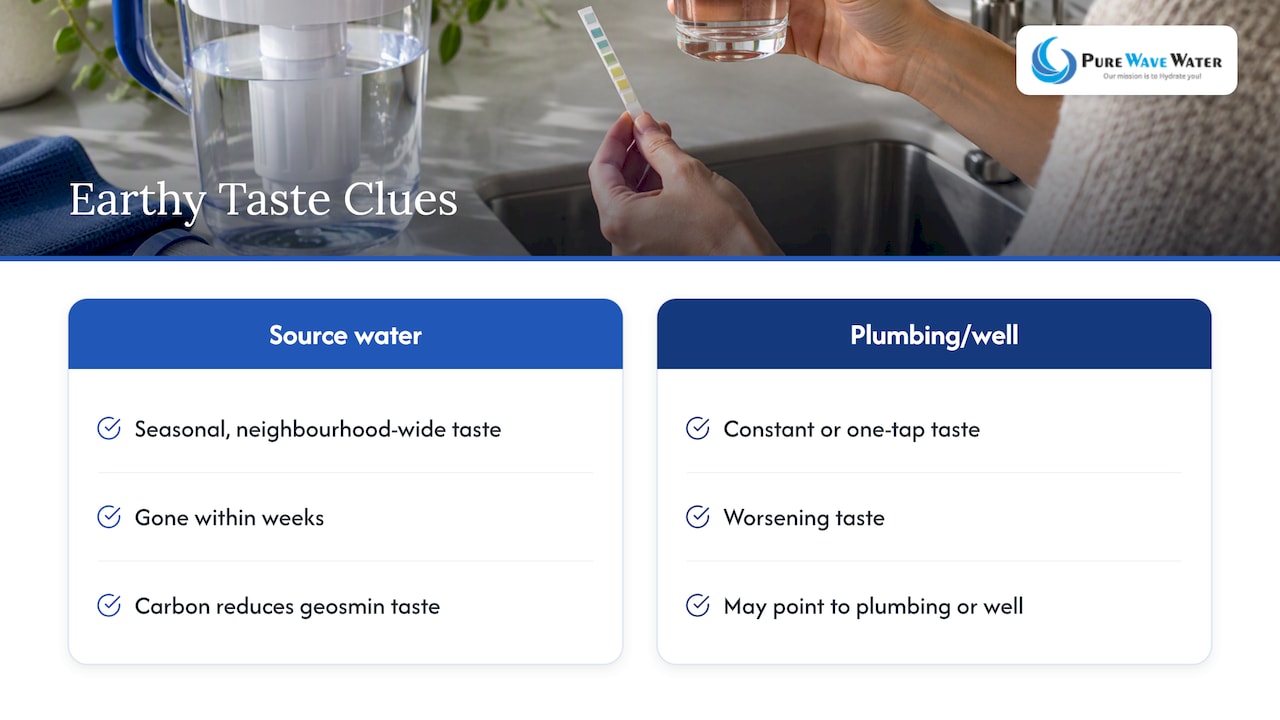
The pattern is the clue. Seasonal, affecting the whole neighbourhood and gone within weeks suggests the source water. Constant, specific to one tap or worsening suggests your plumbing or your well. An activated carbon filter, in a pitcher, under the sink or on a whole-home housing, is the usual way to reduce geosmin taste.
Metallic taste in water
This is the complaint people search for most, and it has three common sources.
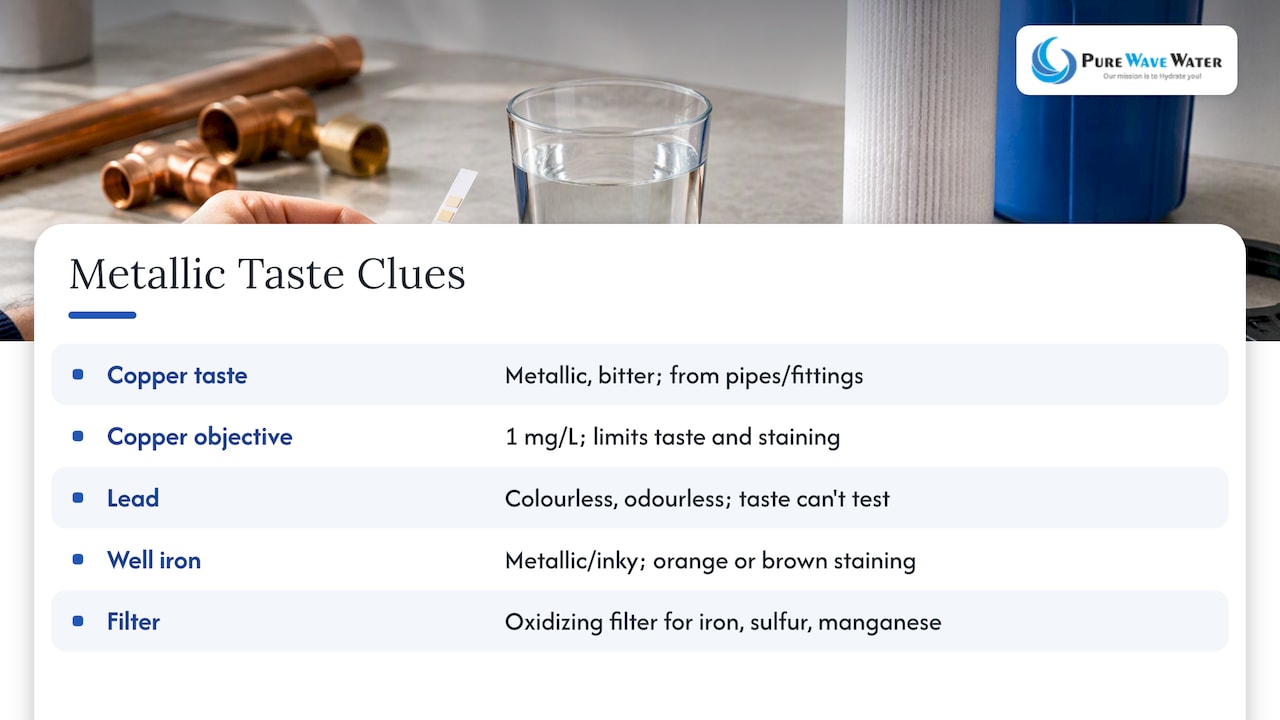
Copper. Health Canada’s guidance says copper can cause a metallic, bitter taste and can enter water from copper pipes and fittings. How much depends on water chemistry, the age of the plumbing and how long water sits in the pipes. That is why the first glass in the morning tastes worst. Health Canada’s aesthetic objective is 1 mg/L, set to limit staining and taste complaints.
Health Canada also states that short-term exposure to high levels of copper may cause nausea, stomach pain, vomiting and diarrhea. If you have a persistent metallic taste along with blue-green staining at fixtures, have the water tested for copper rather than guessing, and use the flushing habit meanwhile: run the cold tap until it turns noticeably colder before drinking or cooking.
Corroding iron or copper pipes. King County’s guidance notes that metallic-tasting water can come from corroding iron or copper pipes. The same page makes a point that matters for older homes: lead in water is colourless and odourless, so you cannot taste it. A metallic taste is not a lead test, and a lack of taste is not a clearance. If your home has older plumbing, ask your municipality about lead testing.
Iron and manganese in well water. On a private well, a metallic or inky taste with orange or brown staining points to iron, and sometimes manganese. The U.S. Geological Survey notes that most nuisance constituents occur naturally and are more likely to reach nuisance levels in groundwater, because groundwater reacts with aquifer rocks and sediments. Manganese deserves particular care, so read what to do if your well tests positive for manganese. If the metallic taste comes with a slimy film or a swampy odour, iron bacteria may be involved.
For iron, sulfur and manganese together, a dedicated oxidizing filter is the right category, such as the Zentec air injection hybrid filter for iron, sulphur and manganese. Sizing depends on your measured levels and flow, which is why we test first.
Water that tastes like plastic
A plastic taste is nearly always local to your home. Metro Vancouver explains that it can occur when water sits stagnant in plastic or rubber tubing for long periods, allowing compounds to leach into it. New plastic pipes, faucets or hoses can add the same taste, and it typically fades after a few weeks of regular use.
Work through the likely suspects:
- A new faucet, supply hose or filter cartridge installed recently.
- A fridge water line or ice maker that has sat unused.
- A reverse osmosis tank on a system that has not been drawn down in some time.
- A new plastic water bottle or dispenser reservoir that was not rinsed.
Flush new parts thoroughly, replace anything that stays off after several weeks, and draw down stored water in a tank or fridge line before drinking it. If your RO water tastes metallic or odd, the usual culprits are an overdue cartridge change or a tank that needs sanitizing, not the membrane alone.
Rotten eggs, grass, dirt and other smells
Taste and smell are linked, and most of what we call taste is aroma. A sulfur smell is a separate diagnostic path: check whether it is only in hot water, which points to the water heater, or in cold water as well, which points to the source. We lay the steps out in test, isolate, treat for sulfur smell in water.
If you notice black specks or white flakes alongside the taste, the water is shedding something from the plumbing or the equipment. Start with black specks in water or white flakes in water, since the particles tell you which part is breaking down.
When bad taste means call someone
Most taste problems are aesthetic, but a few signs call for action:
- A sudden change. The Washington State Department of Health advises that a sudden change in taste, smell or colour could indicate a public health concern. On a municipal supply, call your water utility. On a well, stop drinking the water until it is tested.
- A taste that does not clear after flushing, across several taps.
- Illness in the household that coincides with a change in the water.
- A private well that has never been tested, or has not been tested since a flood, a nearby spill or construction.
In Halton Hills, the first call for a municipal concern is your water provider. For well water, testing for bacteria through your public health unit is a separate step from the mineral and hardness testing we do in-store, and both are worth having.
Fixes that match the cause
The right treatment depends on what is in the water, not on how bad it tastes. Here is how we map the main causes to the main solutions.
| Cause | Typical fix | Notes |
|---|---|---|
| Chlorine, geosmin | Activated carbon filter (pitcher, under-sink or whole-home) | Whole-home carbon also helps showers and laundry |
| Chloramine | Catalytic carbon or reverse osmosis | Standing water will not clear it |
| Copper from plumbing | Flushing, then point-of-use reverse osmosis | Confirm with a test first |
| Iron, manganese, sulfur | Oxidizing filter, sometimes with a softener | Sized to measured levels |
| Hardness, scale | Water softener | Does not remove chlorine taste |
| Dissolved solids, mixed tastes | Reverse osmosis | Best single drinking-water upgrade |
| Plastic taste from new parts | Flushing, time, replacement | No equipment usually needed |
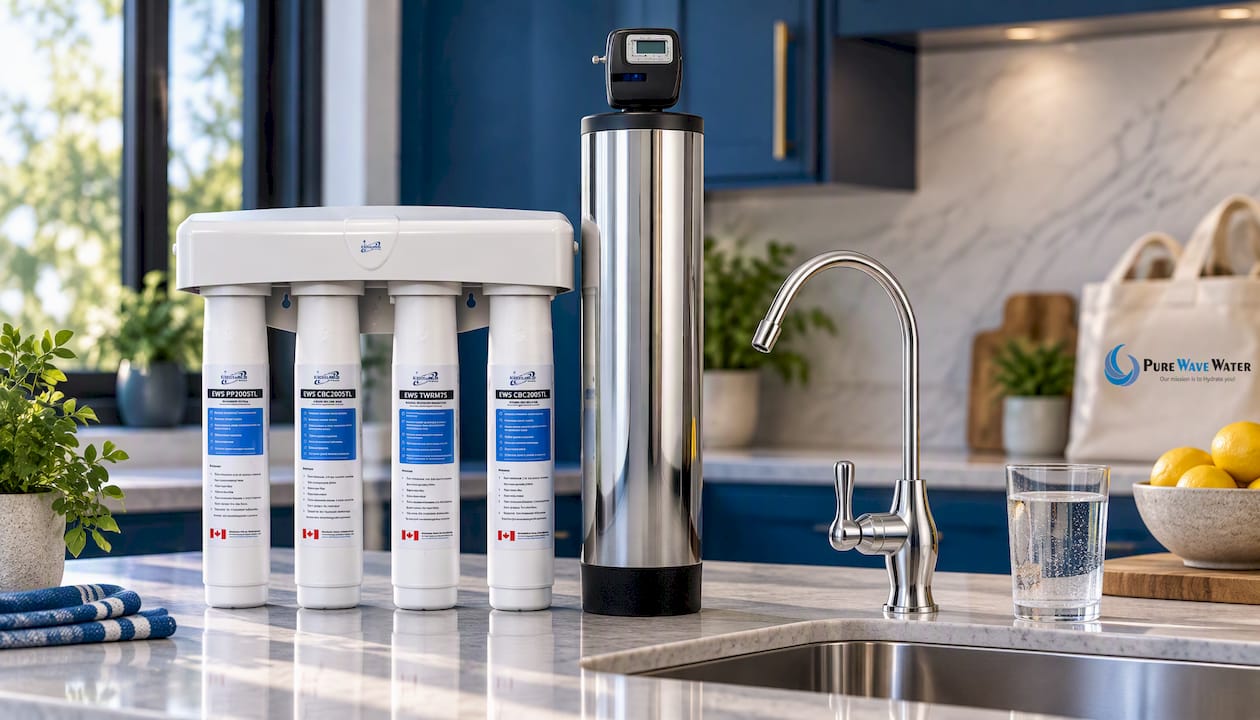
Reverse osmosis deserves a closer look because it handles the widest range of drinking-water tastes at one tap. A countertop or under-sink unit treats only the water you drink and cook with. Our Sureflo Preferred Reverse Osmosis System is one example, paired with a dedicated drinking tap such as the Smart Purifier Plus RO faucet in chrome. Whatever you choose, look for NSF/ANSI certification claims that match your concern. Filters certified to NSF/ANSI 42 address aesthetic effects like chlorine taste, and RO systems are typically certified to NSF/ANSI 58. Ask for the product’s certification documents rather than relying on the box.
If you also buy bottled or delivered water, it helps to understand what you are paying for. The difference between distilled versus purified water explains why some bottled options taste flat while filtered tap water keeps its minerals.
Our perspective
We see the same pattern every week in Georgetown and across Halton Hills: someone has spent money on a filter pitcher, then a bigger filter, and the taste is still there, because nobody identified what they were treating.
That is why we start with a free in-store water test and recommend only what the result supports. A chlorine complaint, a copper complaint and an iron complaint look alike at the glass, and each needs a different answer. If your water just needs a carbon cartridge, that is what we will tell you. If it needs a softener, an oxidizing filter or reverse osmosis, we will show you why.
Bring a sample from the tap that bothers you, and tell us what you notice: when it is worst, whether it is hot or cold, whether the neighbours have noticed. Those details narrow the cause faster than any brochure. Our technicians also install and service systems, including most major brands, and we supply the consumables afterwards: cartridges, membranes, UV lamps, salt and media. A system is only as good as its maintenance, and an overdue cartridge is a common reason a taste comes back.
CloudSprout16
Get your water tested in Georgetown
If your tap water tastes off and you are not sure why, bring a sample to us. We offer free in-store water testing for hardness, iron and other water-quality concerns, then recommend only the treatment or product you need. If you would rather have a technician handle it, our installation and repair services cover new systems and servicing of existing ones, with written quotes.
Shopping from home? Browse reverse osmosis, filtration systems, housings and filters, softeners and replacement supplies in our online shop, or start at Pure Wave Water to book testing and maintenance.
FAQ
Is bad tasting tap water safe to drink?
Often, yes. Chlorine tastes and seasonal earthy tastes from algae are common in municipal supplies, and the City of Toronto says water remains safe during its late-summer events. A sudden change, a taste that persists across taps, or any illness is a reason to contact your utility or public health unit, and well owners should test.
Why does my tap water taste metallic?
The usual causes are copper or iron from household pipes, or iron and manganese in well water. Health Canada notes that copper can cause a metallic, bitter taste. A water test tells you which metal it is, since you cannot tell by taste alone, and lead has no taste at all.
Why does my water taste like plastic?
Plastic or rubber tubing, new fixtures, hoses or filters can release compounds, especially when water has sat in them. Metro Vancouver notes this typically fades after a few weeks of regular use. Flush the line, and replace the part if the taste stays.
Will a water softener fix the taste?
A softener removes hardness minerals and can reduce some iron, but it does not remove chlorine taste or most odours. If taste is the main concern, a carbon filter or reverse osmosis is the more direct answer. Many homes with hard water use a softener for the whole house and RO for drinking.
How long should I let the tap run to clear the taste?
Portland suggests one to two minutes of cold water as a basic flush, and Toronto recommends about 10 minutes at an affected tap. Start short, and extend it if the taste is stale or metallic after the water has sat overnight or while you were away.
Sources
- Tap Water Taste or Odour, City of Toronto
- Drinking Water Quality and Testing, Metro Vancouver
- Water Talk: Copper in Drinking Water, Health Canada
- Taste and odor issues in drinking water, Portland.gov
- Why does my water look, taste, and smell strange? King County
- Drinking Water Taste and Odor, U.S. Geological Survey
- Taste and Odour in Drinking Water, Drinking Water Inspectorate
- Color, taste and odor problems in drinking water, Washington State Department of Health
Recommended

Pure Wave Water shares educational content about water treatment, water softeners, reverse osmosis systems, UV purification, and filtration solutions. Our guides help readers understand water quality concerns, explore treatment options, and make informed decisions about their water treatment needs.