Scale on a tankless heater is mineral buildup, mostly calcium and magnesium, that bakes onto the heat exchanger whenever hard water is heated. It cuts efficiency, restricts flow and can trigger overheating faults. The fix has two parts: flush the unit with food-grade white vinegar on a regular schedule, and soften the water so the scale stops forming. In Georgetown and Acton, where many newer homes have tankless heaters and the water can be very hard, that second part matters more than the first.
TL;DR
- Heating hard water makes dissolved calcium and magnesium precipitate out as scale on the heat exchanger, which reduces heat transfer and can cause overheating.
- Warning signs include error codes, temperature swings and weak hot-water flow, but vents, valves and drains can cause the same faults, so rule those out first.
- Descaling means circulating undiluted food-grade white vinegar through the unit with a pump. Follow your own manual for volumes and timing.
- Many manufacturers’ warranties reference water hardness limits, so check your manual before scale becomes a claim problem.
- The protection plan we recommend is a water softener plus an annual flush, starting with a free hardness test.
Table of Contents
- Why scale forms on a tankless heater
- Signs your tankless heater has scale
- How to descale a tankless water heater
- How often should you flush it?
- Warranty and hardness limits
- Preventing scale: softener plus annual flush
- Our perspective
- Get your water tested
- FAQ
- Sources
Why scale forms on a tankless heater
Hardness in Canada is defined by dissolved calcium and magnesium ions. Health Canada’s operational guidance explains that these ions precipitate out as carbonate and hydroxide salts when the water is heated. The same document notes that total dissolved solids above 500 mg/L can lead to excessive scaling in pipes, heaters, boilers and appliances.
A tankless heater is an unusually demanding place for that to happen. Water passes through narrow channels in the heat exchanger and is brought from cold to hot in seconds, so the metal surface runs far hotter than a tank’s element bathed in a large volume of water. Plumbing & Mechanical describes tankless heat exchangers as extremely vulnerable to limescale: deposits make the unit work harder to transfer heat, reduce efficiency, shorten its life and can cause overheating.
Think of scale as insulation. A thin crust between the flame (or element) and the water means the heater must burn more fuel or draw more power for the same temperature. As the crust thickens, it also narrows the channels, which is why flow drops.
How hard is Georgetown water?
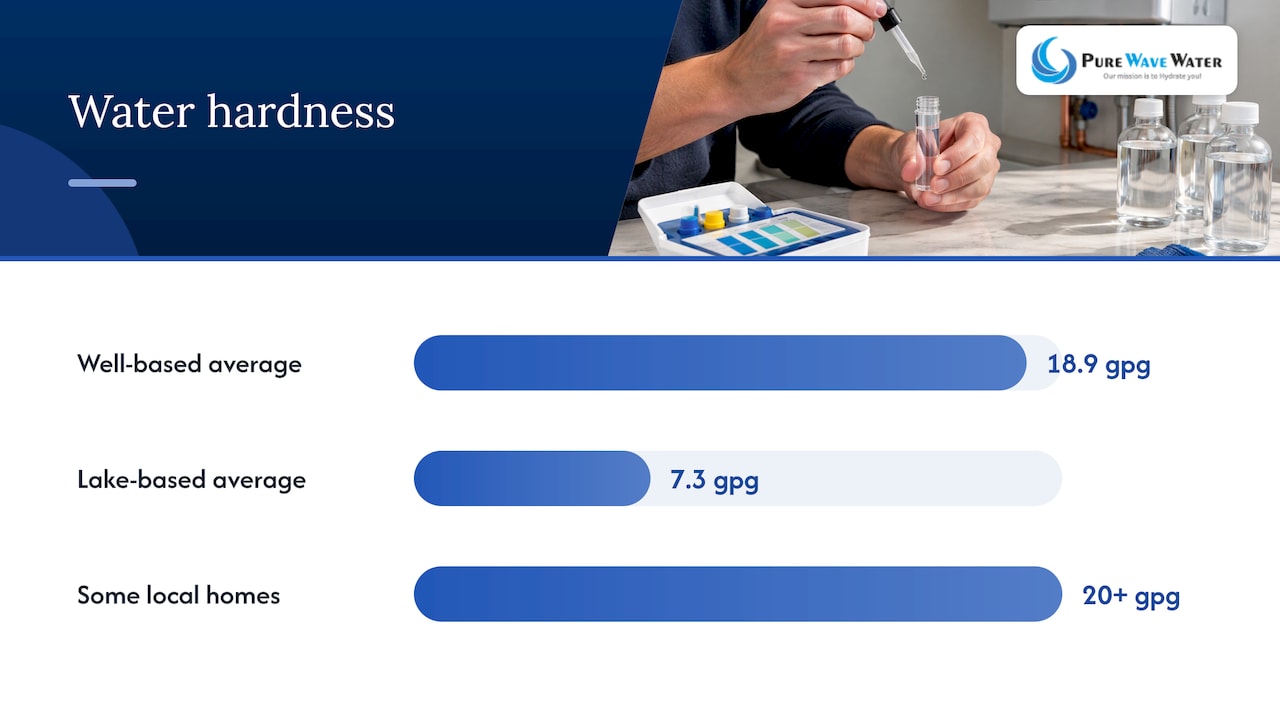
Hardness depends on where your water comes from. According to the Halton Region averages summarised on our Georgetown water hardness page, well-based municipal supply averages about 324 mg/L (roughly 18.9 grains per gallon), while lake-based supply averages about 124 mg/L (roughly 7.3 grains per gallon). Those are distribution averages, not a promise about your tap. Many homes in Georgetown and Acton sit at 20 gpg or more, which is very hard by any standard, and private wells vary again from property to property.
That is why we start with a measurement of your own water rather than a guess.
Signs your tankless heater has scale
Scale rarely announces itself on day one. It builds over months and years, and the symptoms creep in slowly enough that people adapt to them. Watch for:
- Error codes. Many units log a fault when the heat exchanger overheats or flow is restricted. Codes differ by brand, so your manual’s code table is the reference.
- Fluctuating temperature. Hot water that swings between scalding and lukewarm, or a “cold sandwich” gap during a shower, can mean the unit can no longer hold its set point.
- Low hot-water flow. If the cold side of a fixture runs at full pressure but the hot side is weak, narrowed channels or a clogged inlet filter are likely suspects.
- Rising energy bills with no change in household habits.
- Rumbling or popping sounds as water boils in scaled passages.
- White flakes or grit at faucet aerators and showerheads. Our guide to white flakes in water explains what they are and whether they are a concern.
Rule out other causes first
Scale is not the only reason a tankless heater faults. A neglected unit can throw error codes, but blocked vents, condensate drain problems and partly closed valves can produce the same symptoms. Before you spend an afternoon with a pump and a bucket of vinegar, confirm the gas supply, isolation valves, vent and condensate line are all in order. If the problem is hot water that has stopped entirely, this guide to other causes of no hot water helps you separate a scale issue from a simple fault.
If you see white scale on faucets, glass and kettles as well, that is a strong hint the heat exchanger is seeing the same minerals. Our page on removing limescale safely covers the household side of the problem.
How to descale a tankless water heater
Descaling, also called flushing, dissolves the mineral crust with a mild acid and carries it out. The method below follows Rinnai’s flushing procedure for its SENSEI models. Other brands specify their own volumes, times and valve positions, so treat it as an illustration and follow your own manual.
What you need
- A small submersible pump (the manufacturer’s flow rate matters, so check it)
- Two hoses that fit your service valves
- A clean bucket
- Undiluted, food-grade white vinegar
- Fresh water for the rinse
Steps
- Disconnect power to the heater. For a gas unit, that means unplugging it or switching off the circuit; ask a licensed gas technician if you are unsure about any gas connection.
- Close the hot- and cold-water shutoff valves on the unit.
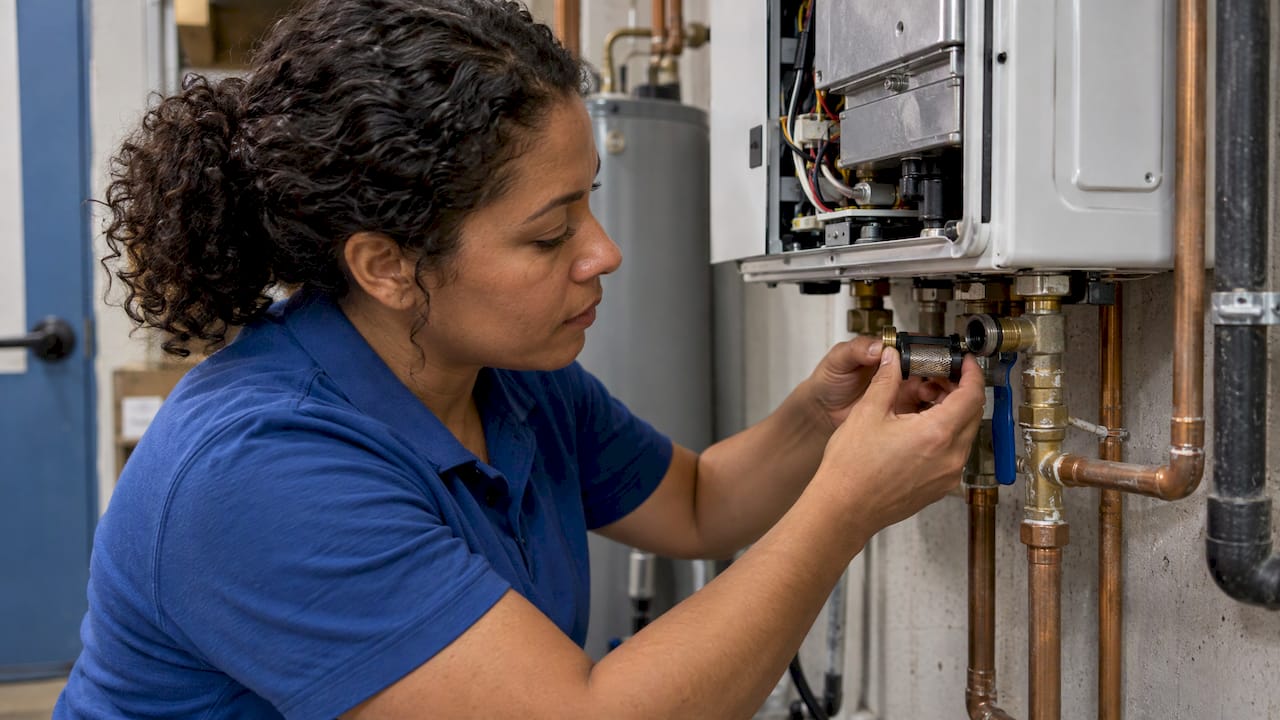
- Connect the pump hoses to the service valves so the vinegar flows from the bucket, through the heat exchanger and back to the bucket in a closed loop.
- Circulate the vinegar. For applicable SENSEI models, Rinnai specifies four gallons of undiluted food-grade white vinegar circulated for at least one hour at 3 to 4 gallons per minute.
- Rinse thoroughly. Rinnai calls for rinsing the heater with water for five minutes before restoring power.
- Clean the inlet filter screen, reopen the valves, check for leaks and restore power.
Expect the whole job to take longer than the circulation time alone, because setup, draining and the rinse all add to it. Heavily scaled units may need a longer circulation than a lightly scaled one, which is one reason a technician’s inspection is worth having if you have never flushed yours.
Can you use vinegar?
Yes, food-grade white vinegar is the common descaler, and Rinnai’s procedure specifies it for the models above. Do not substitute stronger acids unless your manufacturer names them. Pour the used vinegar down a drain with plenty of water, and ventilate the room while you work.
Some homeowners read forum threads advising against descaling at all. A unit that has been neglected for years can have heavy deposits, and a technician can assess it before you start. For regular maintenance on a unit that has been flushed on schedule, the procedure above is routine.
How often should you flush it?
There is no single number that fits every home. Manufacturers state that hard water may call for a more frequent flushing schedule than a standard one. For example, Rinnai’s SENSEI RX manual recommends a softener or scale-prevention device once hardness passes a moderate level and notes that harder water may require more frequent flushing.
A practical way to set your schedule:
| Your situation | Sensible approach |
|---|---|
| Softened water entering the heater | Annual flush, plus cleaning the inlet filter |
| Unsoftened water in a very hard area, such as parts of Georgetown or Acton | Flush more often than your manual’s standard interval, and plan to add a softener |
| Private well with unknown hardness | Test first, then set the schedule from the result |
| Symptoms already present (codes, temperature swings) | Rule out other faults, then flush now |
For more on maintenance routines and timing for tankless units, see this overview of tankless descaling and maintenance schedules.
Ask yourself one more question: when did you last flush the unit? If the answer is “never” and the house is more than a few years old, do it now and note the date on the heater.
Warranty and hardness limits
Many tankless manufacturers publish a maximum hardness in their installation manual, and many warranties reference it. Damage traced to water quality can fall outside coverage. Rinnai, for example, states in its residential warranty document that improper installation or alteration can void the warranty and that replacing components because of water-quality damage is not covered.
We will not quote a number for your brand, because the limits differ and change between models. Do this instead:
- Find your heater’s model number on the rating plate.
- Open the installation and operation manual, or find it on the manufacturer’s Canadian site.
- Look for the sections on water quality, hardness and the warranty terms.
- Compare that figure with a measured hardness from your own tap.
If your water is harder than the manual allows, softening it is the straightforward way to bring the installation back inside the manufacturer’s conditions.
Preventing scale: softener plus annual flush
Flushing removes scale that already exists. A softener stops most of it from forming. Together they are the protection plan we recommend for tankless owners in hard-water areas.
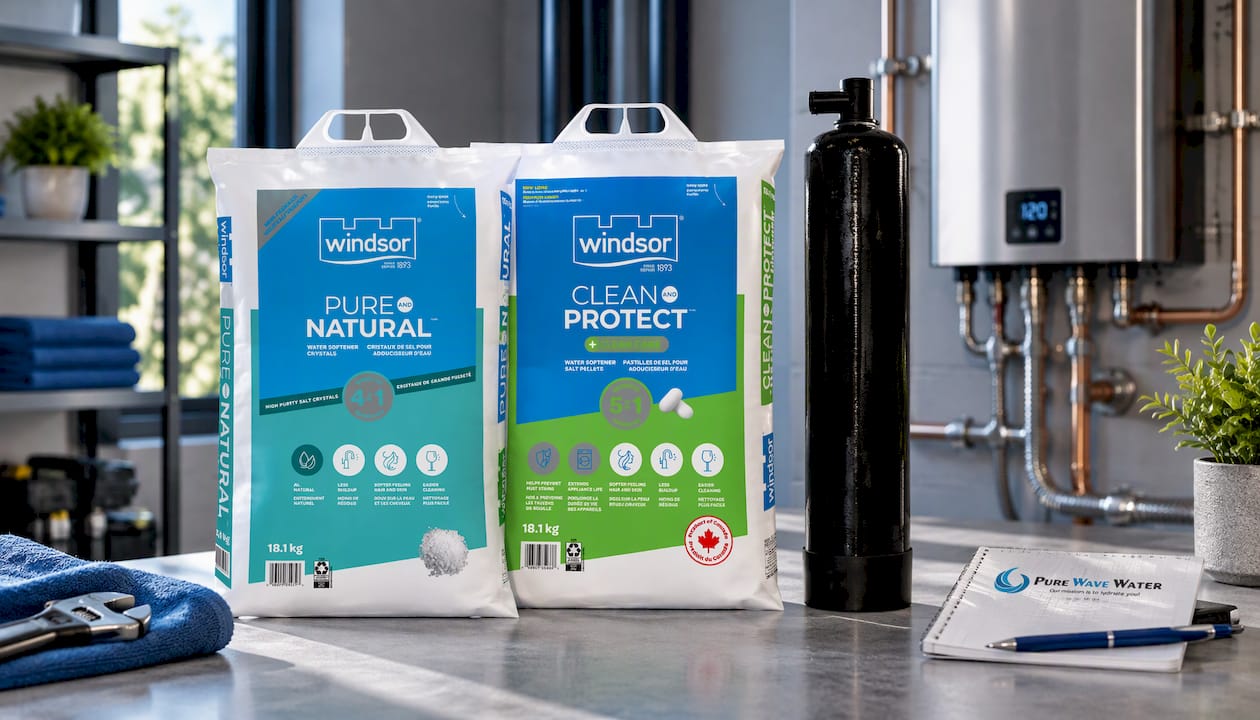
Water softener. A softener exchanges calcium and magnesium for sodium or potassium before the water reaches the heater. Our water softener cost guide for Ontario explains what drives the price of a system and why testing comes first. Two options in our shop:
- The Excalibur Value Series softener, a sound choice for a household that wants reliable softening at a sensible entry point.
- The Excalibur Ultimate Series softener, the premium line for homes that want a more capable system.
A softener needs the right salt to work well. See our guide to choosing softener salt before you order.
Annual flush. Even with softened water, a yearly flush clears fine sediment and any residue, and it gives you a chance to check the inlet screen.
Scale-inhibiting filters. Another approach is a filter that turns hardness minerals into inactive crystals that pass through the heater without sticking to the heat exchanger. Whichever method you choose, match it to your measured hardness and your manufacturer’s requirements.
Temperature. Setting the heater no higher than you need also limits how aggressively minerals precipitate, since scale forms when water is heated. Your manual will give the settings available for your unit.
Why not just descale forever?
You can, but it is repeated work on a unit that is meant to run quietly for years. Every hot shower in very hard water adds a little more crust. A softener changes the water itself, so it also protects your dishwasher, washing machine, faucets and shower glass. If soap scum on tile is part of your story, see our page on soap scum and 200 mg/L hardness.
Our perspective
We see the same pattern across Georgetown and Halton Hills: a newer home, a tankless heater installed with no water treatment, and a few years later a homeowner wondering why the hot water has gone unreliable. The heater is rarely the real problem. The water is.
That is why we begin with a free in-store water test for hardness, iron and other concerns, and then recommend only the treatment you actually need. If your test shows hard water, a softener paired with an annual flush is the most direct way to protect a tankless unit. If it shows something else as well, such as iron or sediment, we will tell you that too.
Our own technicians install and service systems, and they work on most major brands, not only the equipment we sell. We provide written quotes, and we keep supplying the salt, filters and other consumables afterwards, so protection does not stop on installation day.
CloudSprout16
Get your water tested
Bring a water sample to our store at 333 Mountainview Rd S, Georgetown, or call us on 905-702-2700. We test hardness and other concerns at no cost, explain the result in plain terms, and recommend a fix that fits your home. If you need a softener, salt or replacement parts, you can browse the full online shop, and our installation and repair services cover fitting, servicing and maintenance.
Ready to find out how hard your water really is? Book your free hardness test and bring your heater’s model number so we can check it against the manual’s water-quality requirements.
FAQ
How long does it take to descale a tankless water heater?
The circulation step is at least one hour for the Rinnai SENSEI procedure, followed by a five-minute rinse. With setup, draining and cleaning the inlet screen, plan for a good part of a morning or afternoon. A heavily scaled unit may need longer, so follow your manual.
What are the first signs of scale?
The early signs are usually a hot-water temperature that wanders, weaker hot-side flow and the occasional error code. Check vents, valves and the condensate drain too, because they cause similar faults. White flakes at aerators can also point to mineral buildup upstream.
Can I put vinegar in a tankless water heater?
Yes, but it is circulated through the heat exchanger with a pump rather than poured in. Use undiluted, food-grade white vinegar, and follow your manufacturer’s volume, flow rate and rinse steps. Rinnai’s published procedure for its SENSEI models is one example.
Does my warranty depend on water hardness?
Many manufacturers’ warranties reference hardness limits or exclude damage caused by water quality. Because limits vary by brand and model, read the water-quality and warranty sections of your own manual and compare them with a tested hardness reading.
Sources
- Health Canada: Guidelines for Canadian Drinking Water Quality, operational parameters
- Plumbing & Mechanical: Preventing scale damage in tankless water heaters
- Thermomate: 5 signs it’s time to descale your tankless water heater
- Rinnai: Optimized flushing procedure for SENSEI tankless water heaters
- Rinnai: SENSEI RX/RXP residential owner’s installation and operation manual
- Rinnai: Residential SENSEI tankless water heater warranty document
Recommended

Pure Wave Water shares educational content about water treatment, water softeners, reverse osmosis systems, UV purification, and filtration solutions. Our guides help readers understand water quality concerns, explore treatment options, and make informed decisions about their water treatment needs.