If you are buying a house with a well in Ontario, do four things before you remove conditions: get a bacteria test and a full chemistry test, ask the seller for the well record and recent results, have the well, pump, pressure tank and treatment equipment looked at, and make your offer conditional on the water results. This checklist is written for rural Halton Hills (Limehouse, Terra Cotta, Ballinafad and the Glen Williams outskirts), Caledon and Erin.
TL;DR
- A free bacteria test through Public Health Ontario covers E. coli and total coliforms only. It does not tell you about hardness, iron, manganese, sulphur, nitrate, sodium or tannins, so add a full chemistry test.
- Ask for the well record, past water results, and the age and service history of the pump, pressure tank and any treatment equipment.
- Look at the well cap, the grade around the casing and the distance to septic systems and other contamination sources.
- Write water results into your offer as a condition, and leave enough time for lab turnaround and a second look if something is off.
- Most problems have a treatment answer. Know which one you are paying for before you close.
Table of Contents
- What is different about a house on a well
- Step 1: Test the water twice, with two different tests
- Step 2: Ask the seller for records and results
- Step 3: Inspect the well and the equipment
- Step 4: Understand typical fix costs (without quotes)
- Step 5: Make the offer conditional on water results
- Our perspective: treat the water as a line in the purchase price
- What a good outcome looks like
- Water testing and treatment from Pure Wave Water
- FAQ
- Sources
What is different about a house on a well
With municipal water, a utility tests and treats the supply for you. On a private well, you are the operator. Ontario has no requirement for owners of private wells serving five or fewer homes to treat or test their drinking water, according to the Auditor General of Ontario’s 2025 audit. The province regulates how wells are constructed, maintained and abandoned, but it does not check your water for you.
That has a practical meaning for a buyer. Nobody is obliged to hand you a water test when you buy, so unless you ask for one, you may not have one. Your conditional period is the cheapest time to learn what the water is like and what the equipment around it is worth.
Step 1: Test the water twice, with two different tests
Buyers often hear “get the water tested” and book one test. You need two, because they answer different questions.
The bacteria test
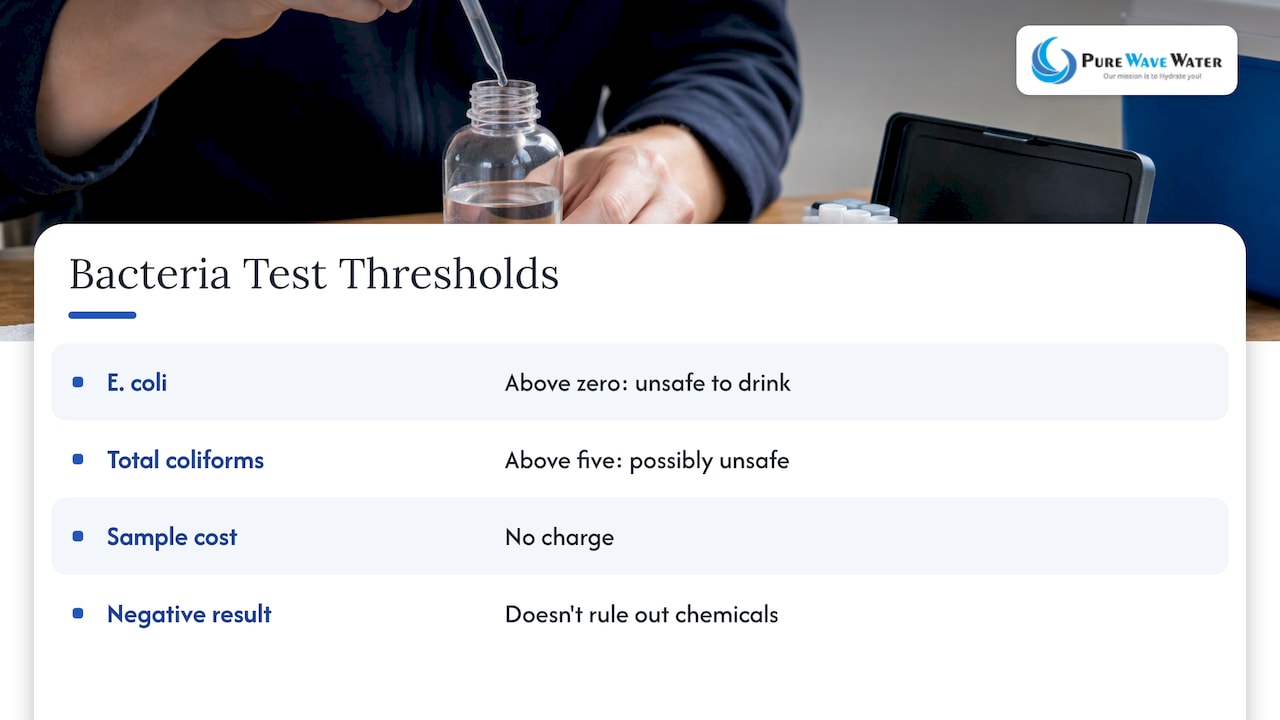
Public Health Ontario Laboratories test private well samples for E. coli and total coliforms. The sample bottle comes from your local public health unit or a designated pickup location, and private well owners can submit samples at no charge. Ontario guidance treats any E. coli above zero as unsafe to drink, and total coliforms above five as possibly unsafe. If a result is unacceptable, stop drinking the water, use another source and contact your local public health unit.
A clean result is good news, but it is narrow. Public Health Ontario’s tests do not cover chemicals, so a negative bacterial result does not rule out other contaminants. Public health guidance also describes a sample as a snapshot of the water at the time it was collected, which is why a seasonal pattern matters. Our guide to fall well water testing in Ontario explains how timing affects what a single sample can tell you.
If the bacteria test comes back positive, do not panic and do not assume the house is a write-off. Our page on coliform in well water walks through boiling, shock chlorination and retesting.
The full chemistry test
This is the test that tells you what living with the water will be like, and what treatment it needs. Ask for these parameters:
| Parameter | What it tells you | What it often leads to |
|---|---|---|
| Hardness | Scale on fixtures, kettles and water heaters; soap scum; dry skin | Water softener |
| Iron | Orange or rust staining, metallic taste | Iron filter, sometimes a softener for low levels |
| Manganese | Black staining; a health-related limit applies | Oxidizing filter; see manganese in well water |
| Sulphur (hydrogen sulphide) | Rotten-egg smell | Air injection or other oxidizing filtration; see sulphur smell in water |
| Nitrate | Can indicate fertilizer, manure or septic influence | Reverse osmosis at the drinking tap; see nitrates in well water |
| Sodium | Matters for people on sodium-restricted diets, and rises with salt-based softening | Informs the softener and drinking-water decisions |
| Tannins | Yellow or brown tint, often from organic matter | Specific media or filtration chosen to match |
Bring the lab report to a treatment specialist rather than guessing from the table. Several of these issues overlap (iron and manganese often travel together, and sulphur smells can come from iron bacteria), so the order of treatment steps matters. The page on iron bacteria in a well covers one common overlap.
Where we come in during your conditional period
We test hardness, iron and other water-quality concerns in our Georgetown store at no cost, and we recommend only the treatment the results call for. Bring a fresh sample in a clean container during your conditional period and we will help you read what it means for the house you are buying. A bacteria test still has to go through the public health lab, and a full chemistry panel is the right companion to it.
Step 2: Ask the seller for records and results
Three documents are worth requesting in writing.
- The well record. Ontario’s well record states how the well was constructed, where it is, the pumping-test results, and general information on water quality and groundwater. The province also explains how to find and use well records. If the seller does not have a copy, ask whether one was kept when the well was last serviced.
- Recent water test results. Ask for the dates and the lab. A result from five years ago says little about the water today, and a result with no lab name is hard to rely on.
- Service and maintenance history. Pump replacements, pressure tank changes, shock chlorination, filter or softener servicing, and any past complaints about taste, odour, staining or running dry.
Also ask about the well type and approximate age, and do not assume every rural-looking property has the same kind. A drilled well and an older dug well carry different contamination risks, and a dug well deserves closer attention to its cover and surroundings.
If an agent tells you the well is “failing”, ask what that means in practice before you decide anything. The word is used loosely. It might point to low yield in late summer, a pump near the end of its life, a failed bacteria test, or a poorly sealed casing. Each has a different remedy and a very different cost, so ask for the inspection report or the test result behind the comment and have a well professional look at it before you walk away or negotiate.
Step 3: Inspect the well and the equipment
The water you drink passes through a system: the well, the pump, the pressure tank, the controls and any treatment equipment. Ask about the age, maintenance history and known problems of each part, rather than judging the house by the water alone. A well-organized home plumbing maintenance checklist is a useful way to think about the plumbing side of that walk-through.
The wellhead
- Cap and seal. The cap should be secure and watertight. Ontario public health guidance says the cap should sit at least 30 cm above ground, and the Ontario Ground Water Association’s checklist gives at least 0.3 m, the same height.
- Grade. Ground should slope away from the casing so surface water does not pool around it. Ontario guidance explains that surface water can contaminate a well and that proper casing height and a secure lid are meant to keep it out.
- Casing. Look for cracks or poorly sealed joints and connections.
- Dug wells. Check that the cover is intact and tight.
Distances from contamination sources
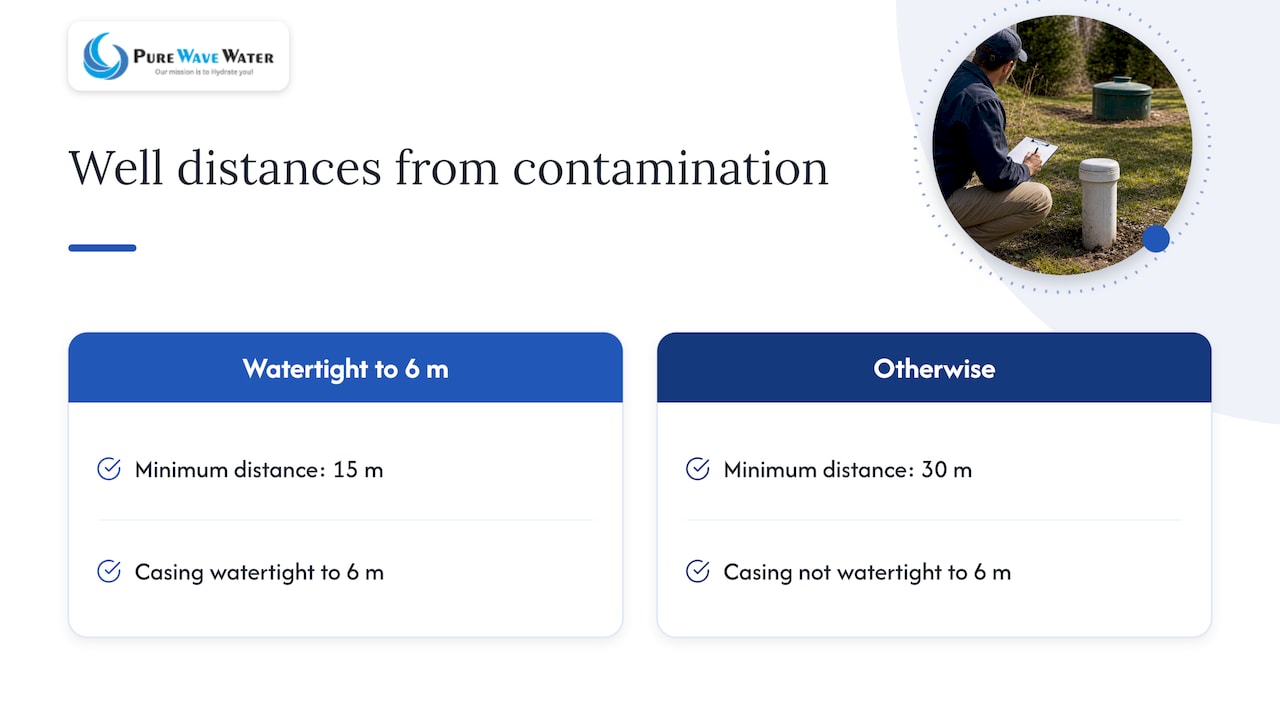
The Ontario Ground Water Association’s buyer checklist advises checking how far the well is from septic systems, manure or fuel storage, agricultural fields and roads. It gives at least 15 m when the casing is watertight to 6 m deep, and at least 30 m otherwise. On a small rural lot in Limehouse or Erin, a septic bed or a neighbour’s barn can be closer than you expect, so pace it out or ask for a site plan. Also ask whether any old abandoned wells on the property were properly decommissioned.
Pump, pressure tank and controls
Ask how old the pump and pressure tank are and when they were last serviced. We cannot give you a lifespan for either that applies to every well, because depth, water chemistry and usage all matter, so a record of replacement dates is more useful than a guess. A tired pressure tank often shows up as a pump that cycles on and off rapidly. If a replacement is needed, a 119-gallon well pressure tank is one of the options we carry.
Existing treatment equipment
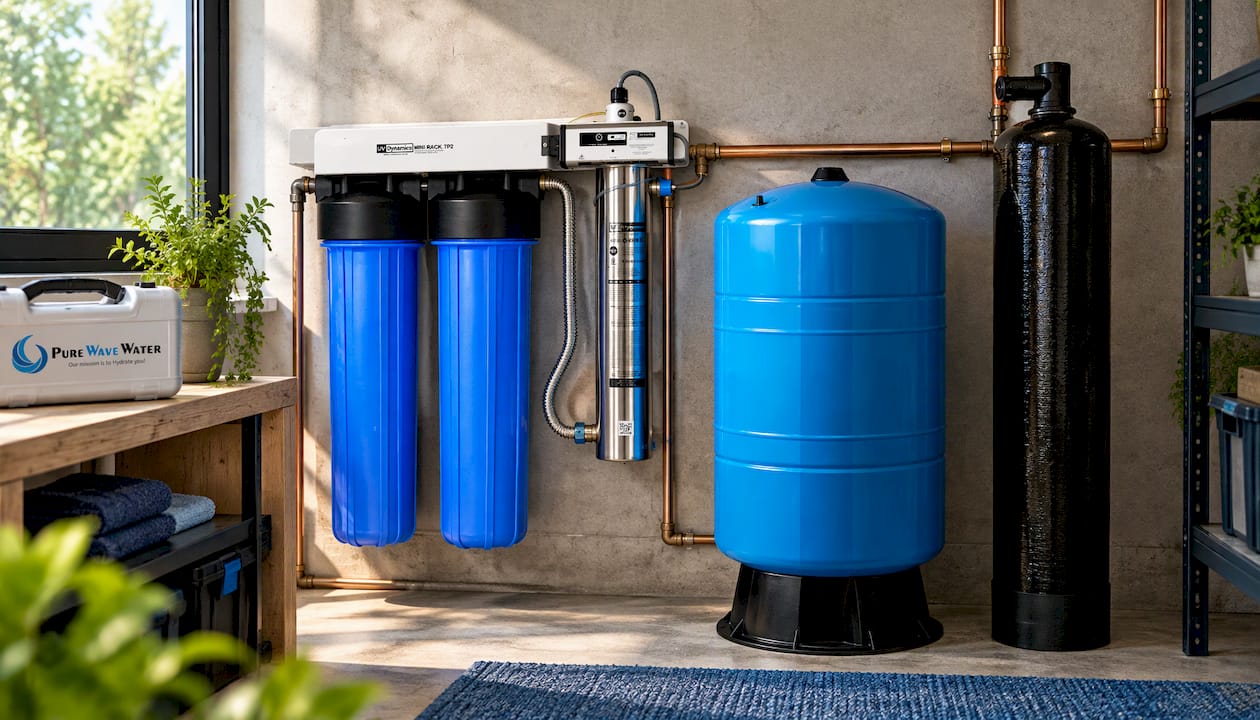
Water softeners, iron filters, UV units and reverse osmosis systems can add real value or be a liability. Ask when each was installed, who serviced it, when filters, lamps, membranes or salt were last changed, and whether the owner has the manuals. A UV lamp that has not been replaced on schedule is not protecting anyone. We service most major brands as well as the systems we sell, so we can look at an inherited system and tell you what it needs.
Quantity as well as quality
Ask the seller about seasonal shortages, especially in late summer. If it is a material concern, talk to a well professional about a water recovery test. The Ontario Ground Water Association links quantity assessment to local knowledge, the well record and a recovery test, and cites a benchmark of 14 L/min for 120 minutes, or 450 L per person per day from a 1996 provincial procedure. A well that tests clean but runs short in August is still a problem.
Step 4: Understand typical fix costs (without quotes)
We will not put a price on a house you have not tested, and a fair figure depends on the water, the flow rate and the home’s plumbing. What we can do is tell you which problems lead to which equipment, so you can ask for written quotes with the right items on them.
| Finding | Typical equipment to ask about |
|---|---|
| Hard water, scale | Water softener |
| Iron, manganese, sulphur | Oxidizing or air injection filtration |
| Positive bacteria result | Shock chlorination and retest; UV disinfection if it recurs |
| Sediment, cloudy water | Sediment pre-filtration |
| Nitrate | Reverse osmosis at the drinking tap |
| Old pump or tank | Replacement and pressure tank sizing |
The one published range we can point to is for softeners: our page on water softener costs in Ontario is titled with a range of $1,500 to $4,800, with the advice to test first. Treat it as a starting frame and not as a quote for your house. For everything else, ask for written quotes that name the equipment, the installation and the consumables you will be buying each year.
For houses with iron, sulphur and manganese together, one option to ask about is the Zentec Superior Air Injection filter, a hybrid capsulate unit designed for iron, sulphur and manganese. Whether it suits a particular home depends on the lab results and the flow the household needs.
When you review the treatment side of a quote, our overview of water filter installation basics is a handy primer on what to clarify before work starts, even though local codes and suppliers differ.
Step 5: Make the offer conditional on water results
The conditions you write into the offer are your protection. Talk to your real estate lawyer and agent about the wording, but build the plan around these points.
- Add a water condition. State that the offer depends on satisfactory bacteria and chemistry results, and on a satisfactory inspection of the well and water system.
- Allow time. Sample bottles have to be collected, returned to the lab and reported on. Allow enough days for results and, if needed, a retest.
- Sample early. Collect samples as soon as you have access, so any failed result leaves you room to negotiate or walk.
- Sample at the tap you will use. Take a fresh sample following the lab’s instructions, and note whether treatment equipment is upstream of the tap.
- Decide your thresholds in advance. Unacceptable bacteria, or a chemistry result that points to a large treatment bill, can lead to a price adjustment, a seller repair or a decision to leave.
- Retest after any fix. If the seller shocks the well, retest before you remove conditions.
Bring a sample to us during your conditional period at our free water test page so you have a read on hardness and iron, and a plain-language recommendation, while you still have leverage.
Our perspective: treat the water as a line in the purchase price
We have been testing and treating water in Georgetown since 1995, and the pattern is consistent. Buyers who test first can negotiate. Buyers who test after closing can only fix.
Most well water in our area can be made good to drink and pleasant to live with. The question is which equipment, in which order, and at what yearly upkeep. A softener for hardness, an oxidizing filter for iron or sulphur, UV for microbiological protection and reverse osmosis at the kitchen tap each solve a different problem, and a sound plan buys only what the lab results justify.
That is why we offer free in-store testing and recommend only the treatment actually needed. Our own technicians install and service systems, including most major brands, and give written quotes. If you are buying in Limehouse, Terra Cotta, Ballinafad, Glen Williams, Caledon or Erin, bring the sample and the seller’s paperwork, and we will help you turn them into a clear list of what the house needs.
CloudSprout16
What a good outcome looks like
You do not need a perfect well. You need a well that is safe, adequate in supply and understood. Here is what a good result looks like before you remove conditions:
- Bacteria results with no E. coli and acceptable total coliforms, on a sample you collected yourself.
- A chemistry report you have read with a specialist, with each issue matched to a treatment option.
- A wellhead with a secure cap, good grade and sensible distance from septic and other sources.
- Pump, tank and treatment equipment with known ages and service history.
- A seller who has handed over the well record.
If one of these is missing, you have a reason to ask for time or a price adjustment, not necessarily a reason to leave.
Water testing and treatment from Pure Wave Water
We are at 333 Mountainview Rd S, Georgetown, and you can reach us at 905-702-2700. We test water, sell and install softeners, reverse osmosis, UV purification and whole-home filtration, and supply filters, cartridges, lamps, membranes and salt. If your results point to iron or manganese across the whole house, a whole-home system such as the Excalibur catalytic whole-home system is one we carry. You can also browse the full water treatment shop or see our installation and repair services.
Book your conditional-period test by bringing a sample to the store, using the free water test page.
FAQ
Does Ontario require a water test when a house with a well is sold?
No. Ontario has no requirement for owners of private wells serving five or fewer homes to treat or test their drinking water, per the Auditor General’s 2025 audit. A seller may still provide results, so ask for them. Arrange your own tests as a condition of the offer.
Is the Public Health Ontario bacteria test enough?
It is essential but not complete. It checks for E. coli and total coliforms, and it does not test for chemicals. Pair it with a full chemistry test for hardness, iron, manganese, sulphur, nitrate, sodium and tannins.
What if the water fails the bacteria test?
Stop drinking the water, use another source and contact your local public health unit, as Ontario guidance directs. Shock chlorination followed by a retest is a common next step, covered on our page about coliform in well water. Do not remove conditions until a retest is clean.
How often should I test after I move in?
Ottawa Public Health recommends testing private well water for bacteria three times a year, and after major plumbing work or well repairs. Your first test at purchase is your baseline.
Sources
- Auditor General of Ontario: Safety of Non-Municipal Drinking Water (2025)
- Testing and treating private water wells | ontario.ca
- Well records | ontario.ca
- Private rural water supplies | ontario.ca
- Well Water Testing | Ottawa Public Health
- Private Wells | Ottawa Public Health
- About Your House: wells and septics | Ontario Ground Water Association
- Water Filter Installation: What to Know First
Recommended

Pure Wave Water shares educational content about water treatment, water softeners, reverse osmosis systems, UV purification, and filtration solutions. Our guides help readers understand water quality concerns, explore treatment options, and make informed decisions about their water treatment needs.