If you use a private well in Georgetown, Halton Hills, Acton or another Ontario community, UV disinfection can be an effective way to reduce microbiological risks in drinking water — but only when the system is properly selected, installed and maintained.
UV is not a general-purpose water filter. It is designed to inactivate microorganisms as water passes through the UV chamber. It does not remove hardness, iron, sediment, nitrate, arsenic or other dissolved contaminants.
That is why the right first step is understanding your water before choosing equipment. Pure Wave Water offers a free basic in-store water test in Georgetown for hardness, iron, total dissolved solids (TDS), pH and chlorine, with manganese tested where applicable. Bacterial testing such as total coliform and E. coli requires laboratory testing.
TL;DR:
- UV systems disinfect water by exposing microorganisms to ultraviolet light; they do not physically remove contaminants from the water.
- For contaminated drinking water, NSF/ANSI 55 Class A systems are designed to provide a UV dose equivalent to at least 40 mJ/cm² under their certified operating conditions.
- A UV system may have different flow ratings at 16, 30 or 40 mJ/cm², so UV dose and flow rate must always be considered together.
- Sediment, iron, manganese and scale can interfere with UV performance, which is why water quality and pre-treatment matter.
- Pure Wave Water’s free basic in-store test covers hardness, iron, TDS, pH and chlorine. Bacterial testing such as E. coli and total coliform requires an appropriate laboratory test.
Table of Contents
- What is UV for well water and how does it actually disinfect?
- What do 30 and 40 mJ/cm² mean?
- When is UV a good choice for well water?
- What should you test before installing UV?
- Why does pre-treatment matter?
- How do you size a UV system?
- How do you maintain a UV system?
- UV systems available from Pure Wave Water
- Well water testing in Halton Hills
- Sources
- FAQ
What is UV for well water and how does it actually disinfect?
Ultraviolet water treatment exposes flowing water to UV-C light inside a treatment chamber. The UV energy interferes with microorganisms so they can no longer reproduce effectively.
This makes UV fundamentally different from conventional filtration.
A sediment filter physically captures particles. A water softener targets hardness minerals. Carbon filtration can address chlorine, taste and odour concerns. Reverse osmosis is used for a different range of dissolved contaminants.
UV, by contrast, is primarily a disinfection step.
It does not physically remove bacteria from the water and it does not remove dissolved chemicals. The microorganisms are exposed to UV energy as they pass through the reactor.
For Canadian well owners, that distinction matters because a private well can have more than one water-quality issue at the same time. A home can have hard water, iron and a microbiological concern, and each issue may require a different part of the treatment system.
What do 30 and 40 mJ/cm² mean?
UV performance is commonly described using UV dose, expressed in millijoules per square centimetre (mJ/cm²).
The important point is that UV dose and flow rate are connected.
Water moving more slowly through the reactor receives more UV exposure. As flow increases, the delivered dose can decrease. That is why the same UV system can carry different flow ratings depending on the specified dose.
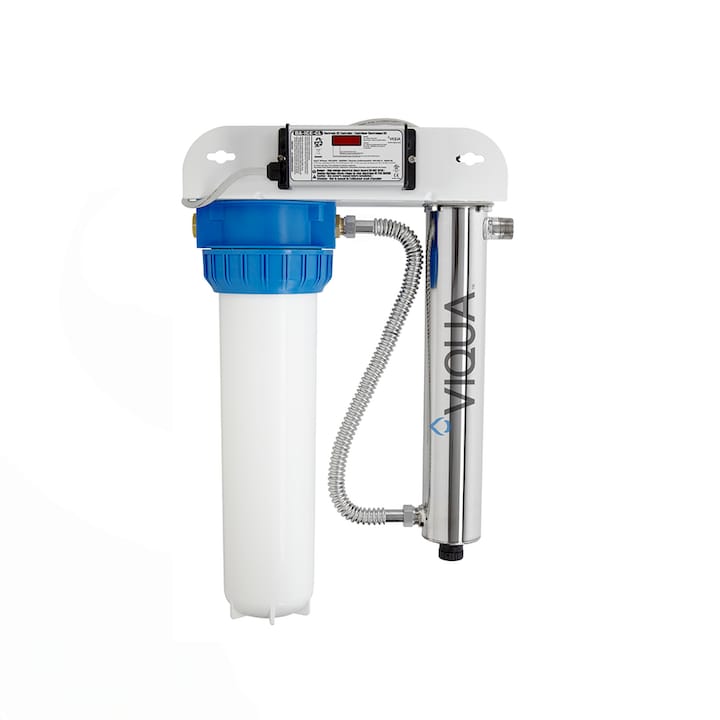
For example, Pure Wave Water’s current listing for the Viqua VH410F20 UV System shows:
- 34 GPM at 16 mJ/cm²
- 18 GPM at 30 mJ/cm²
- 14 GPM at 40 mJ/cm²
None of those numbers should be read by themselves. They describe different combinations of flow rate and UV dose for the same system.
For contaminated drinking water, Health Canada explains that systems certified to NSF/ANSI Standard 55 Class A are designed to deliver a UV dose equivalent to at least 40 mJ/cm² under the conditions specified by the standard.
That does not mean a manufacturer’s 30 mJ/cm² rating is meaningless or incorrect. It simply should not be presented as though it is the same thing as the 40 mJ/cm² Class A requirement.
Key takeaway: When comparing UV systems, do not compare GPM alone. Check the UV dose associated with that flow rating and the certification required for your application.
When is UV a good choice for well water?
UV is intended to address microbiological contamination. Health Canada lists NSF/ANSI 55 Class A ultraviolet treatment as an option for reducing bacteria, viruses and protozoa in well water.
But UV does not solve every well-water problem.
It does not remove:
- Hardness minerals
- Iron or manganese
- Sediment
- Nitrate
- Arsenic
- Other dissolved chemical contaminants simply by exposing them to UV light
If those concerns are present, separate treatment may be required.
Particles in the water can also interfere with UV disinfection by shielding microorganisms from UV light. Health Canada therefore notes that filtration may be required before UV treatment.
The correct treatment sequence depends on the actual water conditions, which is why a well-water treatment decision should begin with testing rather than choosing equipment from flow rate alone.
What should you test before installing UV?
There are two different questions here:
1. What general water-quality problems are present?
Pure Wave Water’s free basic in-store test currently checks:
- Hardness
- Iron
- Total dissolved solids (TDS)
- pH
- Chlorine
- Manganese where applicable
These results can help identify water conditions that may affect treatment selection and maintenance.
2. Is the well microbiologically safe?
That requires proper microbiological testing.
Pure Wave Water’s current testing information states that bacterial testing such as coliform testing requires a laboratory. Pure Wave stocks test kits and can direct well owners to the appropriate public health laboratory.
For Georgetown and Halton Hills residents, Halton Region also provides information on private well bacterial testing. Samples are tested for indicator bacteria including E. coli and total coliforms.
Do not treat a free basic hardness and iron test as a substitute for a laboratory bacterial test. They answer different questions.
Why does pre-treatment matter?
UV light needs to reach the microorganisms in the water.
Sediment and other suspended material can reduce that exposure. Scale or mineral deposits on the quartz sleeve surrounding the UV lamp can also interfere with UV transmission.
Health Canada notes that UV units are often preceded by filtration to reduce fouling or achieve the water quality required for the UV system to operate correctly.
Depending on the water test and the manufacturer’s specifications, a well-water treatment setup may therefore involve equipment before the UV reactor.
For example:
- Sediment filtration can help reduce particles before UV treatment.
- Iron or manganese treatment may be appropriate where those minerals are causing water-quality problems.
- A water softener may be used where hardness is a significant concern.
- UV disinfection can then operate as the microbiological treatment stage.
The exact configuration should be based on the water being treated and the requirements of the specific equipment rather than a universal one-size-fits-all layout.
Pro Tip: If you already have filtration, a softener or iron treatment, bring the make and model information with you when discussing a UV upgrade. The existing treatment setup affects how a new system should be integrated.
How do you size a UV system?
UV sizing is strongly affected by the maximum flow the system needs to treat.
A unit’s GPM rating is not simply a measure of how large the household is. It is the amount of water the UV reactor can treat at the specified performance conditions.
If a UV system is advertised at several different flow rates, check which UV dose applies to each rating.
The Pure Wave Water website currently lists UV systems across a range of capacities, including models from Viqua, UV Dynamics, Excalibur, Luminor and other manufacturers.
For example, the UV category includes systems such as:
- Viqua Arros 9 GPM
- Viqua Arros 15 GPM
- Viqua Arros 22 GPM
- Viqua VH200 and VH410 series systems
- UV Dynamics systems in several flow configurations
- Excalibur and Luminor UV systems
However, a model should not be selected simply because its advertised GPM appears to match the number of bathrooms in a house.
The water quality, required UV performance, peak flow demand, existing plumbing and any pre-treatment equipment all matter.
How do you maintain a UV system?
UV systems need regular maintenance to continue performing as intended.
The lamp can still appear to be illuminated even when its useful UV output has declined. That is why lamp replacement should follow the manufacturer’s maintenance schedule rather than waiting for the lamp to visibly burn out.
The quartz sleeve also needs attention because mineral deposits and fouling can reduce UV transmission.
Typical UV maintenance can include:
- Replacing the UV lamp according to the manufacturer’s specified interval
- Inspecting and cleaning the quartz sleeve
- Replacing the quartz sleeve when required
- Replacing sediment filters or other pre-filters on schedule
- Checking alarms, controllers and system indicators
- Retesting well water to verify microbiological quality
Pure Wave Water currently stocks UV lamps, quartz sleeves, controllers, systems and other UV-related parts from multiple manufacturers.
The company’s service information also states that its technicians provide installation, repair and maintenance for water treatment equipment and service Viqua, Pentair, Luminor and most major brands.
Browse UV lamps and quartz sleeves if you already know the model used in your system.
UV systems available from Pure Wave Water
Pure Wave Water’s current UV system catalogue includes residential and larger-capacity UV equipment for different water-treatment applications.
One example is the Viqua Arros 22 GPM UV System, which Pure Wave lists for applications including whole-home point-of-entry treatment, homes with higher water demand, cottages and untreated water sources.
The site also lists the Viqua VH410F20, which combines UV treatment with an integrated 5-micron sediment filter.
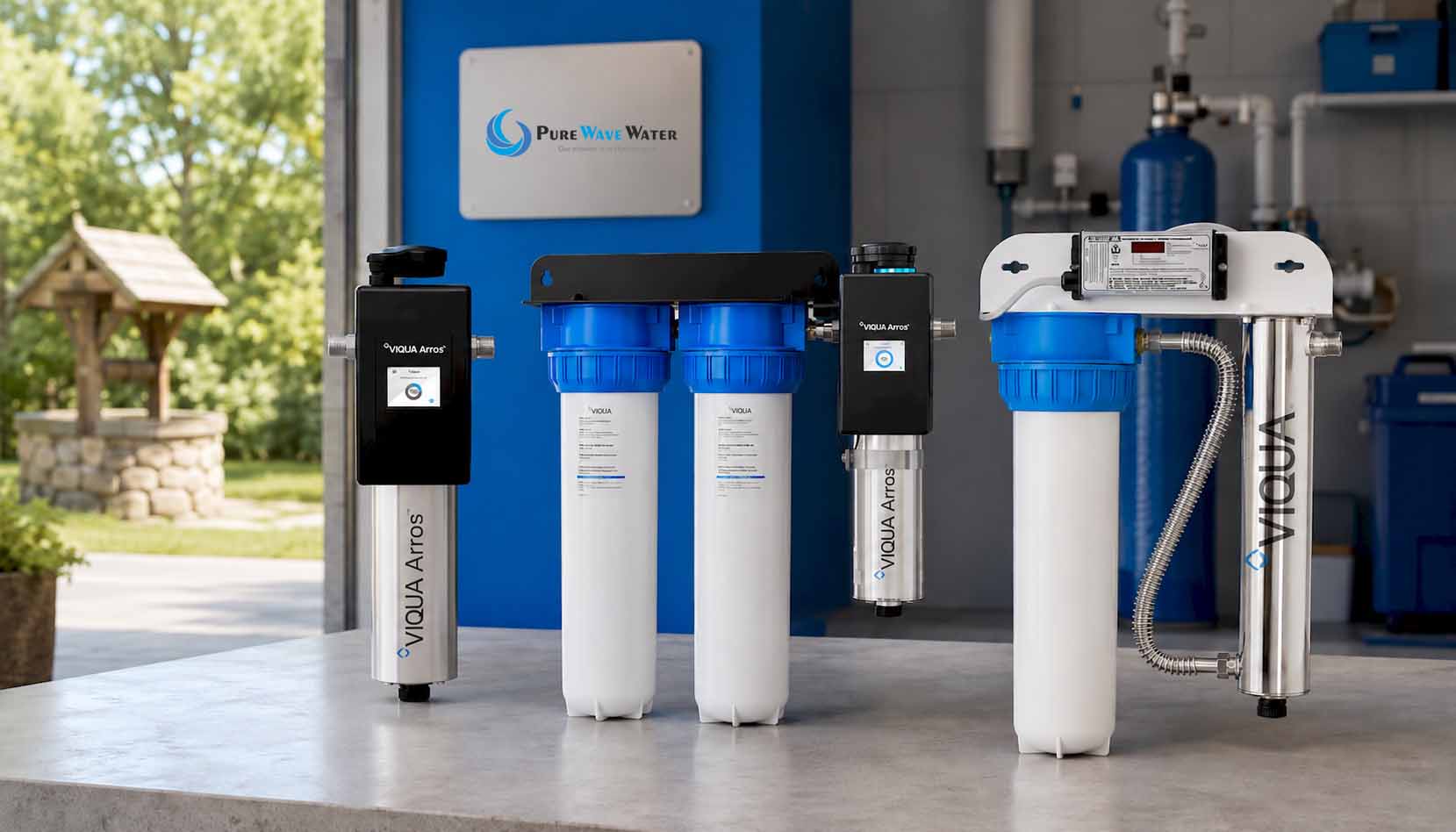
Different systems have different flow capabilities, controls and filtration configurations. Compare the specifications of the actual model rather than assuming every UV system delivers the same UV dose at the same flow rate.
You can view Pure Wave Water’s current UV systems before discussing which setup is appropriate for your water.
Well water testing in Halton Hills
Private well owners are responsible for monitoring their own water quality, and bacterial quality can change even when the water looks, smells and tastes normal.
Halton Region recommends testing private well water for bacteria frequently — at least three times per year, including spring, summer and fall — as well as after events such as flooding, heavy rainfall, snowmelt or well maintenance.
For bacterial testing, Halton Region directs residents to submit samples for testing for E. coli and total coliforms through the Public Health Ontario laboratory system.
That laboratory testing is separate from Pure Wave Water’s basic in-store test.
A practical process for a Georgetown or Halton Hills well owner is:
- Test for bacteria through the appropriate public health laboratory process.
- Bring a separate sample to Pure Wave Water if you want the basic water-quality test for hardness, iron, TDS, pH and chlorine.
- Review both sets of information before selecting treatment.
- Choose the UV system and any required pre-treatment based on the actual water conditions and equipment specifications.
- Continue testing and maintaining the system after installation.
This approach gives you a much clearer picture than assuming that adding a UV lamp automatically solves every well-water concern.
Sources
- Health Canada — Guidelines for Canadian Drinking Water Quality: Total Coliforms
- Health Canada — Well Water and Your Health: Test Your Well Water
- Health Canada — Well Water and Your Health: Treat Your Well Water
- Halton Region — Testing Your Well Water
- Pure Wave Water — Free Water Test
- Pure Wave Water — UV Systems
- Pure Wave Water — Viqua VH410F20 UV System
FAQ
Does UV make well water safe to drink?
UV can reduce microbiological risks when the correct system is used under the conditions it was designed for. However, UV does not remove chemical contaminants, hardness, iron or sediment. Well water should be tested so the treatment system addresses the actual water-quality concerns.
Is 30 mJ/cm² or 40 mJ/cm² better for well water?
The numbers must be considered together with flow rate, system validation and intended use. Health Canada describes NSF/ANSI 55 Class A systems for contaminated water as delivering a dose equivalent to at least 40 mJ/cm². Some UV systems also publish performance ratings at 30 mJ/cm² and other doses, but those ratings should not be treated as equivalent to Class A certification.
What does NSF/ANSI 55 Class A mean?
NSF/ANSI Standard 55 Class A applies to UV systems designed to disinfect contaminated water. Health Canada states that Class A systems are designed to deliver a UV dose equivalent to at least 40 mJ/cm² under the standard’s conditions.
Does Pure Wave Water test well water?
Yes. Pure Wave Water’s Georgetown store accepts well water for its free basic in-store test, which currently covers hardness, iron, TDS, pH and chlorine, with manganese tested where applicable. Bacterial testing such as total coliform and E. coli requires laboratory testing, and Pure Wave’s website states that it stocks test kits and can direct customers to the public health laboratory.
How often should I test my well water for bacteria in Halton Region?
Halton Region recommends testing private well water for bacteria at least three times per year — in spring, summer and fall — and after events such as flooding, heavy rainfall, snowmelt or well maintenance.
Does UV remove iron or hardness from well water?
No. UV is a disinfection technology and does not remove hardness minerals or iron. Those water-quality concerns require separate treatment when treatment is necessary.
Where should a UV system be installed?
Whole-home UV systems are generally installed as part of the point-of-entry treatment setup, with any necessary pre-treatment arranged so the water entering the UV reactor meets the system manufacturer’s requirements. The exact layout depends on the equipment and the water conditions.
Can Pure Wave Water install or service a UV system?
Pure Wave Water’s current service page lists installation, repair and maintenance for water treatment systems. The company also stocks UV systems, replacement lamps, quartz sleeves, controllers and other parts for multiple UV brands.

Pure Wave Water shares educational content about water treatment, water softeners, reverse osmosis systems, UV purification, and filtration solutions. Our guides help readers understand water quality concerns, explore treatment options, and make informed decisions about their water treatment needs.